

• Reconstruction mode. Combines forward and inverse modes. Inversion is
performed for a series of forward calculated spectra which are not necessarily
read from file. The model parameters can be chosen differently for forward
and inverse calculations. This mode is useful for performing sensitivity
studies.
3.2 INVERSION PROBLEMS
3.2.1 Ambiguity
When different sets of model parameters yield similar spectra, the inversion
problem is ambiguous. In such a case, no algorithm can reliably find the correct values
of the fit parameters. The problem is model specific and increases drastically with the
number of fit parameters.
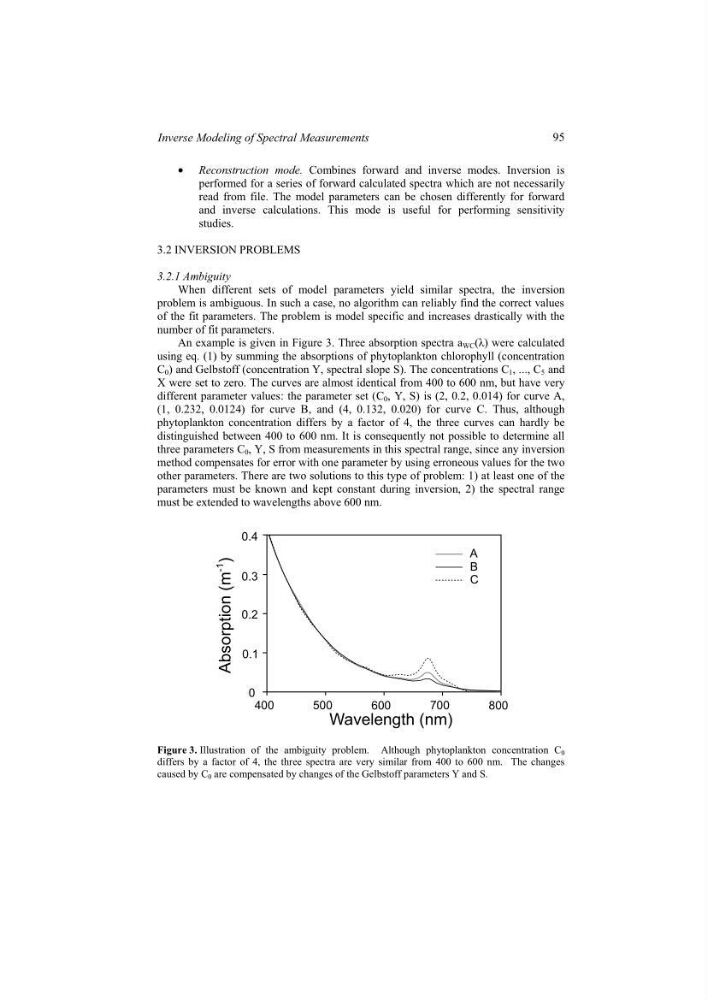
An example is given in Figure 3. Three absorption spectra a WC (Ȝ) were calculated
using eq. (1) by summing the absorptions of phytoplankton chlorophyll (concentration
C 0 ) and Gelbstoff (concentration Y, spectral slope S). The concentrations C 1 , ..., C 5 and
X were set to zero. The curves are almost identical from 400 to 600 nm, but have very
different parameter values: the parameter set (C 0 , Y, S) is (2, 0.2, 0.014) for curve A,
(1, 0.232, 0.0124) for curve B, and (4, 0.132, 0.020) for curve C. Thus, although
phytoplankton concentration differs by a factor of 4, the three curves can hardly be
distinguished between 400 to 600 nm. It is consequently not possible to determine all
three parameters C 0 , Y, S from measurements in this spectral range, since any inversion
method compensates for error with one parameter by using erroneous values for the two
other parameters. There are two solutions to this type of problem: 1) at least one of the
parameters must be known and kept constant during inversion, 2) the spectral range
must be extended to wavelengths above 600 nm.
Wavelength (nm)
Absorption (m
-1
)
A
B
C
0.4
0.3
0.2
0.1
0
400
500
600
700
800
Figure 3. Illustration of the ambiguity problem. Although phytoplankton concentration C 0
differs by a factor of 4, the three spectra are very similar from 400 to 600 nm. The changes
caused by C 0 are compensated by changes of the Gelbstoff parameters Y and S.
95
Inverse Modeling of Spectral Measurements
performed for a series of forward calculated spectra which are not necessarily
read from file. The model parameters can be chosen differently for forward
and inverse calculations. This mode is useful for performing sensitivity
studies.
3.2 INVERSION PROBLEMS
3.2.1 Ambiguity
When different sets of model parameters yield similar spectra, the inversion
problem is ambiguous. In such a case, no algorithm can reliably find the correct values
of the fit parameters. The problem is model specific and increases drastically with the
number of fit parameters.
An example is given in Figure 3. Three absorption spectra a WC (Ȝ) were calculated
using eq. (1) by summing the absorptions of phytoplankton chlorophyll (concentration
C 0 ) and Gelbstoff (concentration Y, spectral slope S). The concentrations C 1 , ..., C 5 and
X were set to zero. The curves are almost identical from 400 to 600 nm, but have very
different parameter values: the parameter set (C 0 , Y, S) is (2, 0.2, 0.014) for curve A,
(1, 0.232, 0.0124) for curve B, and (4, 0.132, 0.020) for curve C. Thus, although
phytoplankton concentration differs by a factor of 4, the three curves can hardly be
distinguished between 400 to 600 nm. It is consequently not possible to determine all
three parameters C 0 , Y, S from measurements in this spectral range, since any inversion
method compensates for error with one parameter by using erroneous values for the two
other parameters. There are two solutions to this type of problem: 1) at least one of the
parameters must be known and kept constant during inversion, 2) the spectral range
must be extended to wavelengths above 600 nm.
Wavelength (nm)
Absorption (m
-1
)
A
B
C
0.4
0.3
0.2
0.1
0
400
500
600
700
800
Figure 3. Illustration of the ambiguity problem. Although phytoplankton concentration C 0
differs by a factor of 4, the three spectra are very similar from 400 to 600 nm. The changes
caused by C 0 are compensated by changes of the Gelbstoff parameters Y and S.
95
Inverse Modeling of Spectral Measurements