

,
)
(
a
B
f
)
(
R
1
N
0
n
n
n
n
b
rs
¦
−
=
λ
⋅
⋅
=
λ
(22)
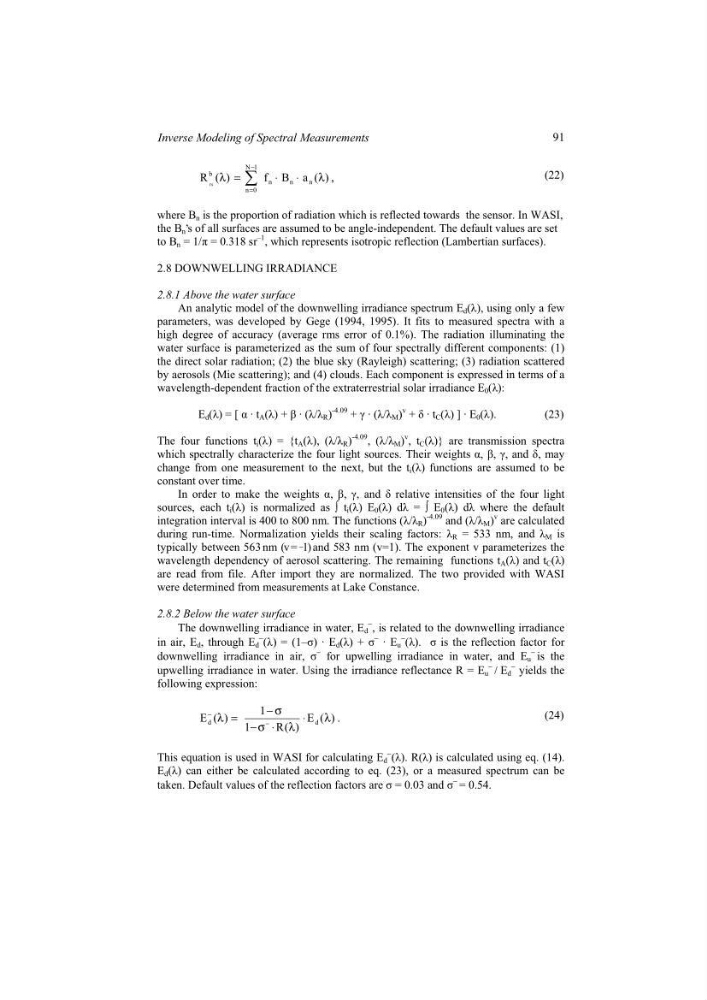
where B n is the proportion of radiation which is reflected towards the sensor. In WASI,
the B n s of all surfaces are assumed to be angle-independent. The default values are set
to B n = 1/ʌ = 0.318 sr
–1 , which represents isotropic reflection (Lambertian surfaces).
2.8 DOWNWELLING IRRADIANCE
2.8.1 Above the water surface
An analytic model of the downwelling irradiance spectrum E d (Ȝ), using only a few
parameters, was developed by Gege (1994, 1995). It fits to measured spectra with a
high degree of accuracy (average rms error of 0.1%). The radiation illuminating the
water surface is parameterized as the sum of four spectrally different components: (1)
the direct solar radiation; (2) the blue sky (Rayleigh) scattering; (3) radiation scattered
by aerosols (Mie scattering); and (4) clouds. Each component is expressed in terms of a
wavelength-dependent fraction of the extraterrestrial solar irradiance E 0 (Ȝ):
E d (Ȝ) = [ Į · t A (Ȝ) + ȕ · (Ȝ/Ȝ R )
-4.09 + Ȗ · (Ȝ/Ȝ M )
v + į · t C (Ȝ) ] · E 0 (Ȝ).
(23)
The four functions t i (Ȝ) = {t A (Ȝ), (Ȝ/Ȝ R )
-4.09
, (Ȝ/Ȝ M )
v , t C (Ȝ)} are transmission spectra
which spectrally characterize the four light sources. Their weights Į, ȕ, Ȗ, and į, may
change from one measurement to the next, but the t i (Ȝ) functions are assumed to be
constant over time.
In order to make the weights Į, ȕ, Ȗ, and į relative intensities of the four light
sources, each t i (Ȝ) is normalized as t i (Ȝ) E 0 (Ȝ) dȜ = E 0 (Ȝ) dȜ where the default
integration interval is 400 to 800 nm. The functions (Ȝ/Ȝ R )
-4.09 and (Ȝ/Ȝ M )
v are calculated
during run-time. Normalization yields their scaling factors: Ȝ R = 533 nm, and Ȝ M is
typically between 563 nm (v = 1) and 583 nm (v=1). The exponent v parameterizes the
wavelength dependency of aerosol scattering. The remaining functions t A (Ȝ) and t C (Ȝ)
are read from file. After import they are normalized. The two provided with WASI
were determined from measurements at Lake Constance.
2.8.2 Below the water surface
The downwelling irradiance in water, E d
− , is related to the downwelling irradiance
in air, E d , through E d
− (Ȝ) = (1–ı) · E d (Ȝ) + ı
− · E u
− (Ȝ). ı is the reflection factor for
downwelling irradiance in air, ı
− for upwelling irradiance in water, and E u
− is the
upwelling irradiance in water. Using the irradiance reflectance R = E u
− / E d
− yields the
following expression:
.
)
(
E
)
(
R
1
1
)
(
E
d
d
λ
⋅
λ
⋅
σ
−
σ
−
=
λ
−
−
(24)
This equation is used in WASI for calculating E d
− (Ȝ). R(Ȝ) is calculated using eq. (14).
E d (Ȝ) can either be calculated according to eq. (23), or a measured spectrum can be
taken. Default values of the reflection factors are ı = 0.03 and ı
− = 0.54.
,
−
91
Inverse Modeling of Spectral Measurements
)
(
a
B
f
)
(
R
1
N
0
n
n
n
n
b
rs
¦
−
=
λ
⋅
⋅
=
λ
(22)
where B n is the proportion of radiation which is reflected towards the sensor. In WASI,
the B n s of all surfaces are assumed to be angle-independent. The default values are set
to B n = 1/ʌ = 0.318 sr
–1 , which represents isotropic reflection (Lambertian surfaces).
2.8 DOWNWELLING IRRADIANCE
2.8.1 Above the water surface
An analytic model of the downwelling irradiance spectrum E d (Ȝ), using only a few
parameters, was developed by Gege (1994, 1995). It fits to measured spectra with a
high degree of accuracy (average rms error of 0.1%). The radiation illuminating the
water surface is parameterized as the sum of four spectrally different components: (1)
the direct solar radiation; (2) the blue sky (Rayleigh) scattering; (3) radiation scattered
by aerosols (Mie scattering); and (4) clouds. Each component is expressed in terms of a
wavelength-dependent fraction of the extraterrestrial solar irradiance E 0 (Ȝ):
E d (Ȝ) = [ Į · t A (Ȝ) + ȕ · (Ȝ/Ȝ R )
-4.09 + Ȗ · (Ȝ/Ȝ M )
v + į · t C (Ȝ) ] · E 0 (Ȝ).
(23)
The four functions t i (Ȝ) = {t A (Ȝ), (Ȝ/Ȝ R )
-4.09
, (Ȝ/Ȝ M )
v , t C (Ȝ)} are transmission spectra
which spectrally characterize the four light sources. Their weights Į, ȕ, Ȗ, and į, may
change from one measurement to the next, but the t i (Ȝ) functions are assumed to be
constant over time.
In order to make the weights Į, ȕ, Ȗ, and į relative intensities of the four light
sources, each t i (Ȝ) is normalized as t i (Ȝ) E 0 (Ȝ) dȜ = E 0 (Ȝ) dȜ where the default
integration interval is 400 to 800 nm. The functions (Ȝ/Ȝ R )
-4.09 and (Ȝ/Ȝ M )
v are calculated
during run-time. Normalization yields their scaling factors: Ȝ R = 533 nm, and Ȝ M is
typically between 563 nm (v = 1) and 583 nm (v=1). The exponent v parameterizes the
wavelength dependency of aerosol scattering. The remaining functions t A (Ȝ) and t C (Ȝ)
are read from file. After import they are normalized. The two provided with WASI
were determined from measurements at Lake Constance.
2.8.2 Below the water surface
The downwelling irradiance in water, E d
− , is related to the downwelling irradiance
in air, E d , through E d
− (Ȝ) = (1–ı) · E d (Ȝ) + ı
− · E u
− (Ȝ). ı is the reflection factor for
downwelling irradiance in air, ı
− for upwelling irradiance in water, and E u
− is the
upwelling irradiance in water. Using the irradiance reflectance R = E u
− / E d
− yields the
following expression:
.
)
(
E
)
(
R
1
1
)
(
E
d
d
λ
⋅
λ
⋅
σ
−
σ
−
=
λ
−
−
(24)
This equation is used in WASI for calculating E d
− (Ȝ). R(Ȝ) is calculated using eq. (14).
E d (Ȝ) can either be calculated according to eq. (23), or a measured spectrum can be
taken. Default values of the reflection factors are ı = 0.03 and ı
− = 0.54.
,
−
91
Inverse Modeling of Spectral Measurements