

time delivery of the products and the 15 days delay was clearly a limitation for
these users. Finally, the VEGETATION observations were starting only from
1998, while several applications require long time series.
The AVHRR archive was consequently exploited to derive the GEOV1/AVHRR products that extend the GEOV1/VGT products back to 1981. For this
purpose, the 1999–2000 years where both VEGETATION and AVHRR overlap
were used to train a neural network with GEOV1/VGT products as output and
AVHRR reflectance as inputs. The AVHRR LTDR reflectance products (Devadiga
et al. 2007) were used here. They correspond to atmospherically corrected and
directionally normalized daily values. The corresponding daily LAI and FPAR
products were smoothed using TSGF algorithm (Verger et al. 2011) and gap filled
using the climatology as background information when limited observations are
available. The GEOV1/AVHRR products have been demonstrated to be highly
consistent with the GEOV1/VGT product values while improving largely the
continuity, with almost no gaps (Verger et al. 2012). Figure 2.3a shows a global
map of the GEOV1/VGT LAI product for the first dekad of May 2002 and
Fig. 2.3b demonstrates the consistency between the GEOV1/VGT and GEOV1/
AVHRR products for the overlapping time period.
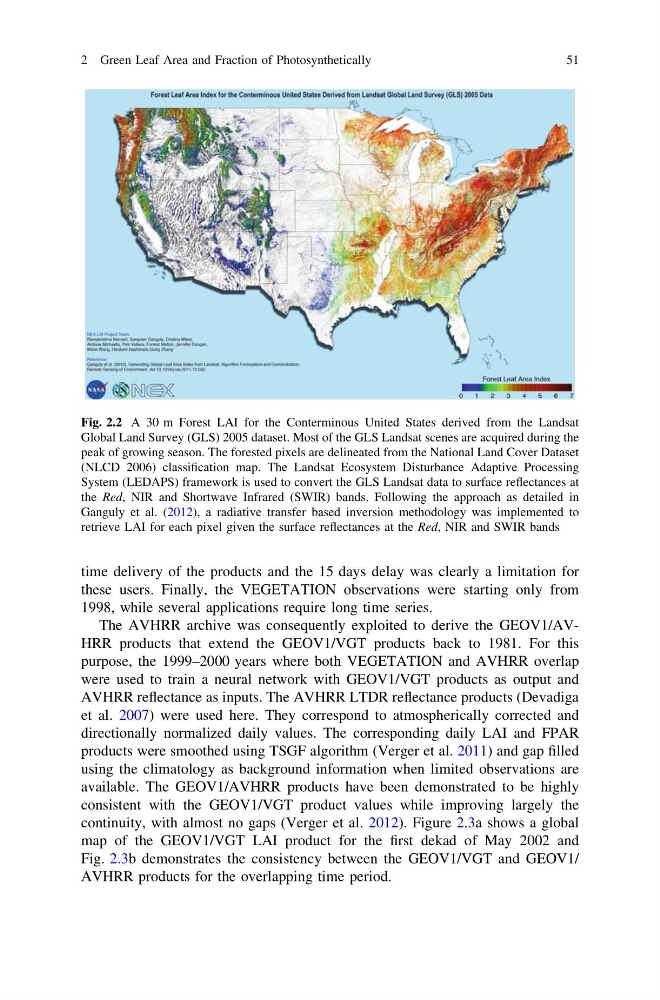
Fig. 2.2 A 30 m Forest LAI for the Conterminous United States derived from the Landsat
Global Land Survey (GLS) 2005 dataset. Most of the GLS Landsat scenes are acquired during the
peak of growing season. The forested pixels are delineated from the National Land Cover Dataset
(NLCD 2006) classification map. The Landsat Ecosystem Disturbance Adaptive Processing
System (LEDAPS) framework is used to convert the GLS Landsat data to surface reflectances at
the Red, NIR and Shortwave Infrared (SWIR) bands. Following the approach as detailed in
Ganguly et al. (2012), a radiative transfer based inversion methodology was implemented to
retrieve LAI for each pixel given the surface reflectances at the Red, NIR and SWIR bands
2 Green Leaf Area and Fraction of Photosynthetically
51
these users. Finally, the VEGETATION observations were starting only from
1998, while several applications require long time series.
The AVHRR archive was consequently exploited to derive the GEOV1/AVHRR products that extend the GEOV1/VGT products back to 1981. For this
purpose, the 1999–2000 years where both VEGETATION and AVHRR overlap
were used to train a neural network with GEOV1/VGT products as output and
AVHRR reflectance as inputs. The AVHRR LTDR reflectance products (Devadiga
et al. 2007) were used here. They correspond to atmospherically corrected and
directionally normalized daily values. The corresponding daily LAI and FPAR
products were smoothed using TSGF algorithm (Verger et al. 2011) and gap filled
using the climatology as background information when limited observations are
available. The GEOV1/AVHRR products have been demonstrated to be highly
consistent with the GEOV1/VGT product values while improving largely the
continuity, with almost no gaps (Verger et al. 2012). Figure 2.3a shows a global
map of the GEOV1/VGT LAI product for the first dekad of May 2002 and
Fig. 2.3b demonstrates the consistency between the GEOV1/VGT and GEOV1/
AVHRR products for the overlapping time period.
Fig. 2.2 A 30 m Forest LAI for the Conterminous United States derived from the Landsat
Global Land Survey (GLS) 2005 dataset. Most of the GLS Landsat scenes are acquired during the
peak of growing season. The forested pixels are delineated from the National Land Cover Dataset
(NLCD 2006) classification map. The Landsat Ecosystem Disturbance Adaptive Processing
System (LEDAPS) framework is used to convert the GLS Landsat data to surface reflectances at
the Red, NIR and Shortwave Infrared (SWIR) bands. Following the approach as detailed in
Ganguly et al. (2012), a radiative transfer based inversion methodology was implemented to
retrieve LAI for each pixel given the surface reflectances at the Red, NIR and SWIR bands
2 Green Leaf Area and Fraction of Photosynthetically
51