

The BSRN network is primarily used to validate the theoretical computations of
radiative fluxes by models, and has been endorsed by the World Climate Research
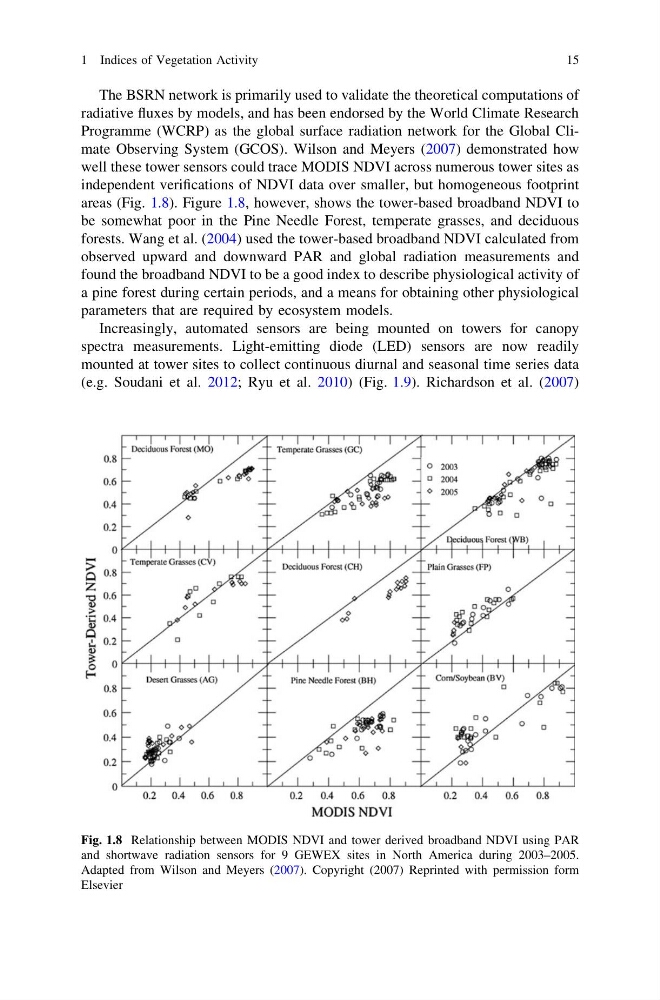
Programme (WCRP) as the global surface radiation network for the Global Climate Observing System (GCOS). Wilson and Meyers (2007) demonstrated how
well these tower sensors could trace MODIS NDVI across numerous tower sites as
independent verifications of NDVI data over smaller, but homogeneous footprint
areas (Fig. 1.8). Figure 1.8, however, shows the tower-based broadband NDVI to
be somewhat poor in the Pine Needle Forest, temperate grasses, and deciduous
forests. Wang et al. (2004) used the tower-based broadband NDVI calculated from
observed upward and downward PAR and global radiation measurements and
found the broadband NDVI to be a good index to describe physiological activity of
a pine forest during certain periods, and a means for obtaining other physiological
parameters that are required by ecosystem models.
Increasingly, automated sensors are being mounted on towers for canopy
spectra measurements. Light-emitting diode (LED) sensors are now readily
mounted at tower sites to collect continuous diurnal and seasonal time series data
(e.g. Soudani et al. 2012; Ryu et al. 2010) (Fig. 1.9). Richardson et al. (2007)
Fig. 1.8 Relationship between MODIS NDVI and tower derived broadband NDVI using PAR
and shortwave radiation sensors for 9 GEWEX sites in North America during 2003–2005.
Adapted from Wilson and Meyers (2007). Copyright (2007) Reprinted with permission form
Elsevier
1 Indices of Vegetation Activity
15
radiative fluxes by models, and has been endorsed by the World Climate Research
Programme (WCRP) as the global surface radiation network for the Global Climate Observing System (GCOS). Wilson and Meyers (2007) demonstrated how
well these tower sensors could trace MODIS NDVI across numerous tower sites as
independent verifications of NDVI data over smaller, but homogeneous footprint
areas (Fig. 1.8). Figure 1.8, however, shows the tower-based broadband NDVI to
be somewhat poor in the Pine Needle Forest, temperate grasses, and deciduous
forests. Wang et al. (2004) used the tower-based broadband NDVI calculated from
observed upward and downward PAR and global radiation measurements and
found the broadband NDVI to be a good index to describe physiological activity of
a pine forest during certain periods, and a means for obtaining other physiological
parameters that are required by ecosystem models.
Increasingly, automated sensors are being mounted on towers for canopy
spectra measurements. Light-emitting diode (LED) sensors are now readily
mounted at tower sites to collect continuous diurnal and seasonal time series data
(e.g. Soudani et al. 2012; Ryu et al. 2010) (Fig. 1.9). Richardson et al. (2007)
Fig. 1.8 Relationship between MODIS NDVI and tower derived broadband NDVI using PAR
and shortwave radiation sensors for 9 GEWEX sites in North America during 2003–2005.
Adapted from Wilson and Meyers (2007). Copyright (2007) Reprinted with permission form
Elsevier
1 Indices of Vegetation Activity
15