

in situ VI version of that product (i.e., it is only the atmosphere correction that is
independently accomplished). Thus, sensor degradation artifacts, drifts in calibration, cross-band (Red, NIR, Blue) loss in spectral integrity and geolocation
error would be present in both data sets and not be readily detected.
Many towers are now instrumented with shortwave and longwave radiation
sensors that enable computation of broadband versions of the NDVI. The Baseline
Surface Radiation Network (BSRN), for example, enables the measurement of
visible (Q par ) and shortwave solar radiation (R g ) with quantum sensors and pyranometers, respectively, that can be used to represent contributions from reflected
NIR and visible radiation (Wilson and Meyers 2007) as,
NDVI tower ¼ R g À Q par
À
Á
NIR À Q par
VIS
h
i
= R g À Q par
À
Á
NIR þ Q par
VIS
h
i
ð1:10Þ
which simplifies to
NDVI tower ¼ 1 À 2
à Q par =R g
ð1:11Þ
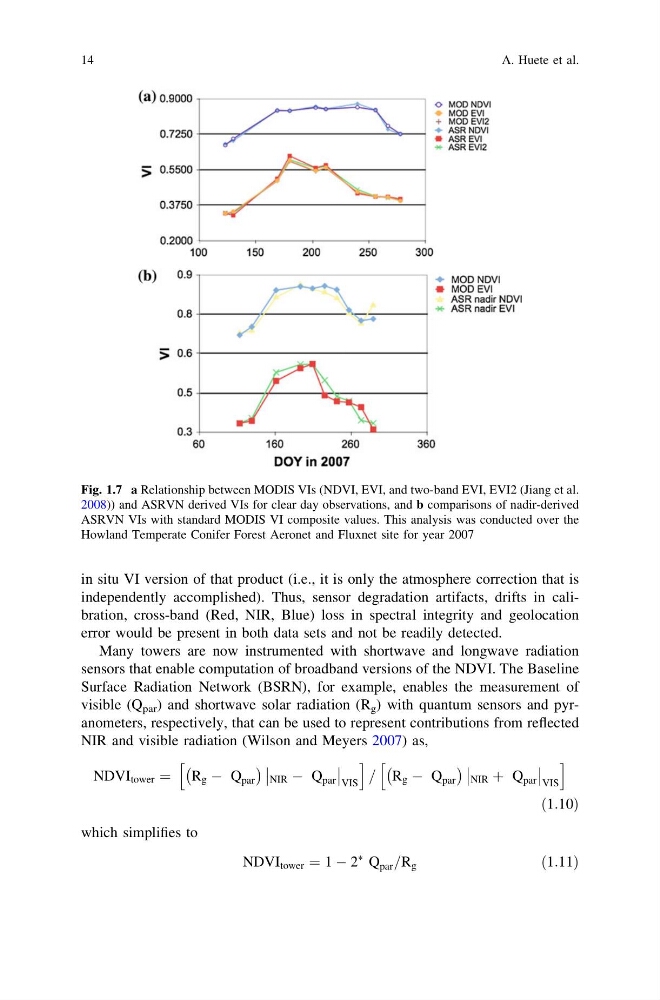
Fig. 1.7 a Relationship between MODIS VIs (NDVI, EVI, and two-band EVI, EVI2 (Jiang et al.
2008)) and ASRVN derived VIs for clear day observations, and b comparisons of nadir-derived
ASRVN VIs with standard MODIS VI composite values. This analysis was conducted over the
Howland Temperate Conifer Forest Aeronet and Fluxnet site for year 2007
14
A. Huete et al.
independently accomplished). Thus, sensor degradation artifacts, drifts in calibration, cross-band (Red, NIR, Blue) loss in spectral integrity and geolocation
error would be present in both data sets and not be readily detected.
Many towers are now instrumented with shortwave and longwave radiation
sensors that enable computation of broadband versions of the NDVI. The Baseline
Surface Radiation Network (BSRN), for example, enables the measurement of
visible (Q par ) and shortwave solar radiation (R g ) with quantum sensors and pyranometers, respectively, that can be used to represent contributions from reflected
NIR and visible radiation (Wilson and Meyers 2007) as,
NDVI tower ¼ R g À Q par
À
Á
NIR À Q par
VIS
h
i
= R g À Q par
À
Á
NIR þ Q par
VIS
h
i
ð1:10Þ
which simplifies to
NDVI tower ¼ 1 À 2
à Q par =R g
ð1:11Þ
Fig. 1.7 a Relationship between MODIS VIs (NDVI, EVI, and two-band EVI, EVI2 (Jiang et al.
2008)) and ASRVN derived VIs for clear day observations, and b comparisons of nadir-derived
ASRVN VIs with standard MODIS VI composite values. This analysis was conducted over the
Howland Temperate Conifer Forest Aeronet and Fluxnet site for year 2007
14
A. Huete et al.