

Chl is only a measure of phytoplankton biomass. When combined with other
ocean variables such as chlorophyll fluorescence, CDOM, and particulate matter
distributions, wind, temperature, photosynthetic available radiation, nutrients, and
mixed layer depth, details can be revealed on ocean primary productivity (e.g.,
Behrenfeld et al. 2001, 2006), phytoplankton physiology (Behrenfeld et al. 2005,
2009), inter-relationship between various OSCs (Siegel et al. 2005; Loisel et al.
2002; Hu et al. 2006), and regional processes that lead to phytoplankton blooms
(e.g., the Sverdrup’s critical depth hypothesis, Siegel et al. 2002).
Satellite Chl has also been used in studies of basin-scale or regional ocean changes.
For example, using multi-year SeaWiFS Chl data, Polovina et al. (2008) showed that
several major ocean gyres (defined by SeaWiFS Chl B 0.07 mg m
-3 ) had expanded
from 1998 to 2006, and gyre variability was revisited by Signorini et al. (2011). Arrigo
et al. (2008) found significant impacts of shrinking Arctic ice cover on local primary
productivity. Hamme et al. (2010) and Lin et al. (2011) showed how volcanic ashes
fuel the Gulf of Alaska and the oligotrophic Pacific Ocean, respectively, and stimulate
phytoplankton blooms. Likewise, numerous studies have shown enhanced Chl biomass after tropical cyclones due to either deeper ocean mixing or upwelling (e.g., Lin
et al. 2003; Babin et al. 2004; Walker et al. 2005; Siswanto et al. 2007). On continental
shelves where terrestrial runoff plays a significant role in modulating the ocean’s
nutrient budget and biogeochemistry, Chl tends to follow local precipitation and river
runoff closely. The riverine influence of the Amazon River and Mississippi/Atchafalaya Rivers on the downstream oceans has been well documented by several
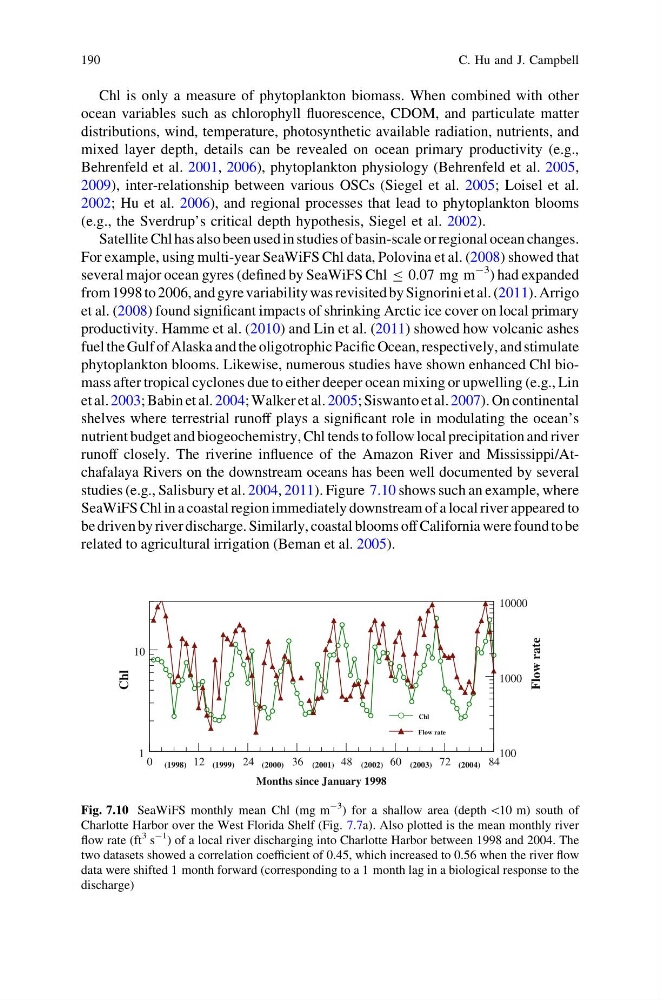
studies (e.g., Salisbury et al. 2004, 2011). Figure 7.10 shows such an example, where
SeaWiFS Chl in a coastal region immediately downstream of a local river appeared to
be driven by river discharge. Similarly, coastal blooms off California were found to be
related to agricultural irrigation (Beman et al. 2005).
(1998)
(1999)
(2000)
(2002)
(2003)
(2004)
(2001)
0
1 2
2 4
3 6
4 8
6 0
7 2
8 4
Months since January 1998
100
1000
10000
Flow rate
1
10
Chl
Flow rate
Chl
Fig. 7.10 SeaWiFS monthly mean Chl (mg m
-3
) for a shallow area (depth \10 m) south of
Charlotte Harbor over the West Florida Shelf (Fig. 7.7a). Also plotted is the mean monthly river
flow rate (ft
3 s
-1
) of a local river discharging into Charlotte Harbor between 1998 and 2004. The
two datasets showed a correlation coefficient of 0.45, which increased to 0.56 when the river flow
data were shifted 1 month forward (corresponding to a 1 month lag in a biological response to the
discharge)
190
C. Hu and J. Campbell
ocean variables such as chlorophyll fluorescence, CDOM, and particulate matter
distributions, wind, temperature, photosynthetic available radiation, nutrients, and
mixed layer depth, details can be revealed on ocean primary productivity (e.g.,
Behrenfeld et al. 2001, 2006), phytoplankton physiology (Behrenfeld et al. 2005,
2009), inter-relationship between various OSCs (Siegel et al. 2005; Loisel et al.
2002; Hu et al. 2006), and regional processes that lead to phytoplankton blooms
(e.g., the Sverdrup’s critical depth hypothesis, Siegel et al. 2002).
Satellite Chl has also been used in studies of basin-scale or regional ocean changes.
For example, using multi-year SeaWiFS Chl data, Polovina et al. (2008) showed that
several major ocean gyres (defined by SeaWiFS Chl B 0.07 mg m
-3 ) had expanded
from 1998 to 2006, and gyre variability was revisited by Signorini et al. (2011). Arrigo
et al. (2008) found significant impacts of shrinking Arctic ice cover on local primary
productivity. Hamme et al. (2010) and Lin et al. (2011) showed how volcanic ashes
fuel the Gulf of Alaska and the oligotrophic Pacific Ocean, respectively, and stimulate
phytoplankton blooms. Likewise, numerous studies have shown enhanced Chl biomass after tropical cyclones due to either deeper ocean mixing or upwelling (e.g., Lin
et al. 2003; Babin et al. 2004; Walker et al. 2005; Siswanto et al. 2007). On continental
shelves where terrestrial runoff plays a significant role in modulating the ocean’s
nutrient budget and biogeochemistry, Chl tends to follow local precipitation and river
runoff closely. The riverine influence of the Amazon River and Mississippi/Atchafalaya Rivers on the downstream oceans has been well documented by several
studies (e.g., Salisbury et al. 2004, 2011). Figure 7.10 shows such an example, where
SeaWiFS Chl in a coastal region immediately downstream of a local river appeared to
be driven by river discharge. Similarly, coastal blooms off California were found to be
related to agricultural irrigation (Beman et al. 2005).
(1998)
(1999)
(2000)
(2002)
(2003)
(2004)
(2001)
0
1 2
2 4
3 6
4 8
6 0
7 2
8 4
Months since January 1998
100
1000
10000
Flow rate
1
10
Chl
Flow rate
Chl
Fig. 7.10 SeaWiFS monthly mean Chl (mg m
-3
) for a shallow area (depth \10 m) south of
Charlotte Harbor over the West Florida Shelf (Fig. 7.7a). Also plotted is the mean monthly river
flow rate (ft
3 s
-1
) of a local river discharging into Charlotte Harbor between 1998 and 2004. The
two datasets showed a correlation coefficient of 0.45, which increased to 0.56 when the river flow
data were shifted 1 month forward (corresponding to a 1 month lag in a biological response to the
discharge)
190
C. Hu and J. Campbell