

cons of the algorithms have been discussed. The pros and cons of empirical bandratio Chl algorithms have also been discussed in Dierssen (2010). The algorithms
are based on the assumption that optical properties are dominated by phytoplankton
and their degradation products (i.e., Case I waters). The impact of other OSCs is
implicitly included in the algorithm coefficients. For global applications, the
algorithm coefficients are tuned to minimize uncertainty from the global datasets.
However, different ocean regions are known to have different OSC compositions
(i.e., relative contributions of CDOM and detrital particles to total a and b b ), and the
same amount of Chl can result in different a ph depending on community composition. Szeto et al. (2011) found systematic biases in the global algorithms among
the major oceans, and concluded that these are related to differences in the relative
proportion of the OSCs and their optical properties. Likewise, Sauer et al. (2012)
reported on the influence of varying IOPs on the empirical algorithm. To improve
algorithm performance, the coefficients may be tuned for regional applications
(e.g., Kahru and Mitchell 1999; McKee et al. 2007a; Mitchell and Kahru 2009).
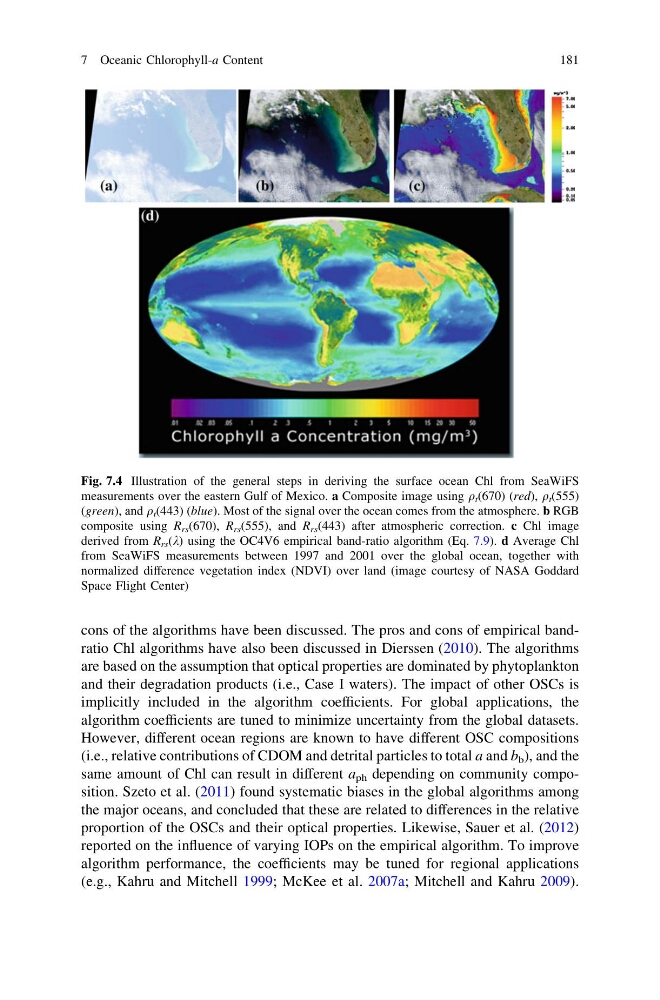
Fig. 7.4 Illustration of the general steps in deriving the surface ocean Chl from SeaWiFS
measurements over the eastern Gulf of Mexico. a Composite image using q t (670) (red), q t (555)
(green), and q t (443) (blue). Most of the signal over the ocean comes from the atmosphere. b RGB
composite using R rs (670), R rs (555), and R rs (443) after atmospheric correction. c Chl image
derived from R rs (k) using the OC4V6 empirical band-ratio algorithm (Eq. 7.9). d Average Chl
from SeaWiFS measurements between 1997 and 2001 over the global ocean, together with
normalized difference vegetation index (NDVI) over land (image courtesy of NASA Goddard
Space Flight Center)
7 Oceanic Chlorophyll-a Content
181
are based on the assumption that optical properties are dominated by phytoplankton
and their degradation products (i.e., Case I waters). The impact of other OSCs is
implicitly included in the algorithm coefficients. For global applications, the
algorithm coefficients are tuned to minimize uncertainty from the global datasets.
However, different ocean regions are known to have different OSC compositions
(i.e., relative contributions of CDOM and detrital particles to total a and b b ), and the
same amount of Chl can result in different a ph depending on community composition. Szeto et al. (2011) found systematic biases in the global algorithms among
the major oceans, and concluded that these are related to differences in the relative
proportion of the OSCs and their optical properties. Likewise, Sauer et al. (2012)
reported on the influence of varying IOPs on the empirical algorithm. To improve
algorithm performance, the coefficients may be tuned for regional applications
(e.g., Kahru and Mitchell 1999; McKee et al. 2007a; Mitchell and Kahru 2009).
Fig. 7.4 Illustration of the general steps in deriving the surface ocean Chl from SeaWiFS
measurements over the eastern Gulf of Mexico. a Composite image using q t (670) (red), q t (555)
(green), and q t (443) (blue). Most of the signal over the ocean comes from the atmosphere. b RGB
composite using R rs (670), R rs (555), and R rs (443) after atmospheric correction. c Chl image
derived from R rs (k) using the OC4V6 empirical band-ratio algorithm (Eq. 7.9). d Average Chl
from SeaWiFS measurements between 1997 and 2001 over the global ocean, together with
normalized difference vegetation index (NDVI) over land (image courtesy of NASA Goddard
Space Flight Center)
7 Oceanic Chlorophyll-a Content
181