

models have been developed to derive Chl and IOPs using R rs (e.g., Sathyendranath
et al. 1989; Maritorena et al. 2002; IOCCG 2006; Brewin et al. 2013).
Figure 7.2 is a schematic diagram showing how the color of the ocean (R rs (k))
is determined (and therefore can be modeled) by the various OSCs and in particular by Chl, when R rs (k) is measured in the field, for example from a ship. As
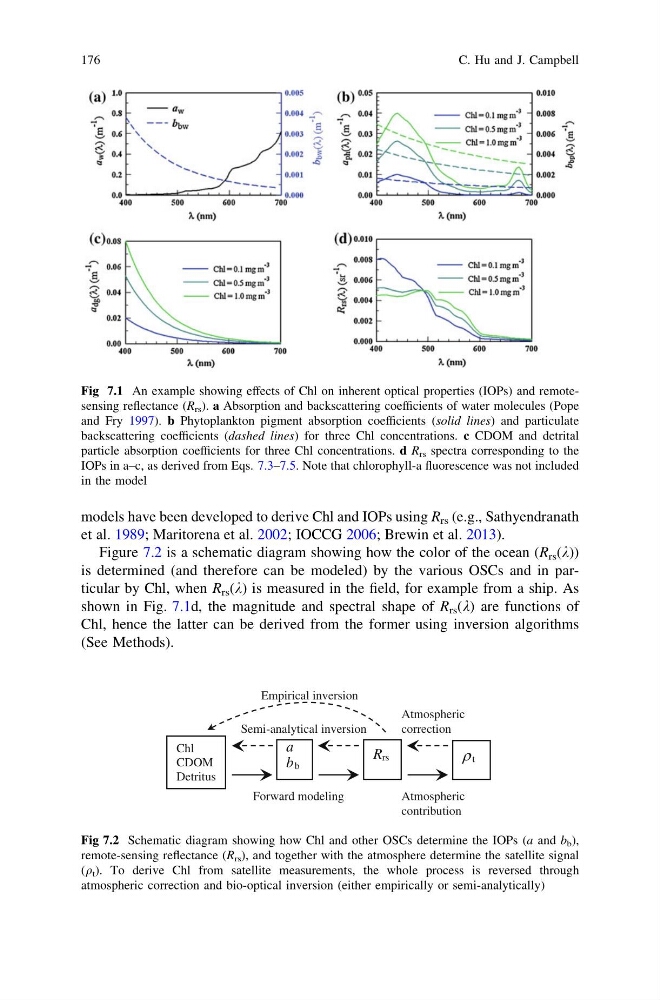
shown in Fig. 7.1d, the magnitude and spectral shape of R rs (k) are functions of
Chl, hence the latter can be derived from the former using inversion algorithms
(See Methods).
Fig 7.1 An example showing effects of Chl on inherent optical properties (IOPs) and remotesensing reflectance (R rs ). a Absorption and backscattering coefficients of water molecules (Pope
and Fry 1997). b Phytoplankton pigment absorption coefficients (solid lines) and particulate
backscattering coefficients (dashed lines) for three Chl concentrations. c CDOM and detrital
particle absorption coefficients for three Chl concentrations. d R rs spectra corresponding to the
IOPs in a–c, as derived from Eqs. 7.3–7.5. Note that chlorophyll-a fluorescence was not included
in the model
Chl
CDOM
Detritus
a
b b
R rs
ρ t
Forward modeling
Atmospheric
contribution
Atmospheric
correction
Semi-analytical inversion
Empirical inversion
Fig 7.2 Schematic diagram showing how Chl and other OSCs determine the IOPs (a and b b ),
remote-sensing reflectance (R rs ), and together with the atmosphere determine the satellite signal
(q t ). To derive Chl from satellite measurements, the whole process is reversed through
atmospheric correction and bio-optical inversion (either empirically or semi-analytically)
176
C. Hu and J. Campbell
et al. 1989; Maritorena et al. 2002; IOCCG 2006; Brewin et al. 2013).
Figure 7.2 is a schematic diagram showing how the color of the ocean (R rs (k))
is determined (and therefore can be modeled) by the various OSCs and in particular by Chl, when R rs (k) is measured in the field, for example from a ship. As
shown in Fig. 7.1d, the magnitude and spectral shape of R rs (k) are functions of
Chl, hence the latter can be derived from the former using inversion algorithms
(See Methods).
Fig 7.1 An example showing effects of Chl on inherent optical properties (IOPs) and remotesensing reflectance (R rs ). a Absorption and backscattering coefficients of water molecules (Pope
and Fry 1997). b Phytoplankton pigment absorption coefficients (solid lines) and particulate
backscattering coefficients (dashed lines) for three Chl concentrations. c CDOM and detrital
particle absorption coefficients for three Chl concentrations. d R rs spectra corresponding to the
IOPs in a–c, as derived from Eqs. 7.3–7.5. Note that chlorophyll-a fluorescence was not included
in the model
Chl
CDOM
Detritus
a
b b
R rs
ρ t
Forward modeling
Atmospheric
contribution
Atmospheric
correction
Semi-analytical inversion
Empirical inversion
Fig 7.2 Schematic diagram showing how Chl and other OSCs determine the IOPs (a and b b ),
remote-sensing reflectance (R rs ), and together with the atmosphere determine the satellite signal
(q t ). To derive Chl from satellite measurements, the whole process is reversed through
atmospheric correction and bio-optical inversion (either empirically or semi-analytically)
176
C. Hu and J. Campbell