

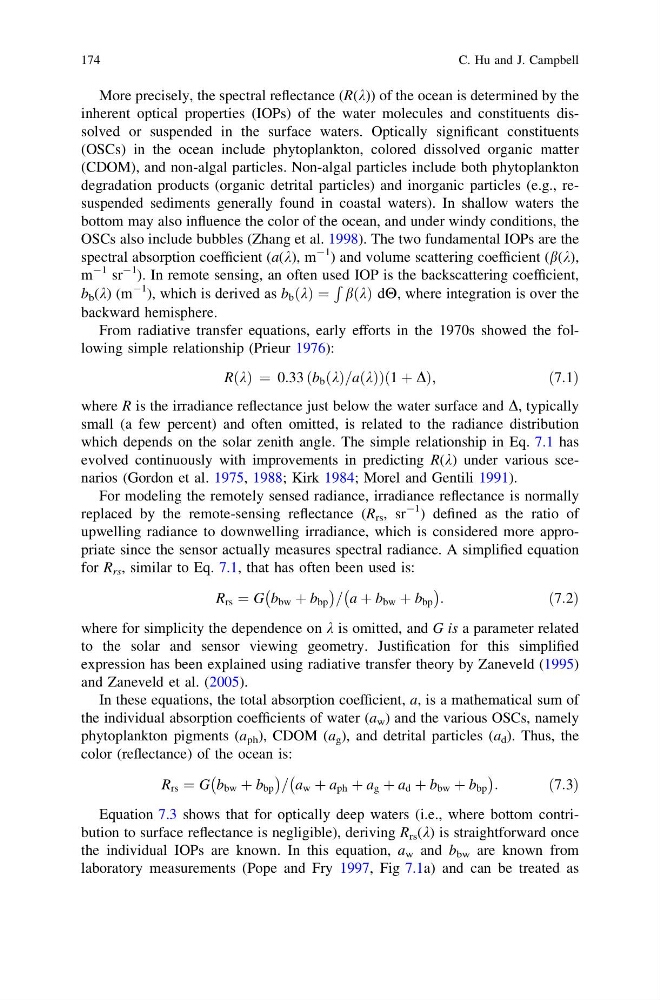
More precisely, the spectral reflectance (R(k)) of the ocean is determined by the
inherent optical properties (IOPs) of the water molecules and constituents dissolved or suspended in the surface waters. Optically significant constituents
(OSCs) in the ocean include phytoplankton, colored dissolved organic matter
(CDOM), and non-algal particles. Non-algal particles include both phytoplankton
degradation products (organic detrital particles) and inorganic particles (e.g., resuspended sediments generally found in coastal waters). In shallow waters the
bottom may also influence the color of the ocean, and under windy conditions, the
OSCs also include bubbles (Zhang et al. 1998). The two fundamental IOPs are the
spectral absorption coefficient (a(k), m
-1 ) and volume scattering coefficient (b(k),
m
-1 sr
-1 ). In remote sensing, an often used IOP is the backscattering coefficient,
b b (k) (m
-1 ), which is derived as b b k
ð Þ ¼
R
b k
ð Þ dH, where integration is over the
backward hemisphere.
From radiative transfer equations, early efforts in the 1970s showed the following simple relationship (Prieur 1976):
R k
ð Þ ¼ 0:33 b b k
ð Þ=a k
ð Þ
ð
Þ1 þ D
ð
Þ;
ð7:1Þ
where R is the irradiance reflectance just below the water surface and D, typically
small (a few percent) and often omitted, is related to the radiance distribution
which depends on the solar zenith angle. The simple relationship in Eq. 7.1 has
evolved continuously with improvements in predicting R(k) under various scenarios (Gordon et al. 1975, 1988; Kirk 1984; Morel and Gentili 1991).
For modeling the remotely sensed radiance, irradiance reflectance is normally
replaced by the remote-sensing reflectance (R rs , sr
-1 ) defined as the ratio of
upwelling radiance to downwelling irradiance, which is considered more appropriate since the sensor actually measures spectral radiance. A simplified equation
for R rs , similar to Eq. 7.1, that has often been used is:
R rs ¼ G b bw þ b bp
À
Á
= a þ b bw þ b bp
À
Á
:
ð7:2Þ
where for simplicity the dependence on k is omitted, and G is a parameter related
to the solar and sensor viewing geometry. Justification for this simplified
expression has been explained using radiative transfer theory by Zaneveld (1995)
and Zaneveld et al. (2005).
In these equations, the total absorption coefficient, a, is a mathematical sum of
the individual absorption coefficients of water (a w ) and the various OSCs, namely
phytoplankton pigments (a ph ), CDOM (a g ), and detrital particles (a d ). Thus, the
color (reflectance) of the ocean is:
R rs ¼ G b bw þ b bp
À
Á
= a w þ a ph þ a g þ a d þ b bw þ b bp
À
Á
:
ð7:3Þ
Equation 7.3 shows that for optically deep waters (i.e., where bottom contribution to surface reflectance is negligible), deriving R rs (k) is straightforward once
the individual IOPs are known. In this equation, a w and b bw are known from
laboratory measurements (Pope and Fry 1997, Fig 7.1a) and can be treated as
174
C. Hu and J. Campbell
inherent optical properties (IOPs) of the water molecules and constituents dissolved or suspended in the surface waters. Optically significant constituents
(OSCs) in the ocean include phytoplankton, colored dissolved organic matter
(CDOM), and non-algal particles. Non-algal particles include both phytoplankton
degradation products (organic detrital particles) and inorganic particles (e.g., resuspended sediments generally found in coastal waters). In shallow waters the
bottom may also influence the color of the ocean, and under windy conditions, the
OSCs also include bubbles (Zhang et al. 1998). The two fundamental IOPs are the
spectral absorption coefficient (a(k), m
-1 ) and volume scattering coefficient (b(k),
m
-1 sr
-1 ). In remote sensing, an often used IOP is the backscattering coefficient,
b b (k) (m
-1 ), which is derived as b b k
ð Þ ¼
R
b k
ð Þ dH, where integration is over the
backward hemisphere.
From radiative transfer equations, early efforts in the 1970s showed the following simple relationship (Prieur 1976):
R k
ð Þ ¼ 0:33 b b k
ð Þ=a k
ð Þ
ð
Þ1 þ D
ð
Þ;
ð7:1Þ
where R is the irradiance reflectance just below the water surface and D, typically
small (a few percent) and often omitted, is related to the radiance distribution
which depends on the solar zenith angle. The simple relationship in Eq. 7.1 has
evolved continuously with improvements in predicting R(k) under various scenarios (Gordon et al. 1975, 1988; Kirk 1984; Morel and Gentili 1991).
For modeling the remotely sensed radiance, irradiance reflectance is normally
replaced by the remote-sensing reflectance (R rs , sr
-1 ) defined as the ratio of
upwelling radiance to downwelling irradiance, which is considered more appropriate since the sensor actually measures spectral radiance. A simplified equation
for R rs , similar to Eq. 7.1, that has often been used is:
R rs ¼ G b bw þ b bp
À
Á
= a þ b bw þ b bp
À
Á
:
ð7:2Þ
where for simplicity the dependence on k is omitted, and G is a parameter related
to the solar and sensor viewing geometry. Justification for this simplified
expression has been explained using radiative transfer theory by Zaneveld (1995)
and Zaneveld et al. (2005).
In these equations, the total absorption coefficient, a, is a mathematical sum of
the individual absorption coefficients of water (a w ) and the various OSCs, namely
phytoplankton pigments (a ph ), CDOM (a g ), and detrital particles (a d ). Thus, the
color (reflectance) of the ocean is:
R rs ¼ G b bw þ b bp
À
Á
= a w þ a ph þ a g þ a d þ b bw þ b bp
À
Á
:
ð7:3Þ
Equation 7.3 shows that for optically deep waters (i.e., where bottom contribution to surface reflectance is negligible), deriving R rs (k) is straightforward once
the individual IOPs are known. In this equation, a w and b bw are known from
laboratory measurements (Pope and Fry 1997, Fig 7.1a) and can be treated as
174
C. Hu and J. Campbell