

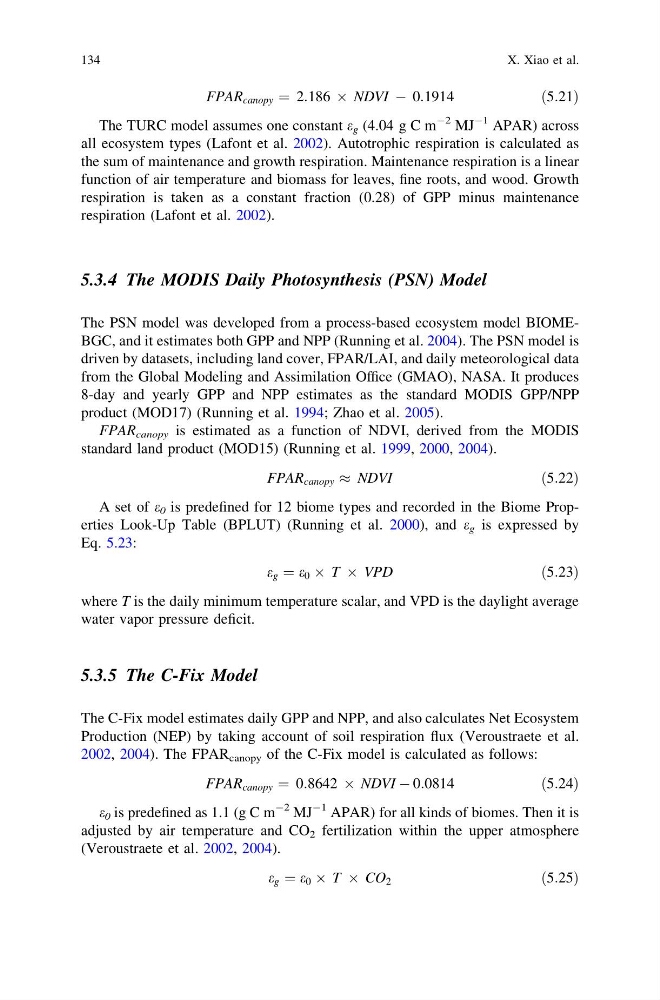
FPAR canopy ¼ 2:186 Â NDVI À 0:1914
ð5:21Þ
The TURC model assumes one constant e g (4.04 g C m
-2 MJ
-1 APAR) across
all ecosystem types (Lafont et al. 2002). Autotrophic respiration is calculated as
the sum of maintenance and growth respiration. Maintenance respiration is a linear
function of air temperature and biomass for leaves, fine roots, and wood. Growth
respiration is taken as a constant fraction (0.28) of GPP minus maintenance
respiration (Lafont et al. 2002).
5.3.4 The MODIS Daily Photosynthesis (PSN) Model
The PSN model was developed from a process-based ecosystem model BIOMEBGC, and it estimates both GPP and NPP (Running et al. 2004). The PSN model is
driven by datasets, including land cover, FPAR/LAI, and daily meteorological data
from the Global Modeling and Assimilation Office (GMAO), NASA. It produces
8-day and yearly GPP and NPP estimates as the standard MODIS GPP/NPP
product (MOD17) (Running et al. 1994; Zhao et al. 2005).
FPAR canopy is estimated as a function of NDVI, derived from the MODIS
standard land product (MOD15) (Running et al. 1999, 2000, 2004).
FPAR canopy % NDVI
ð5:22Þ
A set of e 0 is predefined for 12 biome types and recorded in the Biome Properties Look-Up Table (BPLUT) (Running et al. 2000), and e g is expressed by
Eq. 5.23:
e g ¼ e 0 Â T Â VPD
ð5:23Þ
where T is the daily minimum temperature scalar, and VPD is the daylight average
water vapor pressure deficit.
5.3.5 The C-Fix Model
The C-Fix model estimates daily GPP and NPP, and also calculates Net Ecosystem
Production (NEP) by taking account of soil respiration flux (Veroustraete et al.
2002, 2004). The FPAR canopy of the C-Fix model is calculated as follows:
FPAR canopy ¼ 0:8642 Â NDVI À 0:0814
ð5:24Þ
e 0 is predefined as 1.1 (g C m
-2 MJ
-1 APAR) for all kinds of biomes. Then it is
adjusted by air temperature and CO 2 fertilization within the upper atmosphere
(Veroustraete et al. 2002, 2004).
e g ¼ e 0 Â T Â CO 2
ð5:25Þ
134
X. Xiao et al.
ð5:21Þ
The TURC model assumes one constant e g (4.04 g C m
-2 MJ
-1 APAR) across
all ecosystem types (Lafont et al. 2002). Autotrophic respiration is calculated as
the sum of maintenance and growth respiration. Maintenance respiration is a linear
function of air temperature and biomass for leaves, fine roots, and wood. Growth
respiration is taken as a constant fraction (0.28) of GPP minus maintenance
respiration (Lafont et al. 2002).
5.3.4 The MODIS Daily Photosynthesis (PSN) Model
The PSN model was developed from a process-based ecosystem model BIOMEBGC, and it estimates both GPP and NPP (Running et al. 2004). The PSN model is
driven by datasets, including land cover, FPAR/LAI, and daily meteorological data
from the Global Modeling and Assimilation Office (GMAO), NASA. It produces
8-day and yearly GPP and NPP estimates as the standard MODIS GPP/NPP
product (MOD17) (Running et al. 1994; Zhao et al. 2005).
FPAR canopy is estimated as a function of NDVI, derived from the MODIS
standard land product (MOD15) (Running et al. 1999, 2000, 2004).
FPAR canopy % NDVI
ð5:22Þ
A set of e 0 is predefined for 12 biome types and recorded in the Biome Properties Look-Up Table (BPLUT) (Running et al. 2000), and e g is expressed by
Eq. 5.23:
e g ¼ e 0 Â T Â VPD
ð5:23Þ
where T is the daily minimum temperature scalar, and VPD is the daylight average
water vapor pressure deficit.
5.3.5 The C-Fix Model
The C-Fix model estimates daily GPP and NPP, and also calculates Net Ecosystem
Production (NEP) by taking account of soil respiration flux (Veroustraete et al.
2002, 2004). The FPAR canopy of the C-Fix model is calculated as follows:
FPAR canopy ¼ 0:8642 Â NDVI À 0:0814
ð5:24Þ
e 0 is predefined as 1.1 (g C m
-2 MJ
-1 APAR) for all kinds of biomes. Then it is
adjusted by air temperature and CO 2 fertilization within the upper atmosphere
(Veroustraete et al. 2002, 2004).
e g ¼ e 0 Â T Â CO 2
ð5:25Þ
134
X. Xiao et al.