

function F(x), the mean of the random value M(), and the dispersion D() are
derived from the probability density.
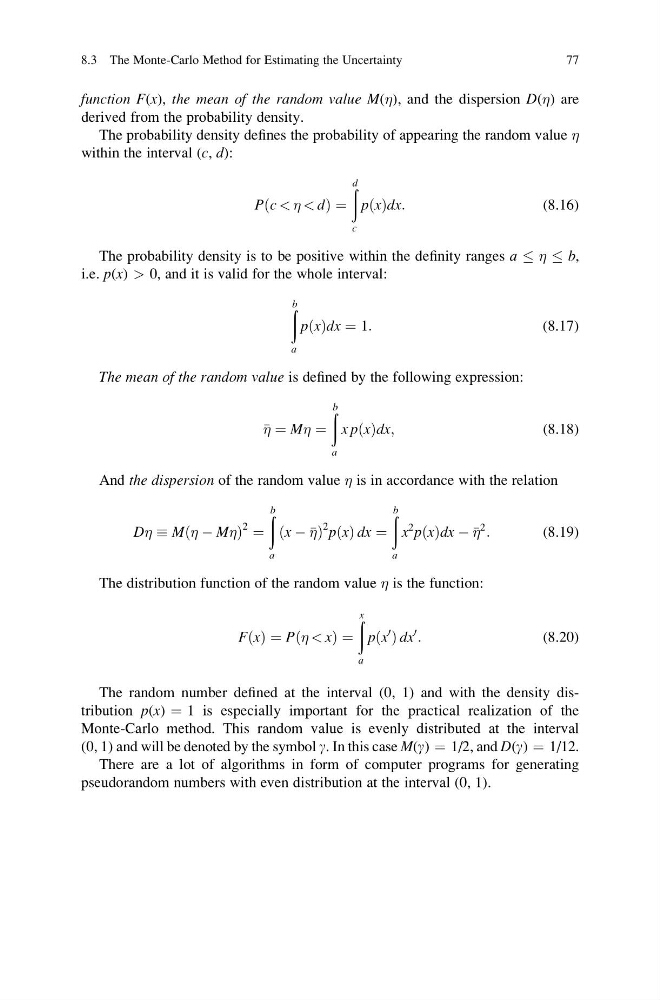
The probability density defines the probability of appearing the random value
within the interval (c, d):
P c < < d
ð
Þ¼
ð d
c
pðxÞdx:
(8.16)
The probability density is to be positive within the definity ranges a b,
i.e. p(x) > 0, and it is valid for the whole interval:
ð b
a
pðxÞdx ¼ 1:
(8.17)
The mean of the random value is defined by the following expression:
¼ M ¼
ð b
a
x pðxÞdx;
(8.18)
And the dispersion of the random value is in accordance with the relation
D M À M
ð
Þ
2 ¼
ð b
a
x À
ð
Þ
2 pðxÞ dx ¼
ð b
a
x
2 pðxÞdx À
2
:
(8.19)
The distribution function of the random value is the function:
FðxÞ ¼ P < x
ð
Þ¼
ð x
a
p x
0
ð Þdx
0
:
(8.20)
The random number defined at the interval (0, 1) and with the density distribution p(x) ¼ 1 is especially important for the practical realization of the
Monte-Carlo method. This random value is evenly distributed at the interval
(0, 1) and will be denoted by the symbol g. In this case M(g) ¼ 1/2, and D(g) ¼ 1/12.
There are a lot of algorithms in form of computer programs for generating
pseudorandom numbers with even distribution at the interval (0, 1).
8.3 The Monte-Carlo Method for Estimating the Uncertainty
77
derived from the probability density.
The probability density defines the probability of appearing the random value
within the interval (c, d):
P c < < d
ð
Þ¼
ð d
c
pðxÞdx:
(8.16)
The probability density is to be positive within the definity ranges a b,
i.e. p(x) > 0, and it is valid for the whole interval:
ð b
a
pðxÞdx ¼ 1:
(8.17)
The mean of the random value is defined by the following expression:
¼ M ¼
ð b
a
x pðxÞdx;
(8.18)
And the dispersion of the random value is in accordance with the relation
D M À M
ð
Þ
2 ¼
ð b
a
x À
ð
Þ
2 pðxÞ dx ¼
ð b
a
x
2 pðxÞdx À
2
:
(8.19)
The distribution function of the random value is the function:
FðxÞ ¼ P < x
ð
Þ¼
ð x
a
p x
0
ð Þdx
0
:
(8.20)
The random number defined at the interval (0, 1) and with the density distribution p(x) ¼ 1 is especially important for the practical realization of the
Monte-Carlo method. This random value is evenly distributed at the interval
(0, 1) and will be denoted by the symbol g. In this case M(g) ¼ 1/2, and D(g) ¼ 1/12.
There are a lot of algorithms in form of computer programs for generating
pseudorandom numbers with even distribution at the interval (0, 1).
8.3 The Monte-Carlo Method for Estimating the Uncertainty
77