

4.2 Elsasser’s Model of the Regular Molecular Band
Elsasser W.M. has in 1938 observed lines evenly distributed in spectral range of
CO 2 absorption band 15 mm and proposed this model that consists of periodical
lines. The band is sometimes called Elsasser’s band.
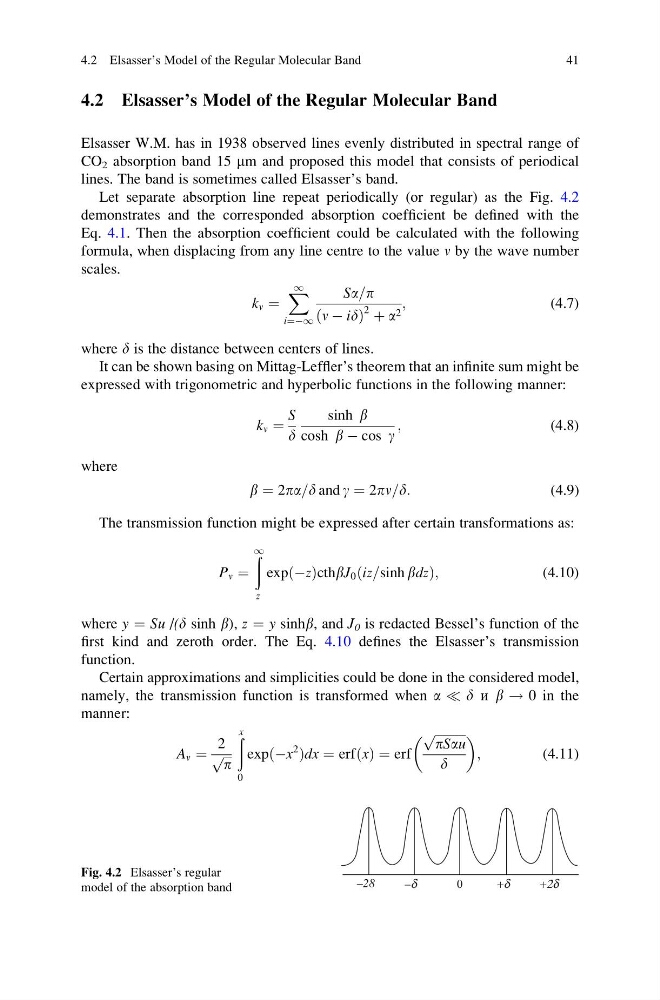
Let separate absorption line repeat periodically (or regular) as the Fig. 4.2
demonstrates and the corresponded absorption coefficient be defined with the
Eq. 4.1. Then the absorption coefficient could be calculated with the following
formula, when displacing from any line centre to the value n by the wave number
scales.
k n ¼
X 1
i¼À1
Sa=p
n À id
ð
Þ
2 þ a 2
;
(4.7)
where d is the distance between centers of lines.
It can be shown basing on Mittag-Leffler’s theorem that an infinite sum might be
expressed with trigonometric and hyperbolic functions in the following manner:
k n ¼
S
d
sinh b
cosh b À cos g
;
(4.8)
where
b ¼ 2pa d
= and g ¼ 2pn d
= :
(4.9)
The transmission function might be expressed after certain transformations as:
P n ¼
ð
1
z
expðÀzÞcthbJ 0 iz sinh b
=
dz
ð
Þ ;
(4.10)
where y ¼ Su /(d sinh b), z ¼ y sinhb, and J 0 is redacted Bessel’s function of the
first kind and zeroth order. The Eq. 4.10 defines the Elsasser’s transmission
function.
Certain approximations and simplicities could be done in the considered model,
namely, the transmission function is transformed when a ( d и b ! 0 in the
manner:
A n ¼
2
ffiffiffi
p
p
ð x
0
expðÀx
2
Þdx ¼ erfðxÞ ¼ erf
ffiffiffiffiffiffiffiffiffiffi
pSau
p
d
;
(4.11)
–28
–d
0
+ d
+2d
Fig. 4.2 Elsasser’s regular
model of the absorption band
4.2 Elsasser’s Model of the Regular Molecular Band
41
Elsasser W.M. has in 1938 observed lines evenly distributed in spectral range of
CO 2 absorption band 15 mm and proposed this model that consists of periodical
lines. The band is sometimes called Elsasser’s band.
Let separate absorption line repeat periodically (or regular) as the Fig. 4.2
demonstrates and the corresponded absorption coefficient be defined with the
Eq. 4.1. Then the absorption coefficient could be calculated with the following
formula, when displacing from any line centre to the value n by the wave number
scales.
k n ¼
X 1
i¼À1
Sa=p
n À id
ð
Þ
2 þ a 2
;
(4.7)
where d is the distance between centers of lines.
It can be shown basing on Mittag-Leffler’s theorem that an infinite sum might be
expressed with trigonometric and hyperbolic functions in the following manner:
k n ¼
S
d
sinh b
cosh b À cos g
;
(4.8)
where
b ¼ 2pa d
= and g ¼ 2pn d
= :
(4.9)
The transmission function might be expressed after certain transformations as:
P n ¼
ð
1
z
expðÀzÞcthbJ 0 iz sinh b
=
dz
ð
Þ ;
(4.10)
where y ¼ Su /(d sinh b), z ¼ y sinhb, and J 0 is redacted Bessel’s function of the
first kind and zeroth order. The Eq. 4.10 defines the Elsasser’s transmission
function.
Certain approximations and simplicities could be done in the considered model,
namely, the transmission function is transformed when a ( d и b ! 0 in the
manner:
A n ¼
2
ffiffiffi
p
p
ð x
0
expðÀx
2
Þdx ¼ erfðxÞ ¼ erf
ffiffiffiffiffiffiffiffiffiffi
pSau
p
d
;
(4.11)
–28
–d
0
+ d
+2d
Fig. 4.2 Elsasser’s regular
model of the absorption band
4.2 Elsasser’s Model of the Regular Molecular Band
41