

Let the viewing zenith angle be y, and the radiation passes between altitude
levels z 1 and z 2 . Then the value u ¼ u(y,z 1, z 2 ) is defined for the heterogeneous
atmosphere with the altitudinal profile of absorbing component density r(z) as:
uðy; z 1 ; z 2 Þ ¼
ð z2
z1
r ðxÞ
dx
cos ðyÞ
:
(4.3)
It is possible obtaining the following formula for the absorption coefficient with
substitution of the Eq. 4.1 to the Eq. 4.2:
P n ðuÞ ¼
1
Dn
ð
Dn
exp À
S
p
a
ðv À v 0 Þ
2 þ a 2
u
"
#
dn:
(4.4)
Two important limiting cases concerned weak and strong absorption follow from
the Eqs. 4.2 and 4.4. It is true (S u/a) ! 0 for the weak absorption and the
absorption function is defined in the fashion:
A n ¼ 1 À P n % ðS=DnÞu:
(4.5)
The absorption function A n is proportional to the value u, and the ranges of low
values (S u/a) is called the linear absorption region.
The strong absorption corresponds to the strong line (S u/a)!1, thus the value
a ( 1 and the absorption function A n is derived in the form:
A n ¼ 1 À P n % 2
ffiffiffiffiffiffiffiffiffiffiffiffiffi
Sa=Dn
p
ffiffi ffi
u
p
(4.6)
Here the absorption is proportional to the square root of the value u and ranges of
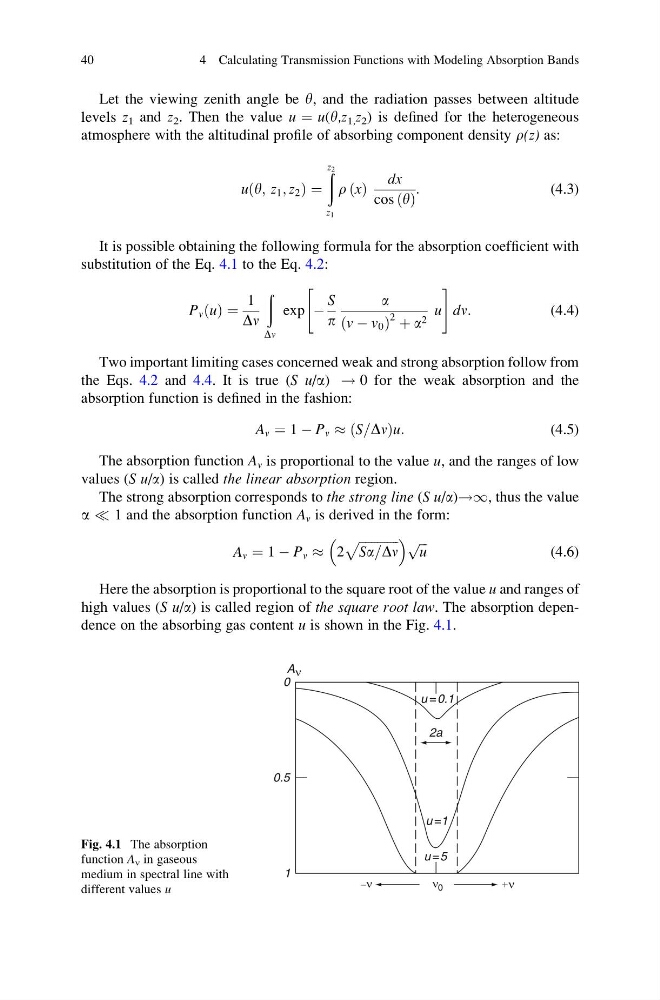
high values (S u/a) is called region of the square root law. The absorption dependence on the absorbing gas content u is shown in the Fig. 4.1.
ν 0
+ν
–ν
1
0.5
u =1
u =5
2a
u =0.1
0
A ν
Fig. 4.1 The absorption
function A n in gaseous
medium in spectral line with
different values u
40
4 Calculating Transmission Functions with Modeling Absorption Bands
levels z 1 and z 2 . Then the value u ¼ u(y,z 1, z 2 ) is defined for the heterogeneous
atmosphere with the altitudinal profile of absorbing component density r(z) as:
uðy; z 1 ; z 2 Þ ¼
ð z2
z1
r ðxÞ
dx
cos ðyÞ
:
(4.3)
It is possible obtaining the following formula for the absorption coefficient with
substitution of the Eq. 4.1 to the Eq. 4.2:
P n ðuÞ ¼
1
Dn
ð
Dn
exp À
S
p
a
ðv À v 0 Þ
2 þ a 2
u
"
#
dn:
(4.4)
Two important limiting cases concerned weak and strong absorption follow from
the Eqs. 4.2 and 4.4. It is true (S u/a) ! 0 for the weak absorption and the
absorption function is defined in the fashion:
A n ¼ 1 À P n % ðS=DnÞu:
(4.5)
The absorption function A n is proportional to the value u, and the ranges of low
values (S u/a) is called the linear absorption region.
The strong absorption corresponds to the strong line (S u/a)!1, thus the value
a ( 1 and the absorption function A n is derived in the form:
A n ¼ 1 À P n % 2
ffiffiffiffiffiffiffiffiffiffiffiffiffi
Sa=Dn
p
ffiffi ffi
u
p
(4.6)
Here the absorption is proportional to the square root of the value u and ranges of
high values (S u/a) is called region of the square root law. The absorption dependence on the absorbing gas content u is shown in the Fig. 4.1.
ν 0
+ν
–ν
1
0.5
u =1
u =5
2a
u =0.1
0
A ν
Fig. 4.1 The absorption
function A n in gaseous
medium in spectral line with
different values u
40
4 Calculating Transmission Functions with Modeling Absorption Bands