

media physical state while applying Eqs. 8.1, 8.2 and 8.5 for calculating the absorption
coefficient k n .
The absorption (emission) line is not a just line. Certain mechanisms govern the
spectral line broadening. The most significant are broadening by collisions (pressure) and by Doppler’s effect.
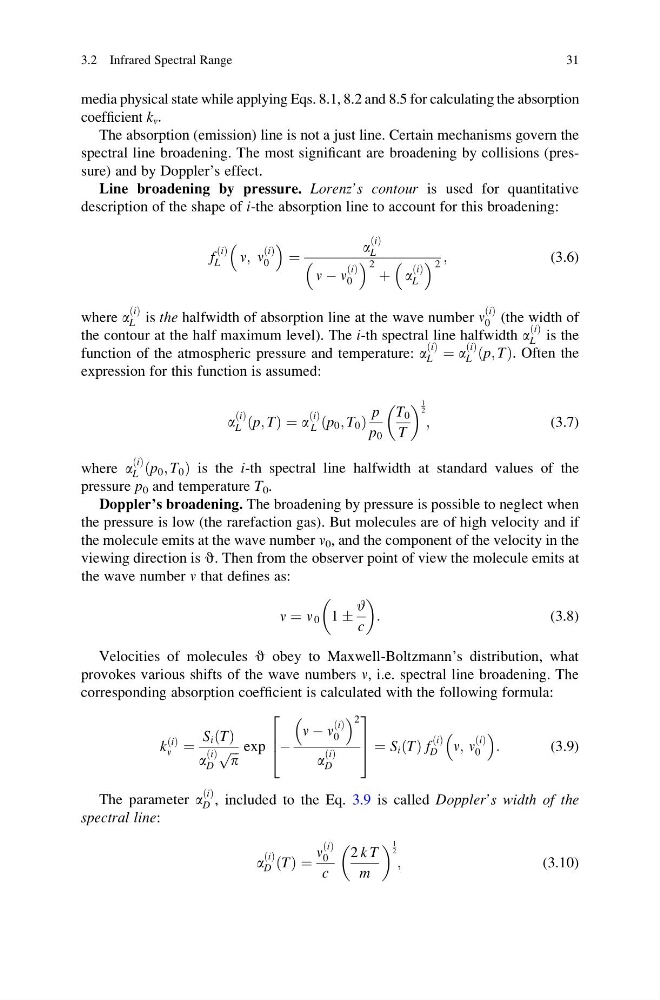
Line broadening by pressure. Lorenz’s contour is used for quantitative
description of the shape of i-the absorption line to account for this broadening:
f
ðiÞ
L
n; n
ðiÞ
0
¼
a
ðiÞ
L
n À n
ðiÞ
0
2 þ a
ðiÞ
L
2 ;
(3.6)
where a
ðiÞ
L is the halfwidth of absorption line at the wave number n
ðiÞ
0 (the width of
the contour at the half maximum level). The i-th spectral line halfwidth a
ðiÞ
L is the
function of the atmospheric pressure and temperature: a
ðiÞ
L ¼ a
ðiÞ
L ðp; TÞ. Often the
expression for this function is assumed:
a
ðiÞ
L p; T
ð
Þ ¼ a
ðiÞ
L p 0 ; T 0
ð
Þ
p
p 0
T 0
T
1
2 ;
(3.7)
where a
ðiÞ
L ðp 0 ; T 0 Þ is the i-th spectral line halfwidth at standard values of the
pressure p 0 and temperature T 0 .
Doppler’s broadening. The broadening by pressure is possible to neglect when
the pressure is low (the rarefaction gas). But molecules are of high velocity and if
the molecule emits at the wave number n 0 , and the component of the velocity in the
viewing direction is ϑ. Then from the observer point of view the molecule emits at
the wave number n that defines as:
n ¼ n 0 1 Æ
#
c
:
(3.8)
Velocities of molecules ϑ obey to Maxwell-Boltzmann’s distribution, what
provokes various shifts of the wave numbers n, i.e. spectral line broadening. The
corresponding absorption coefficient is calculated with the following formula:
k
ðiÞ
n ¼
S i ðTÞ
a
ðiÞ
D
ffiffiffi
p
p exp À
n À n
ðiÞ
0
2
a
ðiÞ
D
2
6
4
3
7
5 ¼ S i ðTÞ f
ðiÞ
D n; n
ðiÞ
0
:
(3.9)
The parameter a
ðiÞ
D , included to the Eq. 3.9 is called Doppler’s width of the
spectral line:
a
ðiÞ
D ðTÞ ¼
n
ðiÞ
0
c
2 k T
m
1
2 ;
(3.10)
3.2 Infrared Spectral Range
31
coefficient k n .
The absorption (emission) line is not a just line. Certain mechanisms govern the
spectral line broadening. The most significant are broadening by collisions (pressure) and by Doppler’s effect.
Line broadening by pressure. Lorenz’s contour is used for quantitative
description of the shape of i-the absorption line to account for this broadening:
f
ðiÞ
L
n; n
ðiÞ
0
¼
a
ðiÞ
L
n À n
ðiÞ
0
2 þ a
ðiÞ
L
2 ;
(3.6)
where a
ðiÞ
L is the halfwidth of absorption line at the wave number n
ðiÞ
0 (the width of
the contour at the half maximum level). The i-th spectral line halfwidth a
ðiÞ
L is the
function of the atmospheric pressure and temperature: a
ðiÞ
L ¼ a
ðiÞ
L ðp; TÞ. Often the
expression for this function is assumed:
a
ðiÞ
L p; T
ð
Þ ¼ a
ðiÞ
L p 0 ; T 0
ð
Þ
p
p 0
T 0
T
1
2 ;
(3.7)
where a
ðiÞ
L ðp 0 ; T 0 Þ is the i-th spectral line halfwidth at standard values of the
pressure p 0 and temperature T 0 .
Doppler’s broadening. The broadening by pressure is possible to neglect when
the pressure is low (the rarefaction gas). But molecules are of high velocity and if
the molecule emits at the wave number n 0 , and the component of the velocity in the
viewing direction is ϑ. Then from the observer point of view the molecule emits at
the wave number n that defines as:
n ¼ n 0 1 Æ
#
c
:
(3.8)
Velocities of molecules ϑ obey to Maxwell-Boltzmann’s distribution, what
provokes various shifts of the wave numbers n, i.e. spectral line broadening. The
corresponding absorption coefficient is calculated with the following formula:
k
ðiÞ
n ¼
S i ðTÞ
a
ðiÞ
D
ffiffiffi
p
p exp À
n À n
ðiÞ
0
2
a
ðiÞ
D
2
6
4
3
7
5 ¼ S i ðTÞ f
ðiÞ
D n; n
ðiÞ
0
:
(3.9)
The parameter a
ðiÞ
D , included to the Eq. 3.9 is called Doppler’s width of the
spectral line:
a
ðiÞ
D ðTÞ ¼
n
ðiÞ
0
c
2 k T
m
1
2 ;
(3.10)
3.2 Infrared Spectral Range
31