

where
k n
ðiÞ
¼
S i ðTÞ
p
f
ðiÞ n; n
ðiÞ
0
:
(3.2)
and N is the total amount of spectral absorption lines considered for calculating the
absorption coefficient at the wave number n (in the spectral range [n 0 ÀDn, n 0 + Dn ],
where Dn is the a priori fixed parameter); k
ðiÞ
n is the value of i-th item of the
absorption coefficient contributed by i-th spectral absorption line n
ðiÞ
0 ; S i (T) is the
intensity of i-th spectral line for the gaseous temperature T; f i (n,n
ðiÞ
0 ) is the spectral
line contour depending on the temperature and pressure of the gaseous medium.
The intensity S i (T) in the Eq. 8.2 is defined by the expression:
S i ðTÞ ¼
ð
1
0
k
ðiÞ
n ðTÞdn;
(3.3)
And the following relation is true from normalization of the function f i (n, n
ðiÞ
0 ):
ð
1
0
f
ðiÞ
ðn; n
ðiÞ
0 Þdn ¼ 1
(3.4)
The dependence of the intensity S i on temperature might be expressed with the
following relation:
S i ðTÞ ¼ S i T 0
ð Þ
Q # T 0
ð Þ
Q # ðTÞ
T 0
T
j
exp À
1439 E
00
i T À T 0
ð
Þ
T T 0
!
:
(3.5)
where S i (T 0 ) is the i-th spectral line intensity for the temperature T 0 ; E
00 is the energy
([cm
À1 ]) of the lowest level, from which the transition happens; Q # (T) is so called
the vibrational statistical sum; j is the parameter depending on molecule type.
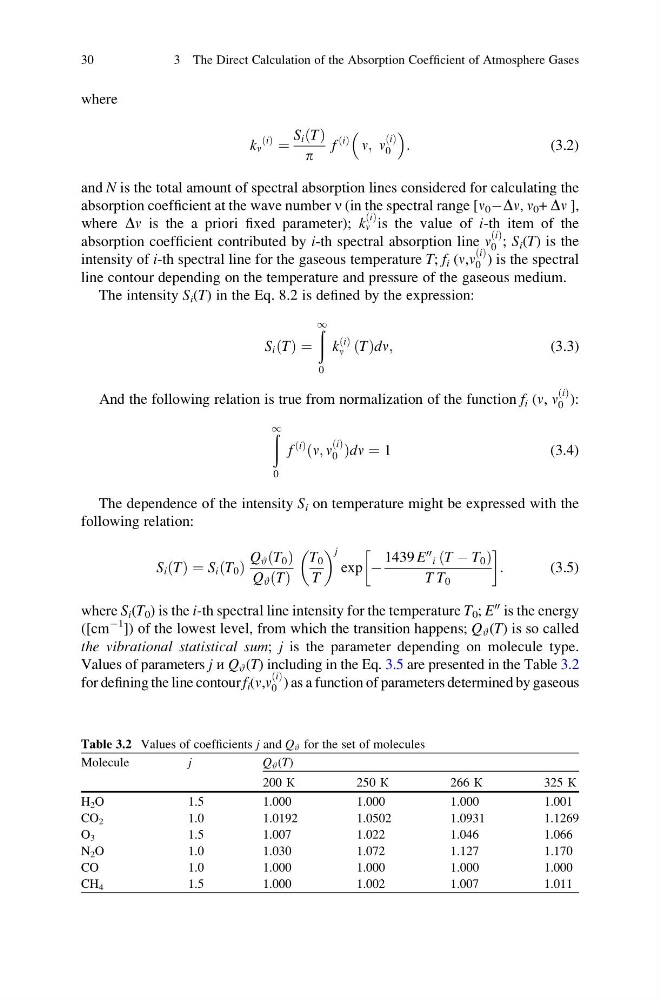
Values of parameters j и Q # (T) including in the Eq. 3.5 are presented in the Table 3.2
for defining the line contour f i (n,n
ðiÞ
0 ) as a function of parameters determined by gaseous
Table 3.2 Values of coefficients j and Q # for the set of molecules
Molecule
j
Q # (T)
200 К
250 К
266 К
325 К
H 2 O
1.5
1.000
1.000
1.000
1.001
CO 2
1.0
1.0192
1.0502
1.0931
1.1269
O 3
1.5
1.007
1.022
1.046
1.066
N 2 O
1.0
1.030
1.072
1.127
1.170
CO
1.0
1.000
1.000
1.000
1.000
CH 4
1.5
1.000
1.002
1.007
1.011
30
3 The Direct Calculation of the Absorption Coefficient of Atmosphere Gases
k n
ðiÞ
¼
S i ðTÞ
p
f
ðiÞ n; n
ðiÞ
0
:
(3.2)
and N is the total amount of spectral absorption lines considered for calculating the
absorption coefficient at the wave number n (in the spectral range [n 0 ÀDn, n 0 + Dn ],
where Dn is the a priori fixed parameter); k
ðiÞ
n is the value of i-th item of the
absorption coefficient contributed by i-th spectral absorption line n
ðiÞ
0 ; S i (T) is the
intensity of i-th spectral line for the gaseous temperature T; f i (n,n
ðiÞ
0 ) is the spectral
line contour depending on the temperature and pressure of the gaseous medium.
The intensity S i (T) in the Eq. 8.2 is defined by the expression:
S i ðTÞ ¼
ð
1
0
k
ðiÞ
n ðTÞdn;
(3.3)
And the following relation is true from normalization of the function f i (n, n
ðiÞ
0 ):
ð
1
0
f
ðiÞ
ðn; n
ðiÞ
0 Þdn ¼ 1
(3.4)
The dependence of the intensity S i on temperature might be expressed with the
following relation:
S i ðTÞ ¼ S i T 0
ð Þ
Q # T 0
ð Þ
Q # ðTÞ
T 0
T
j
exp À
1439 E
00
i T À T 0
ð
Þ
T T 0
!
:
(3.5)
where S i (T 0 ) is the i-th spectral line intensity for the temperature T 0 ; E
00 is the energy
([cm
À1 ]) of the lowest level, from which the transition happens; Q # (T) is so called
the vibrational statistical sum; j is the parameter depending on molecule type.
Values of parameters j и Q # (T) including in the Eq. 3.5 are presented in the Table 3.2
for defining the line contour f i (n,n
ðiÞ
0 ) as a function of parameters determined by gaseous
Table 3.2 Values of coefficients j and Q # for the set of molecules
Molecule
j
Q # (T)
200 К
250 К
266 К
325 К
H 2 O
1.5
1.000
1.000
1.000
1.001
CO 2
1.0
1.0192
1.0502
1.0931
1.1269
O 3
1.5
1.007
1.022
1.046
1.066
N 2 O
1.0
1.030
1.072
1.127
1.170
CO
1.0
1.000
1.000
1.000
1.000
CH 4
1.5
1.000
1.002
1.007
1.011
30
3 The Direct Calculation of the Absorption Coefficient of Atmosphere Gases