

where n is the wave number and h is Planck’s constant, which is equal to
6.626 Â 10
À34 Js. It is clear that the decreasing of wavelength l increases energy
of an electro-magnetic wave.
The inner energy of a molecule adds up as follows:
E ¼ E transl þ E electron þ E vibrat þ E rotat þ E elÀvibr þ E elÀrot þ E vibrÀrot
Continue spectrum is provided only by translational motion (heat) of molecules.
Other interaction types are characterized discrete spectrum. Hence, change of
molecule energy happens with quantum jump hn. The solution of Schr€ odinger
equation for the wave function (eigenvectors and eigenfunctions) presents the set
of discrete values of molecule energy.
The Pauli-Fermi principle determines permitted levels of molecule energy E i ,
and the portion DE ij ¼ E i -E j , of energy changes while molecule transits from the
initial level E i to the level E j . The Planck’s formula DE ij ¼ hn ij determines the
molecule absorption (emission) spectrum. Hence, only permitted energy values
correspond to only certain wave numbers (wavelengths), forming spectral lines.
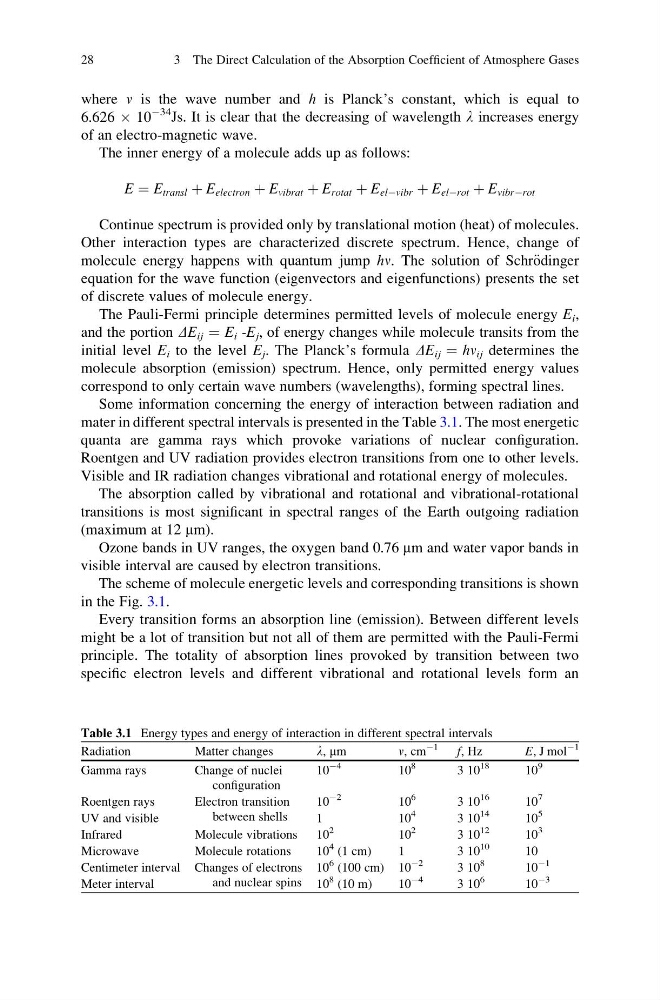
Some information concerning the energy of interaction between radiation and
mater in different spectral intervals is presented in the Table 3.1. The most energetic
quanta are gamma rays which provoke variations of nuclear configuration.
Roentgen and UV radiation provides electron transitions from one to other levels.
Visible and IR radiation changes vibrational and rotational energy of molecules.
The absorption called by vibrational and rotational and vibrational-rotational
transitions is most significant in spectral ranges of the Earth outgoing radiation
(maximum at 12 mm).
Ozone bands in UV ranges, the oxygen band 0.76 mm and water vapor bands in
visible interval are caused by electron transitions.
The scheme of molecule energetic levels and corresponding transitions is shown
in the Fig. 3.1.
Every transition forms an absorption line (emission). Between different levels
might be a lot of transition but not all of them are permitted with the Pauli-Fermi
principle. The totality of absorption lines provoked by transition between two
specific electron levels and different vibrational and rotational levels form an
Table 3.1 Energy types and energy of interaction in different spectral intervals
Radiation
Matter changes
l, mm
n, cm
À1
f, Hz
E, J mol
À1
Gamma rays
Change of nuclei
configuration
10
À4
10
8
3 10
18
10
9
Roentgen rays
Electron transition
between shells
10
À2
10
6
3 10
16
10
7
UV and visible
1
10
4
3 10
14
10
5
Infrared
Molecule vibrations
10
2
10
2
3 10
12
10
3
Microwave
Molecule rotations
10
4 (1 cm)
1
3 10
10
10
Centimeter interval Changes of electrons
and nuclear spins
10
6 (100 cm) 10
À2
3 10
8
10
À1
Meter interval
10
8 (10 m)
10
À4
3 10
6
10
À3
28
3 The Direct Calculation of the Absorption Coefficient of Atmosphere Gases
6.626 Â 10
À34 Js. It is clear that the decreasing of wavelength l increases energy
of an electro-magnetic wave.
The inner energy of a molecule adds up as follows:
E ¼ E transl þ E electron þ E vibrat þ E rotat þ E elÀvibr þ E elÀrot þ E vibrÀrot
Continue spectrum is provided only by translational motion (heat) of molecules.
Other interaction types are characterized discrete spectrum. Hence, change of
molecule energy happens with quantum jump hn. The solution of Schr€ odinger
equation for the wave function (eigenvectors and eigenfunctions) presents the set
of discrete values of molecule energy.
The Pauli-Fermi principle determines permitted levels of molecule energy E i ,
and the portion DE ij ¼ E i -E j , of energy changes while molecule transits from the
initial level E i to the level E j . The Planck’s formula DE ij ¼ hn ij determines the
molecule absorption (emission) spectrum. Hence, only permitted energy values
correspond to only certain wave numbers (wavelengths), forming spectral lines.
Some information concerning the energy of interaction between radiation and
mater in different spectral intervals is presented in the Table 3.1. The most energetic
quanta are gamma rays which provoke variations of nuclear configuration.
Roentgen and UV radiation provides electron transitions from one to other levels.
Visible and IR radiation changes vibrational and rotational energy of molecules.
The absorption called by vibrational and rotational and vibrational-rotational
transitions is most significant in spectral ranges of the Earth outgoing radiation
(maximum at 12 mm).
Ozone bands in UV ranges, the oxygen band 0.76 mm and water vapor bands in
visible interval are caused by electron transitions.
The scheme of molecule energetic levels and corresponding transitions is shown
in the Fig. 3.1.
Every transition forms an absorption line (emission). Between different levels
might be a lot of transition but not all of them are permitted with the Pauli-Fermi
principle. The totality of absorption lines provoked by transition between two
specific electron levels and different vibrational and rotational levels form an
Table 3.1 Energy types and energy of interaction in different spectral intervals
Radiation
Matter changes
l, mm
n, cm
À1
f, Hz
E, J mol
À1
Gamma rays
Change of nuclei
configuration
10
À4
10
8
3 10
18
10
9
Roentgen rays
Electron transition
between shells
10
À2
10
6
3 10
16
10
7
UV and visible
1
10
4
3 10
14
10
5
Infrared
Molecule vibrations
10
2
10
2
3 10
12
10
3
Microwave
Molecule rotations
10
4 (1 cm)
1
3 10
10
10
Centimeter interval Changes of electrons
and nuclear spins
10
6 (100 cm) 10
À2
3 10
8
10
À1
Meter interval
10
8 (10 m)
10
À4
3 10
6
10
À3
28
3 The Direct Calculation of the Absorption Coefficient of Atmosphere Gases