

of real substances to their brightness temperature allows the clear plotting of the
spectrum in wide ranges and easy correlation of intensity values at different spectral
diapasons. The reason is the weak spectral variability of the brightness temperature
comparing with intensity. This variability disappeared in the blackbody limit case.
For example the blackbody at the temperature of 7,000 К, then brightness temperature T n ¼ 7,000 K coincides with the thermodynamic and it is constant at all
wavelength; the spectral brightness varies over nine orders of magnitude.
The brightness temperature of the heat radiation intensity (including the surface
heat radiation) is derived from the relation below
B n ðT n Þ J
"
n Á
(2.10)
The following formula for calculating the brightness temperature T n of the self
heat radiation intensity of the surface is derived by taking into account Eqs. 2.8, 2.9
and 2.10 :
T n ¼
bn
ln 1 þ
an 3
J
"
n
h
i:
(2.11)
By substituting the Eq. 2.9 it is obtained for T n :
T n ¼
bn
ln 1 þ
an 3
enBnðTsÞ
h
i:
(2.12)
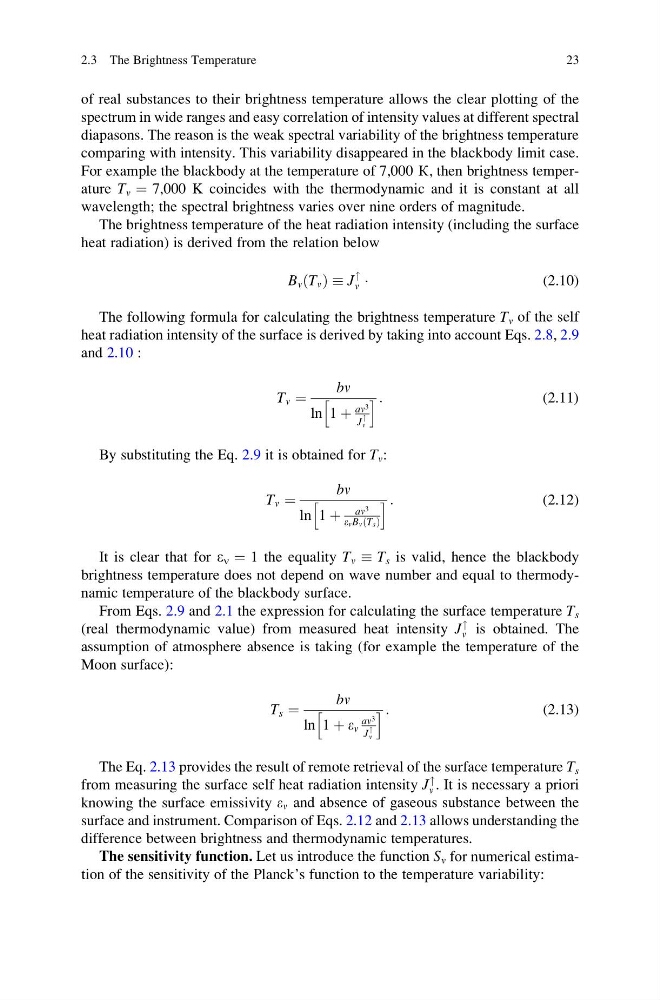
It is clear that for e n ¼ 1 the equality T n T s is valid, hence the blackbody
brightness temperature does not depend on wave number and equal to thermodynamic temperature of the blackbody surface.
From Eqs. 2.9 and 2.1 the expression for calculating the surface temperature T s
(real thermodynamic value) from measured heat intensity J
"
n is obtained. The
assumption of atmosphere absence is taking (for example the temperature of the
Moon surface):
T s ¼
bn
ln 1 þ e n
an 3
J
"
n
h
i:
(2.13)
The Eq. 2.13 provides the result of remote retrieval of the surface temperature T s
from measuring the surface self heat radiation intensity J
"
n . It is necessary a priori
knowing the surface emissivity e n and absence of gaseous substance between the
surface and instrument. Comparison of Eqs. 2.12 and 2.13 allows understanding the
difference between brightness and thermodynamic temperatures.
The sensitivity function. Let us introduce the function S n for numerical estimation of the sensitivity of the Planck’s function to the temperature variability:
2.3 The Brightness Temperature
23
spectrum in wide ranges and easy correlation of intensity values at different spectral
diapasons. The reason is the weak spectral variability of the brightness temperature
comparing with intensity. This variability disappeared in the blackbody limit case.
For example the blackbody at the temperature of 7,000 К, then brightness temperature T n ¼ 7,000 K coincides with the thermodynamic and it is constant at all
wavelength; the spectral brightness varies over nine orders of magnitude.
The brightness temperature of the heat radiation intensity (including the surface
heat radiation) is derived from the relation below
B n ðT n Þ J
"
n Á
(2.10)
The following formula for calculating the brightness temperature T n of the self
heat radiation intensity of the surface is derived by taking into account Eqs. 2.8, 2.9
and 2.10 :
T n ¼
bn
ln 1 þ
an 3
J
"
n
h
i:
(2.11)
By substituting the Eq. 2.9 it is obtained for T n :
T n ¼
bn
ln 1 þ
an 3
enBnðTsÞ
h
i:
(2.12)
It is clear that for e n ¼ 1 the equality T n T s is valid, hence the blackbody
brightness temperature does not depend on wave number and equal to thermodynamic temperature of the blackbody surface.
From Eqs. 2.9 and 2.1 the expression for calculating the surface temperature T s
(real thermodynamic value) from measured heat intensity J
"
n is obtained. The
assumption of atmosphere absence is taking (for example the temperature of the
Moon surface):
T s ¼
bn
ln 1 þ e n
an 3
J
"
n
h
i:
(2.13)
The Eq. 2.13 provides the result of remote retrieval of the surface temperature T s
from measuring the surface self heat radiation intensity J
"
n . It is necessary a priori
knowing the surface emissivity e n and absence of gaseous substance between the
surface and instrument. Comparison of Eqs. 2.12 and 2.13 allows understanding the
difference between brightness and thermodynamic temperatures.
The sensitivity function. Let us introduce the function S n for numerical estimation of the sensitivity of the Planck’s function to the temperature variability:
2.3 The Brightness Temperature
23