

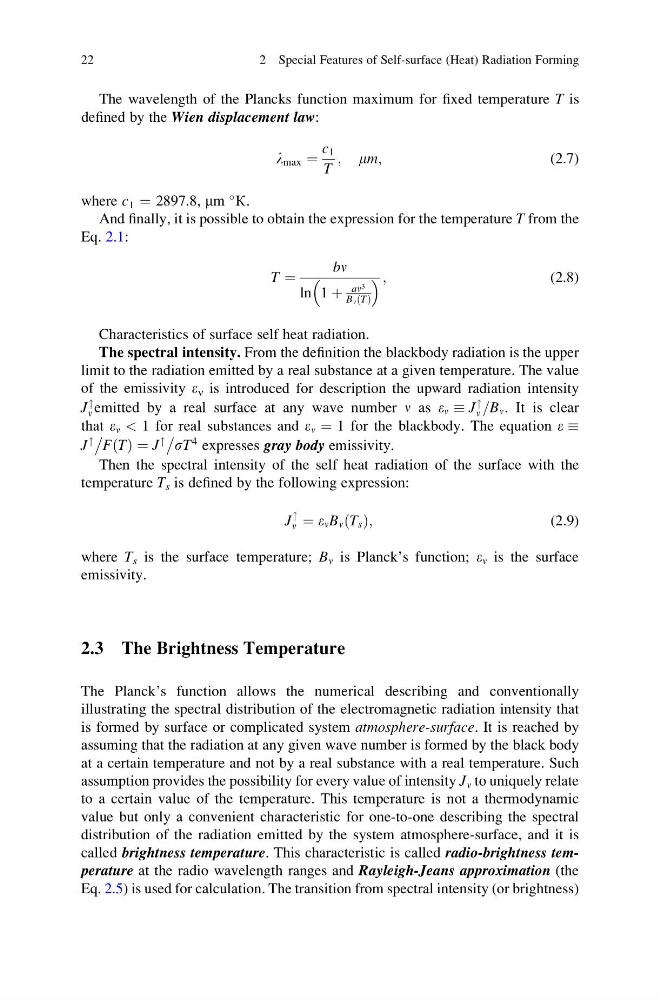
The wavelength of the Plancks function maximum for fixed temperature T is
defined by the Wien displacement law:
l max ¼
c 1
T
; mm;
(2.7)
where c 1 ¼ 2897.8, mm
К.
And finally, it is possible to obtain the expression for the temperature T from the
Eq. 2.1:
T ¼
bn
ln 1 þ
an 3
BnðTÞ
;
(2.8)
Characteristics of surface self heat radiation.
The spectral intensity. From the definition the blackbody radiation is the upper
limit to the radiation emitted by a real substance at a given temperature. The value
of the emissivity e n is introduced for description the upward radiation intensity
J
"
n emitted by a real surface at any wave number n as e n J
"
n B n
= . It is clear
that e n < 1 for real substances and e n ¼ 1 for the blackbody. The equation e
J
" FðTÞ ¼ J
" sT
4
expresses gray body emissivity.
Then the spectral intensity of the self heat radiation of the surface with the
temperature T s is defined by the following expression:
J
"
n ¼ e n B n ðT s Þ;
(2.9)
where T s is the surface temperature; B n is Planck’s function; e n is the surface
emissivity.
2.3 The Brightness Temperature
The Planck’s function allows the numerical describing and conventionally
illustrating the spectral distribution of the electromagnetic radiation intensity that
is formed by surface or complicated system atmosphere-surface. It is reached by
assuming that the radiation at any given wave number is formed by the black body
at a certain temperature and not by a real substance with a real temperature. Such
assumption provides the possibility for every value of intensity J n to uniquely relate
to a certain value of the temperature. This temperature is not a thermodynamic
value but only a convenient characteristic for one-to-one describing the spectral
distribution of the radiation emitted by the system atmosphere-surface, and it is
called brightness temperature. This characteristic is called radio-brightness temperature at the radio wavelength ranges and Rayleigh-Jeans approximation (the
Eq. 2.5) is used for calculation. The transition from spectral intensity (or brightness)
22
2 Special Features of Self-surface (Heat) Radiation Forming
defined by the Wien displacement law:
l max ¼
c 1
T
; mm;
(2.7)
where c 1 ¼ 2897.8, mm
К.
And finally, it is possible to obtain the expression for the temperature T from the
Eq. 2.1:
T ¼
bn
ln 1 þ
an 3
BnðTÞ
;
(2.8)
Characteristics of surface self heat radiation.
The spectral intensity. From the definition the blackbody radiation is the upper
limit to the radiation emitted by a real substance at a given temperature. The value
of the emissivity e n is introduced for description the upward radiation intensity
J
"
n emitted by a real surface at any wave number n as e n J
"
n B n
= . It is clear
that e n < 1 for real substances and e n ¼ 1 for the blackbody. The equation e
J
" FðTÞ ¼ J
" sT
4
expresses gray body emissivity.
Then the spectral intensity of the self heat radiation of the surface with the
temperature T s is defined by the following expression:
J
"
n ¼ e n B n ðT s Þ;
(2.9)
where T s is the surface temperature; B n is Planck’s function; e n is the surface
emissivity.
2.3 The Brightness Temperature
The Planck’s function allows the numerical describing and conventionally
illustrating the spectral distribution of the electromagnetic radiation intensity that
is formed by surface or complicated system atmosphere-surface. It is reached by
assuming that the radiation at any given wave number is formed by the black body
at a certain temperature and not by a real substance with a real temperature. Such
assumption provides the possibility for every value of intensity J n to uniquely relate
to a certain value of the temperature. This temperature is not a thermodynamic
value but only a convenient characteristic for one-to-one describing the spectral
distribution of the radiation emitted by the system atmosphere-surface, and it is
called brightness temperature. This characteristic is called radio-brightness temperature at the radio wavelength ranges and Rayleigh-Jeans approximation (the
Eq. 2.5) is used for calculation. The transition from spectral intensity (or brightness)
22
2 Special Features of Self-surface (Heat) Radiation Forming