

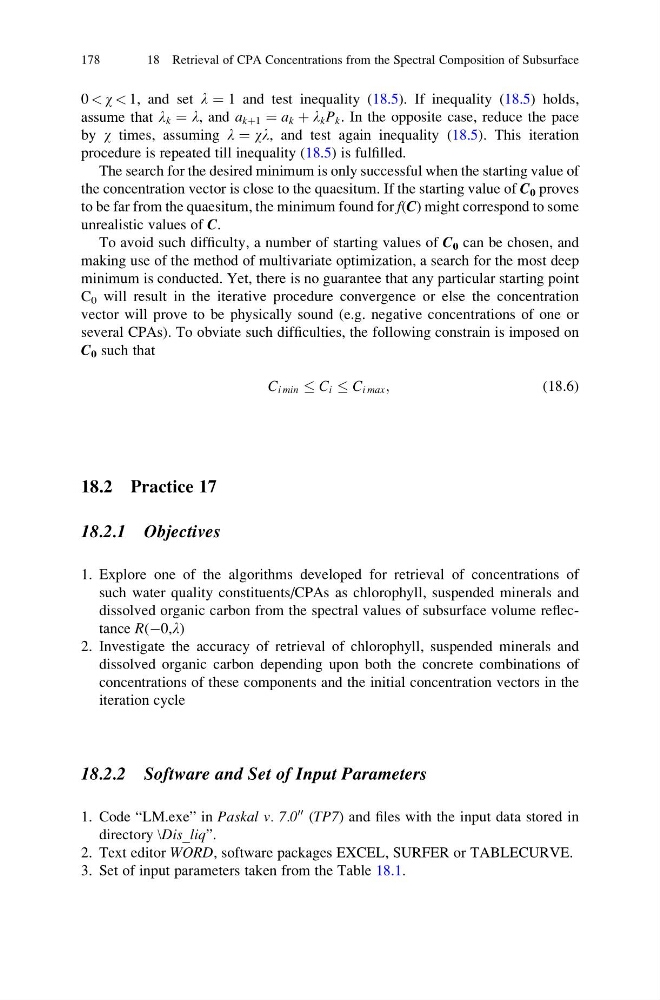
0 < w < 1, and set l ¼ 1 and test inequality (18.5). If inequality (18.5) holds,
assume that l k ¼ l, and a kþ1 ¼ a k þ l k P k . In the opposite case, reduce the pace
by w times, assuming l ¼ wl, and test again inequality (18.5). This iteration
procedure is repeated till inequality (18.5) is fulfilled.
The search for the desired minimum is only successful when the starting value of
the concentration vector is close to the quaesitum. If the starting value of C 0 proves
to be far from the quaesitum, the minimum found for f(C) might correspond to some
unrealistic values of C.
To avoid such difficulty, a number of starting values of C 0 can be chosen, and
making use of the method of multivariate optimization, a search for the most deep
minimum is conducted. Yet, there is no guarantee that any particular starting point
C 0 will result in the iterative procedure convergence or else the concentration
vector will prove to be physically sound (e.g. negative concentrations of one or
several CPAs). To obviate such difficulties, the following constrain is imposed on
C 0 such that
C i min C i C i max ;
(18.6)
18.2 Practice 17
18.2.1 Objectives
1. Explore one of the algorithms developed for retrieval of concentrations of
such water quality constituents/CPAs as chlorophyll, suspended minerals and
dissolved organic carbon from the spectral values of subsurface volume reflectance R(À0,l)
2. Investigate the accuracy of retrieval of chlorophyll, suspended minerals and
dissolved organic carbon depending upon both the concrete combinations of
concentrations of these components and the initial concentration vectors in the
iteration cycle
18.2.2 Software and Set of Input Parameters
1. Code “LM.exe” in Paskal v. 7.0
00 (TP7) and files with the input data stored in
directory \Dis_liq”.
2. Text editor WORD, software packages EXCEL, SURFER or TABLECURVE.
3. Set of input parameters taken from the Table 18.1.
178
18 Retrieval of CPA Concentrations from the Spectral Composition of Subsurface
assume that l k ¼ l, and a kþ1 ¼ a k þ l k P k . In the opposite case, reduce the pace
by w times, assuming l ¼ wl, and test again inequality (18.5). This iteration
procedure is repeated till inequality (18.5) is fulfilled.
The search for the desired minimum is only successful when the starting value of
the concentration vector is close to the quaesitum. If the starting value of C 0 proves
to be far from the quaesitum, the minimum found for f(C) might correspond to some
unrealistic values of C.
To avoid such difficulty, a number of starting values of C 0 can be chosen, and
making use of the method of multivariate optimization, a search for the most deep
minimum is conducted. Yet, there is no guarantee that any particular starting point
C 0 will result in the iterative procedure convergence or else the concentration
vector will prove to be physically sound (e.g. negative concentrations of one or
several CPAs). To obviate such difficulties, the following constrain is imposed on
C 0 such that
C i min C i C i max ;
(18.6)
18.2 Practice 17
18.2.1 Objectives
1. Explore one of the algorithms developed for retrieval of concentrations of
such water quality constituents/CPAs as chlorophyll, suspended minerals and
dissolved organic carbon from the spectral values of subsurface volume reflectance R(À0,l)
2. Investigate the accuracy of retrieval of chlorophyll, suspended minerals and
dissolved organic carbon depending upon both the concrete combinations of
concentrations of these components and the initial concentration vectors in the
iteration cycle
18.2.2 Software and Set of Input Parameters
1. Code “LM.exe” in Paskal v. 7.0
00 (TP7) and files with the input data stored in
directory \Dis_liq”.
2. Text editor WORD, software packages EXCEL, SURFER or TABLECURVE.
3. Set of input parameters taken from the Table 18.1.
178
18 Retrieval of CPA Concentrations from the Spectral Composition of Subsurface