

a number of wavelengths is developed. In the second stage, the neural network
training is performed: the weighting coefficients are established in a way that the
sum of squared residuals gets minimized. Due to its fast operation, this method
provides for processing space imageries of vast water areas. In more details the
theory and application of this method are given in the referenced publications.
Within the framework of this Exercise, consider more closely another method of
water quality retrieval from remote sensing data in the visible, viz, method of
multivariate optimization (the Levenberg-Marquardt method). As it was indicated
above, the tabulated spectral values of CPA cross-sections for Lake Ladoga will be
used herein for simulations.
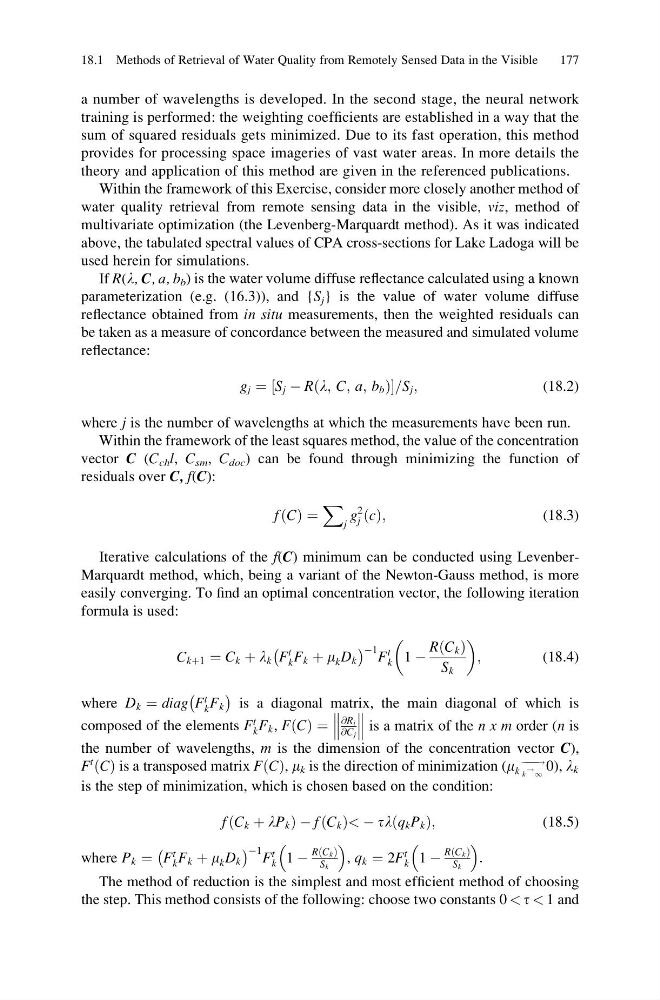
If R(l, C, a, b b ) is the water volume diffuse reflectance calculated using a known
parameterization (e.g. (16.3)), and {S j } is the value of water volume diffuse
reflectance obtained from in situ measurements, then the weighted residuals can
be taken as a measure of concordance between the measured and simulated volume
reflectance:
g j ¼ ½S j À Rðl; C; a; b b Þ=S j ;
(18.2)
where j is the number of wavelengths at which the measurements have been run.
Within the framework of the least squares method, the value of the concentration
vector C (C ch l, C sm , C doc ) can be found through minimizing the function of
residuals over C, f(C):
f ðCÞ ¼
X
j
g
2
j ðcÞ;
(18.3)
Iterative calculations of the f(C) minimum can be conducted using LevenberMarquardt method, which, being a variant of the Newton-Gauss method, is more
easily converging. To find an optimal concentration vector, the following iteration
formula is used:
C kþ1 ¼ C k þ l k F
t
k F k þ m k D k
À
Á À1 F
t
k 1 À
R C k
ð Þ
S k
;
(18.4)
where D k ¼ diag F
t
k F k
À
Á
is a diagonal matrix, the main diagonal of which is
composed of the elements F
t
k F k , FðCÞ ¼
@R i
@C j
is a matrix of the n x m order (n is
the number of wavelengths, m is the dimension of the concentration vector C),
F
t
ðCÞ is a transposed matrix FðCÞ, m k is the direction of minimization (m k
À À À À À !
k
! 1
0), l k
is the step of minimization, which is chosen based on the condition:
f C k þ lP k
ð
ÞÀf C k
ð Þ< À tl q k P k
ð
Þ;
(18.5)
where P k ¼ F
t
k F k þ m k D k
À
Á À1 F
t
k 1 À
R C k
ð Þ
S k
, q k ¼ 2F
t
k 1 À
R C k
ð Þ
S k
.
The method of reduction is the simplest and most efficient method of choosing
the step. This method consists of the following: choose two constants 0 < t < 1 and
18.1 Methods of Retrieval of Water Quality from Remotely Sensed Data in the Visible
177
training is performed: the weighting coefficients are established in a way that the
sum of squared residuals gets minimized. Due to its fast operation, this method
provides for processing space imageries of vast water areas. In more details the
theory and application of this method are given in the referenced publications.
Within the framework of this Exercise, consider more closely another method of
water quality retrieval from remote sensing data in the visible, viz, method of
multivariate optimization (the Levenberg-Marquardt method). As it was indicated
above, the tabulated spectral values of CPA cross-sections for Lake Ladoga will be
used herein for simulations.
If R(l, C, a, b b ) is the water volume diffuse reflectance calculated using a known
parameterization (e.g. (16.3)), and {S j } is the value of water volume diffuse
reflectance obtained from in situ measurements, then the weighted residuals can
be taken as a measure of concordance between the measured and simulated volume
reflectance:
g j ¼ ½S j À Rðl; C; a; b b Þ=S j ;
(18.2)
where j is the number of wavelengths at which the measurements have been run.
Within the framework of the least squares method, the value of the concentration
vector C (C ch l, C sm , C doc ) can be found through minimizing the function of
residuals over C, f(C):
f ðCÞ ¼
X
j
g
2
j ðcÞ;
(18.3)
Iterative calculations of the f(C) minimum can be conducted using LevenberMarquardt method, which, being a variant of the Newton-Gauss method, is more
easily converging. To find an optimal concentration vector, the following iteration
formula is used:
C kþ1 ¼ C k þ l k F
t
k F k þ m k D k
À
Á À1 F
t
k 1 À
R C k
ð Þ
S k
;
(18.4)
where D k ¼ diag F
t
k F k
À
Á
is a diagonal matrix, the main diagonal of which is
composed of the elements F
t
k F k , FðCÞ ¼
@R i
@C j
is a matrix of the n x m order (n is
the number of wavelengths, m is the dimension of the concentration vector C),
F
t
ðCÞ is a transposed matrix FðCÞ, m k is the direction of minimization (m k
À À À À À !
k
! 1
0), l k
is the step of minimization, which is chosen based on the condition:
f C k þ lP k
ð
ÞÀf C k
ð Þ< À tl q k P k
ð
Þ;
(18.5)
where P k ¼ F
t
k F k þ m k D k
À
Á À1 F
t
k 1 À
R C k
ð Þ
S k
, q k ¼ 2F
t
k 1 À
R C k
ð Þ
S k
.
The method of reduction is the simplest and most efficient method of choosing
the step. This method consists of the following: choose two constants 0 < t < 1 and
18.1 Methods of Retrieval of Water Quality from Remotely Sensed Data in the Visible
177