

rich in various CPAs, the actual influence of R r on RðÀ0; lÞ proves to be
insignificant.
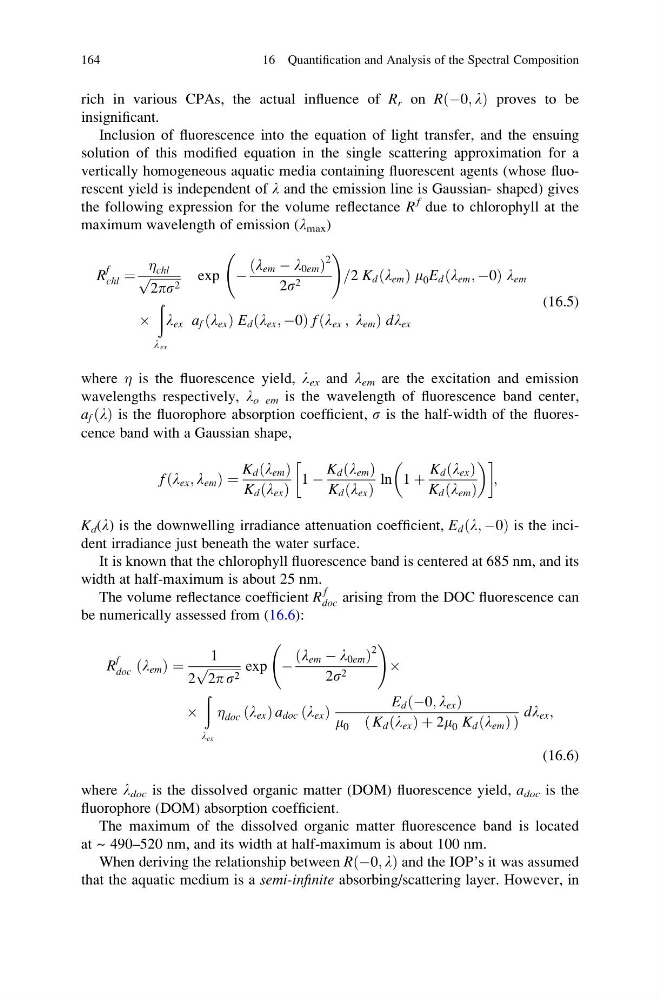
Inclusion of fluorescence into the equation of light transfer, and the ensuing
solution of this modified equation in the single scattering approximation for a
vertically homogeneous aquatic media containing fluorescent agents (whose fluorescent yield is independent of l and the emission line is Gaussian- shaped) gives
the following expression for the volume reflectance R
f due to chlorophyll at the
maximum wavelength of emission (l max )
R
f
chl ¼
chl
ffiffiffiffiffiffiffiffiffiffi
2ps 2
p
exp À
l em À l 0em
ð
Þ
2
2s 2
!
=2 K d l em
ð Þ m 0 E d l em ; À0
ð
Þl em
Â
ð
l ex
l ex a f l ex
ð Þ E d l ex ; À0
ð
Þf l ex ; l em
ð
Þdl ex
(16.5)
where is the fluorescence yield, l ex and l em are the excitation and emission
wavelengths respectively, l o em is the wavelength of fluorescence band center,
a f ðlÞ is the fluorophore absorption coefficient, s is the half-width of the fluorescence band with a Gaussian shape,
f ðl ex ; l em Þ ¼
K d ðl em Þ
K d ðl ex Þ
1 À
K d ðl em Þ
K d ðl ex Þ
ln 1 þ
K d ðl ex Þ
K d ðl em Þ
!
;
K d (l) is the downwelling irradiance attenuation coefficient, E d ðl; À0Þ is the incident irradiance just beneath the water surface.
It is known that the chlorophyll fluorescence band is centered at 685 nm, and its
width at half-maximum is about 25 nm.
The volume reflectance coefficient R
f
doc arising from the DOC fluorescence can
be numerically assessed from (16.6):
R
f
doc l em
ð Þ ¼
1
2
ffiffiffiffiffiffiffiffiffiffi ffi
2p s 2
p
exp À
l em À l 0em
ð
Þ
2
2s 2
!
Â
Â
ð
l ex
doc l ex
ð Þa doc l ex
ð Þ
E d À0; l ex
ð
Þ
m 0
K d l ex
ð Þ þ 2m 0 K d l em
ð Þ
ð
Þ
dl ex ;
(16.6)
where l doc is the dissolved organic matter (DOM) fluorescence yield, a doc is the
fluorophore (DOM) absorption coefficient.
The maximum of the dissolved organic matter fluorescence band is located
at ~ 490–520 nm, and its width at half-maximum is about 100 nm.
When deriving the relationship between RðÀ0; lÞ and the IOP’s it was assumed
that the aquatic medium is a semi-infinite absorbing/scattering layer. However, in
164
16 Quantification and Analysis of the Spectral Composition
insignificant.
Inclusion of fluorescence into the equation of light transfer, and the ensuing
solution of this modified equation in the single scattering approximation for a
vertically homogeneous aquatic media containing fluorescent agents (whose fluorescent yield is independent of l and the emission line is Gaussian- shaped) gives
the following expression for the volume reflectance R
f due to chlorophyll at the
maximum wavelength of emission (l max )
R
f
chl ¼
chl
ffiffiffiffiffiffiffiffiffiffi
2ps 2
p
exp À
l em À l 0em
ð
Þ
2
2s 2
!
=2 K d l em
ð Þ m 0 E d l em ; À0
ð
Þl em
Â
ð
l ex
l ex a f l ex
ð Þ E d l ex ; À0
ð
Þf l ex ; l em
ð
Þdl ex
(16.5)
where is the fluorescence yield, l ex and l em are the excitation and emission
wavelengths respectively, l o em is the wavelength of fluorescence band center,
a f ðlÞ is the fluorophore absorption coefficient, s is the half-width of the fluorescence band with a Gaussian shape,
f ðl ex ; l em Þ ¼
K d ðl em Þ
K d ðl ex Þ
1 À
K d ðl em Þ
K d ðl ex Þ
ln 1 þ
K d ðl ex Þ
K d ðl em Þ
!
;
K d (l) is the downwelling irradiance attenuation coefficient, E d ðl; À0Þ is the incident irradiance just beneath the water surface.
It is known that the chlorophyll fluorescence band is centered at 685 nm, and its
width at half-maximum is about 25 nm.
The volume reflectance coefficient R
f
doc arising from the DOC fluorescence can
be numerically assessed from (16.6):
R
f
doc l em
ð Þ ¼
1
2
ffiffiffiffiffiffiffiffiffiffi ffi
2p s 2
p
exp À
l em À l 0em
ð
Þ
2
2s 2
!
Â
Â
ð
l ex
doc l ex
ð Þa doc l ex
ð Þ
E d À0; l ex
ð
Þ
m 0
K d l ex
ð Þ þ 2m 0 K d l em
ð Þ
ð
Þ
dl ex ;
(16.6)
where l doc is the dissolved organic matter (DOM) fluorescence yield, a doc is the
fluorophore (DOM) absorption coefficient.
The maximum of the dissolved organic matter fluorescence band is located
at ~ 490–520 nm, and its width at half-maximum is about 100 nm.
When deriving the relationship between RðÀ0; lÞ and the IOP’s it was assumed
that the aquatic medium is a semi-infinite absorbing/scattering layer. However, in
164
16 Quantification and Analysis of the Spectral Composition