

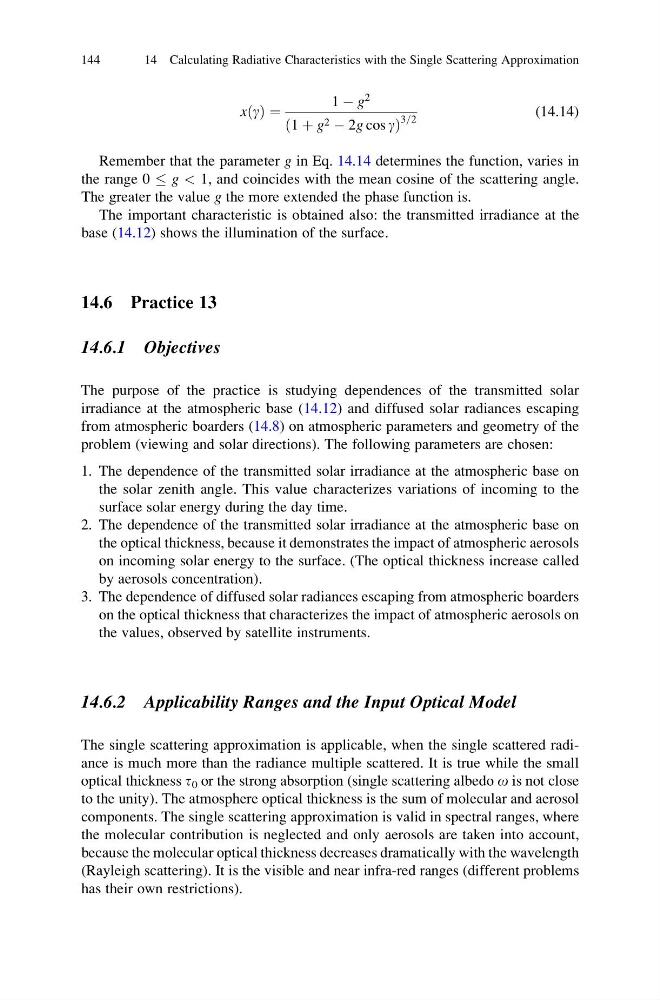
xðgÞ ¼
1 À g
2
ð1 þ g 2 À 2g cos gÞ
3=2
(14.14)
Remember that the parameter g in Eq. 14.14 determines the function, varies in
the range 0 g < 1, and coincides with the mean cosine of the scattering angle.
The greater the value g the more extended the phase function is.
The important characteristic is obtained also: the transmitted irradiance at the
base (14.12) shows the illumination of the surface.
14.6 Practice 13
14.6.1 Objectives
The purpose of the practice is studying dependences of the transmitted solar
irradiance at the atmospheric base (14.12) and diffused solar radiances escaping
from atmospheric boarders (14.8) on atmospheric parameters and geometry of the
problem (viewing and solar directions). The following parameters are chosen:
1. The dependence of the transmitted solar irradiance at the atmospheric base on
the solar zenith angle. This value characterizes variations of incoming to the
surface solar energy during the day time.
2. The dependence of the transmitted solar irradiance at the atmospheric base on
the optical thickness, because it demonstrates the impact of atmospheric aerosols
on incoming solar energy to the surface. (The optical thickness increase called
by aerosols concentration).
3. The dependence of diffused solar radiances escaping from atmospheric boarders
on the optical thickness that characterizes the impact of atmospheric aerosols on
the values, observed by satellite instruments.
14.6.2 Applicability Ranges and the Input Optical Model
The single scattering approximation is applicable, when the single scattered radiance is much more than the radiance multiple scattered. It is true while the small
optical thickness t 0 or the strong absorption (single scattering albedo o is not close
to the unity). The atmosphere optical thickness is the sum of molecular and aerosol
components. The single scattering approximation is valid in spectral ranges, where
the molecular contribution is neglected and only aerosols are taken into account,
because the molecular optical thickness decreases dramatically with the wavelength
(Rayleigh scattering). It is the visible and near infra-red ranges (different problems
has their own restrictions).
144
14 Calculating Radiative Characteristics with the Single Scattering Approximation
1 À g
2
ð1 þ g 2 À 2g cos gÞ
3=2
(14.14)
Remember that the parameter g in Eq. 14.14 determines the function, varies in
the range 0 g < 1, and coincides with the mean cosine of the scattering angle.
The greater the value g the more extended the phase function is.
The important characteristic is obtained also: the transmitted irradiance at the
base (14.12) shows the illumination of the surface.
14.6 Practice 13
14.6.1 Objectives
The purpose of the practice is studying dependences of the transmitted solar
irradiance at the atmospheric base (14.12) and diffused solar radiances escaping
from atmospheric boarders (14.8) on atmospheric parameters and geometry of the
problem (viewing and solar directions). The following parameters are chosen:
1. The dependence of the transmitted solar irradiance at the atmospheric base on
the solar zenith angle. This value characterizes variations of incoming to the
surface solar energy during the day time.
2. The dependence of the transmitted solar irradiance at the atmospheric base on
the optical thickness, because it demonstrates the impact of atmospheric aerosols
on incoming solar energy to the surface. (The optical thickness increase called
by aerosols concentration).
3. The dependence of diffused solar radiances escaping from atmospheric boarders
on the optical thickness that characterizes the impact of atmospheric aerosols on
the values, observed by satellite instruments.
14.6.2 Applicability Ranges and the Input Optical Model
The single scattering approximation is applicable, when the single scattered radiance is much more than the radiance multiple scattered. It is true while the small
optical thickness t 0 or the strong absorption (single scattering albedo o is not close
to the unity). The atmosphere optical thickness is the sum of molecular and aerosol
components. The single scattering approximation is valid in spectral ranges, where
the molecular contribution is neglected and only aerosols are taken into account,
because the molecular optical thickness decreases dramatically with the wavelength
(Rayleigh scattering). It is the visible and near infra-red ranges (different problems
has their own restrictions).
144
14 Calculating Radiative Characteristics with the Single Scattering Approximation