

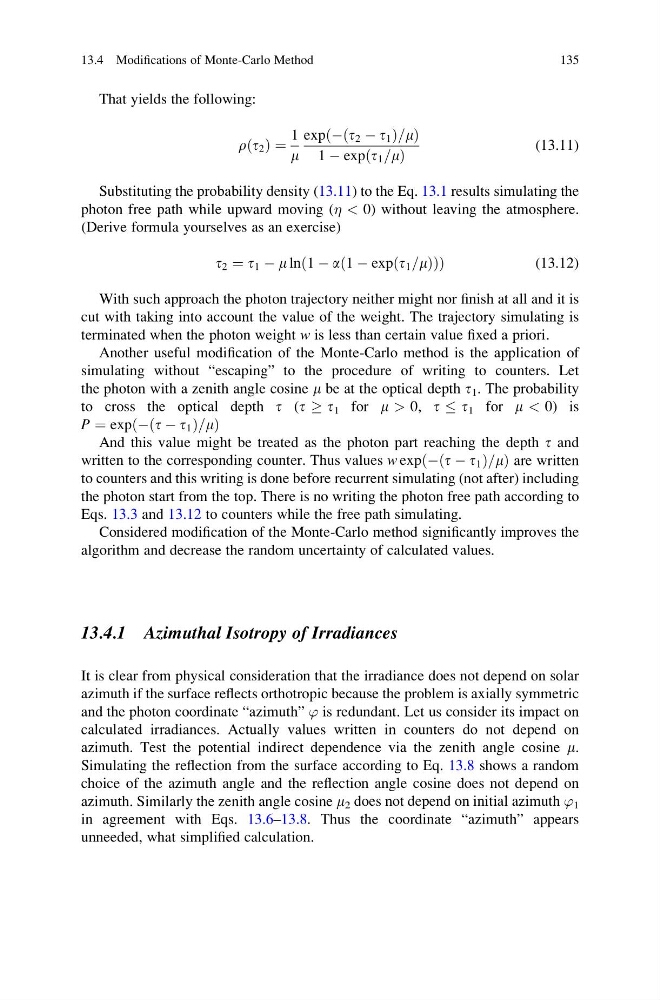
That yields the following:
rðt 2 Þ ¼
1
m
expðÀðt 2 À t 1 Þ=mÞ
1 À expðt 1 =mÞ
(13.11)
Substituting the probability density (13.11) to the Eq. 13.1 results simulating the
photon free path while upward moving ( < 0) without leaving the atmosphere.
(Derive formula yourselves as an exercise)
t 2 ¼ t 1 À m lnð1 À að1 À expðt 1 =mÞÞÞ
(13.12)
With such approach the photon trajectory neither might nor finish at all and it is
cut with taking into account the value of the weight. The trajectory simulating is
terminated when the photon weight w is less than certain value fixed a priori.
Another useful modification of the Monte-Carlo method is the application of
simulating without “escaping” to the procedure of writing to counters. Let
the photon with a zenith angle cosine m be at the optical depth t 1 . The probability
to cross the optical depth t (t ! t 1 for m > 0, t t 1 for m < 0) is
P ¼ expðÀðt À t 1 Þ=mÞ
And this value might be treated as the photon part reaching the depth t and
written to the corresponding counter. Thus values w expðÀðt À t 1 Þ=mÞ are written
to counters and this writing is done before recurrent simulating (not after) including
the photon start from the top. There is no writing the photon free path according to
Eqs. 13.3 and 13.12 to counters while the free path simulating.
Considered modification of the Monte-Carlo method significantly improves the
algorithm and decrease the random uncertainty of calculated values.
13.4.1 Azimuthal Isotropy of Irradiances
It is clear from physical consideration that the irradiance does not depend on solar
azimuth if the surface reflects orthotropic because the problem is axially symmetric
and the photon coordinate “azimuth” ’ is redundant. Let us consider its impact on
calculated irradiances. Actually values written in counters do not depend on
azimuth. Test the potential indirect dependence via the zenith angle cosine m.
Simulating the reflection from the surface according to Eq. 13.8 shows a random
choice of the azimuth angle and the reflection angle cosine does not depend on
azimuth. Similarly the zenith angle cosine m 2 does not depend on initial azimuth ’ 1
in agreement with Eqs. 13.6–13.8. Thus the coordinate “azimuth” appears
unneeded, what simplified calculation.
13.4 Modifications of Monte-Carlo Method
135
rðt 2 Þ ¼
1
m
expðÀðt 2 À t 1 Þ=mÞ
1 À expðt 1 =mÞ
(13.11)
Substituting the probability density (13.11) to the Eq. 13.1 results simulating the
photon free path while upward moving ( < 0) without leaving the atmosphere.
(Derive formula yourselves as an exercise)
t 2 ¼ t 1 À m lnð1 À að1 À expðt 1 =mÞÞÞ
(13.12)
With such approach the photon trajectory neither might nor finish at all and it is
cut with taking into account the value of the weight. The trajectory simulating is
terminated when the photon weight w is less than certain value fixed a priori.
Another useful modification of the Monte-Carlo method is the application of
simulating without “escaping” to the procedure of writing to counters. Let
the photon with a zenith angle cosine m be at the optical depth t 1 . The probability
to cross the optical depth t (t ! t 1 for m > 0, t t 1 for m < 0) is
P ¼ expðÀðt À t 1 Þ=mÞ
And this value might be treated as the photon part reaching the depth t and
written to the corresponding counter. Thus values w expðÀðt À t 1 Þ=mÞ are written
to counters and this writing is done before recurrent simulating (not after) including
the photon start from the top. There is no writing the photon free path according to
Eqs. 13.3 and 13.12 to counters while the free path simulating.
Considered modification of the Monte-Carlo method significantly improves the
algorithm and decrease the random uncertainty of calculated values.
13.4.1 Azimuthal Isotropy of Irradiances
It is clear from physical consideration that the irradiance does not depend on solar
azimuth if the surface reflects orthotropic because the problem is axially symmetric
and the photon coordinate “azimuth” ’ is redundant. Let us consider its impact on
calculated irradiances. Actually values written in counters do not depend on
azimuth. Test the potential indirect dependence via the zenith angle cosine m.
Simulating the reflection from the surface according to Eq. 13.8 shows a random
choice of the azimuth angle and the reflection angle cosine does not depend on
azimuth. Similarly the zenith angle cosine m 2 does not depend on initial azimuth ’ 1
in agreement with Eqs. 13.6–13.8. Thus the coordinate “azimuth” appears
unneeded, what simplified calculation.
13.4 Modifications of Monte-Carlo Method
135