

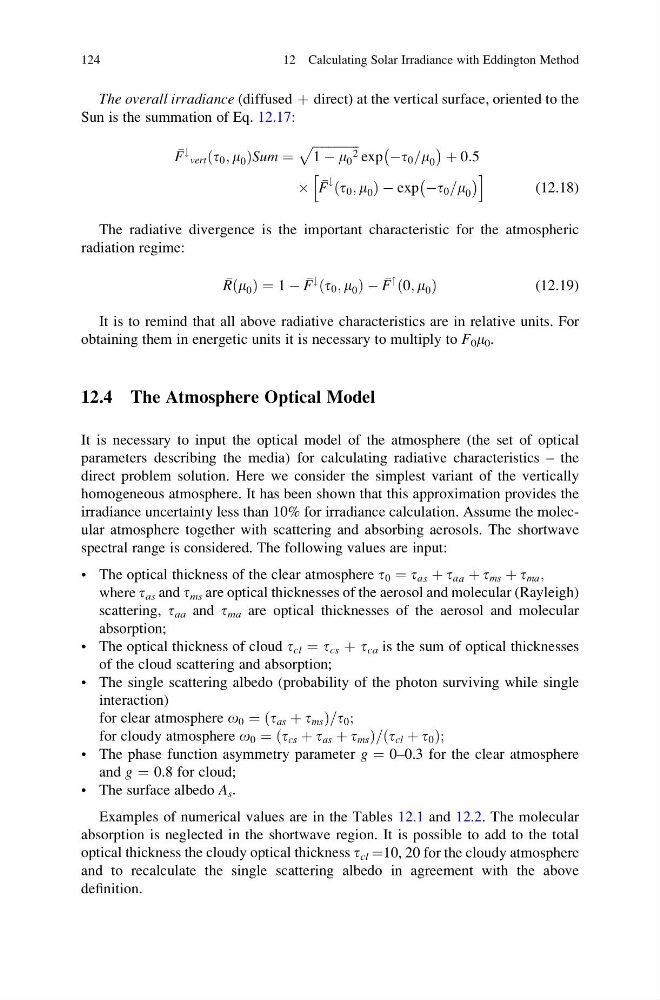
The overall irradiance (diffused þ direct) at the vertical surface, oriented to the
Sun is the summation of Eq. 12.17:
F
#
vert ðt 0 ; m 0 ÞSum ¼
ffiffiffiffiffiffiffiffiffiffiffiffiffiffiffi
1 À m 0
2
p
exp Àt 0 m
= 0
À
Á þ 0:5
Â
F
# ðt 0 ; m 0 Þ À exp Àt 0 m
= 0
À
Á
h
i
(12.18)
The radiative divergence is the important characteristic for the atmospheric
radiation regime:
Rðm 0 Þ ¼ 1 À
F
#
ðt 0 ; m 0 Þ À
F
"
ð0; m 0 Þ
(12.19)
It is to remind that all above radiative characteristics are in relative units. For
obtaining them in energetic units it is necessary to multiply to F 0 m 0 .
12.4 The Atmosphere Optical Model
It is necessary to input the optical model of the atmosphere (the set of optical
parameters describing the media) for calculating radiative characteristics – the
direct problem solution. Here we consider the simplest variant of the vertically
homogeneous atmosphere. It has been shown that this approximation provides the
irradiance uncertainty less than 10% for irradiance calculation. Assume the molecular atmosphere together with scattering and absorbing aerosols. The shortwave
spectral range is considered. The following values are input:
• The optical thickness of the clear atmosphere t 0 ¼ t as þ t aa þ t ms þ t ma ;
where t as and t ms are optical thicknesses of the aerosol and molecular (Rayleigh)
scattering, t aa and t ma are optical thicknesses of the aerosol and molecular
absorption;
• The optical thickness of cloud t cl ¼ t cs þ t ca is the sum of optical thicknesses
of the cloud scattering and absorption;
• The single scattering albedo (probability of the photon surviving while single
interaction)
for clear atmosphere o 0 ¼ ðt as þ t ms Þ=t 0 ;
for cloudy atmosphere o 0 ¼ ðt cs þ t as þ t ms Þ=ðt cl þ t 0 Þ;
• The phase function asymmetry parameter g ¼ 0–0.3 for the clear atmosphere
and g ¼ 0.8 for cloud;
• The surface albedo A s .
Examples of numerical values are in the Tables 12.1 and 12.2. The molecular
absorption is neglected in the shortwave region. It is possible to add to the total
optical thickness the cloudy optical thickness t cl ¼10, 20 for the cloudy atmosphere
and to recalculate the single scattering albedo in agreement with the above
definition.
124
12 Calculating Solar Irradiance with Eddington Method
Sun is the summation of Eq. 12.17:
F
#
vert ðt 0 ; m 0 ÞSum ¼
ffiffiffiffiffiffiffiffiffiffiffiffiffiffiffi
1 À m 0
2
p
exp Àt 0 m
= 0
À
Á þ 0:5
Â
F
# ðt 0 ; m 0 Þ À exp Àt 0 m
= 0
À
Á
h
i
(12.18)
The radiative divergence is the important characteristic for the atmospheric
radiation regime:
Rðm 0 Þ ¼ 1 À
F
#
ðt 0 ; m 0 Þ À
F
"
ð0; m 0 Þ
(12.19)
It is to remind that all above radiative characteristics are in relative units. For
obtaining them in energetic units it is necessary to multiply to F 0 m 0 .
12.4 The Atmosphere Optical Model
It is necessary to input the optical model of the atmosphere (the set of optical
parameters describing the media) for calculating radiative characteristics – the
direct problem solution. Here we consider the simplest variant of the vertically
homogeneous atmosphere. It has been shown that this approximation provides the
irradiance uncertainty less than 10% for irradiance calculation. Assume the molecular atmosphere together with scattering and absorbing aerosols. The shortwave
spectral range is considered. The following values are input:
• The optical thickness of the clear atmosphere t 0 ¼ t as þ t aa þ t ms þ t ma ;
where t as and t ms are optical thicknesses of the aerosol and molecular (Rayleigh)
scattering, t aa and t ma are optical thicknesses of the aerosol and molecular
absorption;
• The optical thickness of cloud t cl ¼ t cs þ t ca is the sum of optical thicknesses
of the cloud scattering and absorption;
• The single scattering albedo (probability of the photon surviving while single
interaction)
for clear atmosphere o 0 ¼ ðt as þ t ms Þ=t 0 ;
for cloudy atmosphere o 0 ¼ ðt cs þ t as þ t ms Þ=ðt cl þ t 0 Þ;
• The phase function asymmetry parameter g ¼ 0–0.3 for the clear atmosphere
and g ¼ 0.8 for cloud;
• The surface albedo A s .
Examples of numerical values are in the Tables 12.1 and 12.2. The molecular
absorption is neglected in the shortwave region. It is possible to add to the total
optical thickness the cloudy optical thickness t cl ¼10, 20 for the cloudy atmosphere
and to recalculate the single scattering albedo in agreement with the above
definition.
124
12 Calculating Solar Irradiance with Eddington Method