

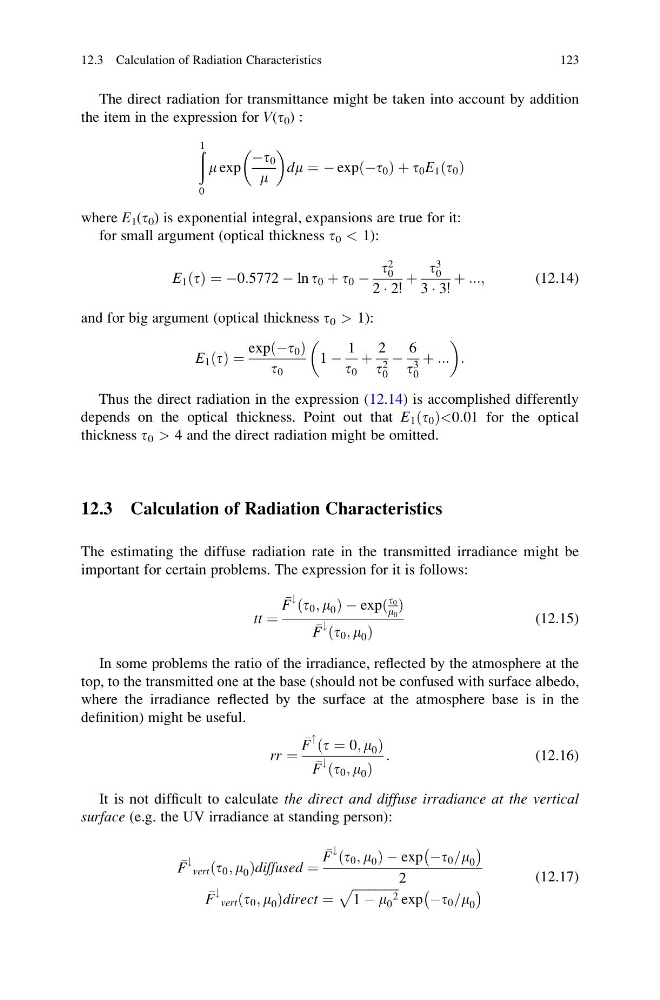
The direct radiation for transmittance might be taken into account by addition
the item in the expression for V(t 0 ) :
ð 1
0
m exp
Àt 0
m
dm ¼ À expðÀt 0 Þ þ t 0 E 1 ðt 0 Þ
where E 1 (t 0 ) is exponential integral, expansions are true for it:
for small argument (optical thickness t 0 < 1):
E 1 ðtÞ ¼ À0:5772 À ln t 0 þ t 0 À
t
2
0
2 Á 2!
þ
t
3
0
3 Á 3!
þ :::;
(12.14)
and for big argument (optical thickness t 0 > 1):
E 1 ðtÞ ¼
expðÀt 0 Þ
t 0
1 À
1
t 0
þ
2
t 2
0
À
6
t
3
0
þ :::
:
Thus the direct radiation in the expression (12.14) is accomplished differently
depends on the optical thickness. Point out that E 1 ðt 0 Þ<0:01 for the optical
thickness t 0 > 4 and the direct radiation might be omitted.
12.3 Calculation of Radiation Characteristics
The estimating the diffuse radiation rate in the transmitted irradiance might be
important for certain problems. The expression for it is follows:
tt ¼
F
# ðt 0 ; m 0 Þ À expð
t0
m 0
Þ
F
# ðt 0 ; m 0 Þ
(12.15)
In some problems the ratio of the irradiance, reflected by the atmosphere at the
top, to the transmitted one at the base (should not be confused with surface albedo,
where the irradiance reflected by the surface at the atmosphere base is in the
definition) might be useful.
rr ¼
F
" ðt ¼ 0; m 0 Þ
F
# ðt 0 ; m 0 Þ
:
(12.16)
It is not difficult to calculate the direct and diffuse irradiance at the vertical
surface (e.g. the UV irradiance at standing person):
F
#
vert ðt 0 ; m 0 Þdiffused ¼
F
# ðt 0 ; m 0 Þ À exp Àt 0 m
= 0
À
Á
2
F
#
vert ðt 0 ; m 0 Þdirect ¼
ffiffiffiffiffiffiffiffiffiffiffiffiffiffiffi
1 À m 0
2
p
exp Àt 0 m
= 0
À
Á
(12.17)
12.3 Calculation of Radiation Characteristics
123
the item in the expression for V(t 0 ) :
ð 1
0
m exp
Àt 0
m
dm ¼ À expðÀt 0 Þ þ t 0 E 1 ðt 0 Þ
where E 1 (t 0 ) is exponential integral, expansions are true for it:
for small argument (optical thickness t 0 < 1):
E 1 ðtÞ ¼ À0:5772 À ln t 0 þ t 0 À
t
2
0
2 Á 2!
þ
t
3
0
3 Á 3!
þ :::;
(12.14)
and for big argument (optical thickness t 0 > 1):
E 1 ðtÞ ¼
expðÀt 0 Þ
t 0
1 À
1
t 0
þ
2
t 2
0
À
6
t
3
0
þ :::
:
Thus the direct radiation in the expression (12.14) is accomplished differently
depends on the optical thickness. Point out that E 1 ðt 0 Þ<0:01 for the optical
thickness t 0 > 4 and the direct radiation might be omitted.
12.3 Calculation of Radiation Characteristics
The estimating the diffuse radiation rate in the transmitted irradiance might be
important for certain problems. The expression for it is follows:
tt ¼
F
# ðt 0 ; m 0 Þ À expð
t0
m 0
Þ
F
# ðt 0 ; m 0 Þ
(12.15)
In some problems the ratio of the irradiance, reflected by the atmosphere at the
top, to the transmitted one at the base (should not be confused with surface albedo,
where the irradiance reflected by the surface at the atmosphere base is in the
definition) might be useful.
rr ¼
F
" ðt ¼ 0; m 0 Þ
F
# ðt 0 ; m 0 Þ
:
(12.16)
It is not difficult to calculate the direct and diffuse irradiance at the vertical
surface (e.g. the UV irradiance at standing person):
F
#
vert ðt 0 ; m 0 Þdiffused ¼
F
# ðt 0 ; m 0 Þ À exp Àt 0 m
= 0
À
Á
2
F
#
vert ðt 0 ; m 0 Þdirect ¼
ffiffiffiffiffiffiffiffiffiffiffiffiffiffiffi
1 À m 0
2
p
exp Àt 0 m
= 0
À
Á
(12.17)
12.3 Calculation of Radiation Characteristics
123