

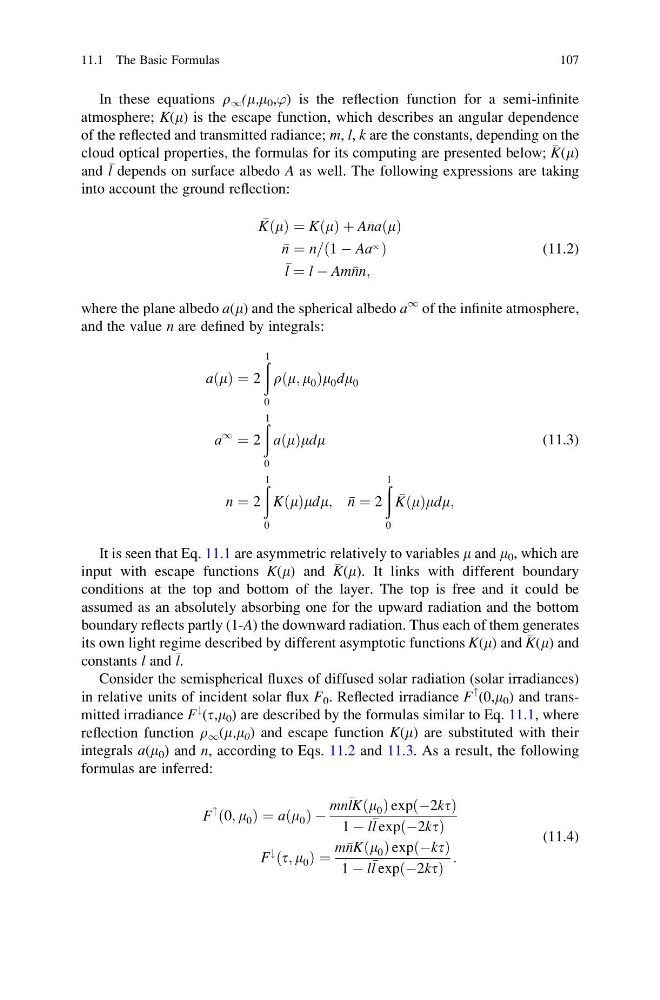
In these equations r 1 (m,m 0 ,’) is the reflection function for a semi-infinite
atmosphere; K(m) is the escape function, which describes an angular dependence
of the reflected and transmitted radiance; m, l, k are the constants, depending on the
cloud optical properties, the formulas for its computing are presented below;
K(m)
and
l depends on surface albedo A as well. The following expressions are taking
into account the ground reflection:
KðmÞ ¼ KðmÞ þ A naðmÞ
n ¼ n ð1 À Aa
1
Þ
=
l ¼ l À Am nn;
(11.2)
where the plane albedo a(m) and the spherical albedo a
1 of the infinite atmosphere,
and the value n are defined by integrals:
aðmÞ ¼ 2
ð 1
0
rðm; m 0 Þm 0 dm 0
a
1
¼ 2
ð 1
0
aðmÞmdm
n ¼ 2
ð 1
0
KðmÞmdm;
n ¼ 2
ð 1
0
KðmÞmdm;
(11.3)
It is seen that Eq. 11.1 are asymmetric relatively to variables m and m 0 , which are
input with escape functions K(m) and
K(m). It links with different boundary
conditions at the top and bottom of the layer. The top is free and it could be
assumed as an absolutely absorbing one for the upward radiation and the bottom
boundary reflects partly (1-A) the downward radiation. Thus each of them generates
its own light regime described by different asymptotic functions K(m) and
K(m) and
constants l and l.
Consider the semispherical fluxes of diffused solar radiation (solar irradiances)
in relative units of incident solar flux F 0 . Reflected irradiance F
"
(0,m 0 ) and transmitted irradiance F
#
(t,m 0 ) are described by the formulas similar to Eq. 11.1, where
reflection function r 1 (m,m 0 ) and escape function K(m) are substituted with their
integrals a(m 0 ) and n, according to Eqs. 11.2 and 11.3. As a result, the following
formulas are inferred:
F
"
ð0; m 0 Þ ¼ aðm 0 Þ À
mn
lKðm 0 Þ expðÀ2ktÞ
1 À l
l expðÀ2ktÞ
F
#
ðt; m 0 Þ ¼
m nKðm 0 Þ expðÀktÞ
1 À l
l expðÀ2ktÞ
:
(11.4)
11.1 The Basic Formulas
107
atmosphere; K(m) is the escape function, which describes an angular dependence
of the reflected and transmitted radiance; m, l, k are the constants, depending on the
cloud optical properties, the formulas for its computing are presented below;
K(m)
and
l depends on surface albedo A as well. The following expressions are taking
into account the ground reflection:
KðmÞ ¼ KðmÞ þ A naðmÞ
n ¼ n ð1 À Aa
1
Þ
=
l ¼ l À Am nn;
(11.2)
where the plane albedo a(m) and the spherical albedo a
1 of the infinite atmosphere,
and the value n are defined by integrals:
aðmÞ ¼ 2
ð 1
0
rðm; m 0 Þm 0 dm 0
a
1
¼ 2
ð 1
0
aðmÞmdm
n ¼ 2
ð 1
0
KðmÞmdm;
n ¼ 2
ð 1
0
KðmÞmdm;
(11.3)
It is seen that Eq. 11.1 are asymmetric relatively to variables m and m 0 , which are
input with escape functions K(m) and
K(m). It links with different boundary
conditions at the top and bottom of the layer. The top is free and it could be
assumed as an absolutely absorbing one for the upward radiation and the bottom
boundary reflects partly (1-A) the downward radiation. Thus each of them generates
its own light regime described by different asymptotic functions K(m) and
K(m) and
constants l and l.
Consider the semispherical fluxes of diffused solar radiation (solar irradiances)
in relative units of incident solar flux F 0 . Reflected irradiance F
"
(0,m 0 ) and transmitted irradiance F
#
(t,m 0 ) are described by the formulas similar to Eq. 11.1, where
reflection function r 1 (m,m 0 ) and escape function K(m) are substituted with their
integrals a(m 0 ) and n, according to Eqs. 11.2 and 11.3. As a result, the following
formulas are inferred:
F
"
ð0; m 0 Þ ¼ aðm 0 Þ À
mn
lKðm 0 Þ expðÀ2ktÞ
1 À l
l expðÀ2ktÞ
F
#
ðt; m 0 Þ ¼
m nKðm 0 Þ expðÀktÞ
1 À l
l expðÀ2ktÞ
:
(11.4)
11.1 The Basic Formulas
107