

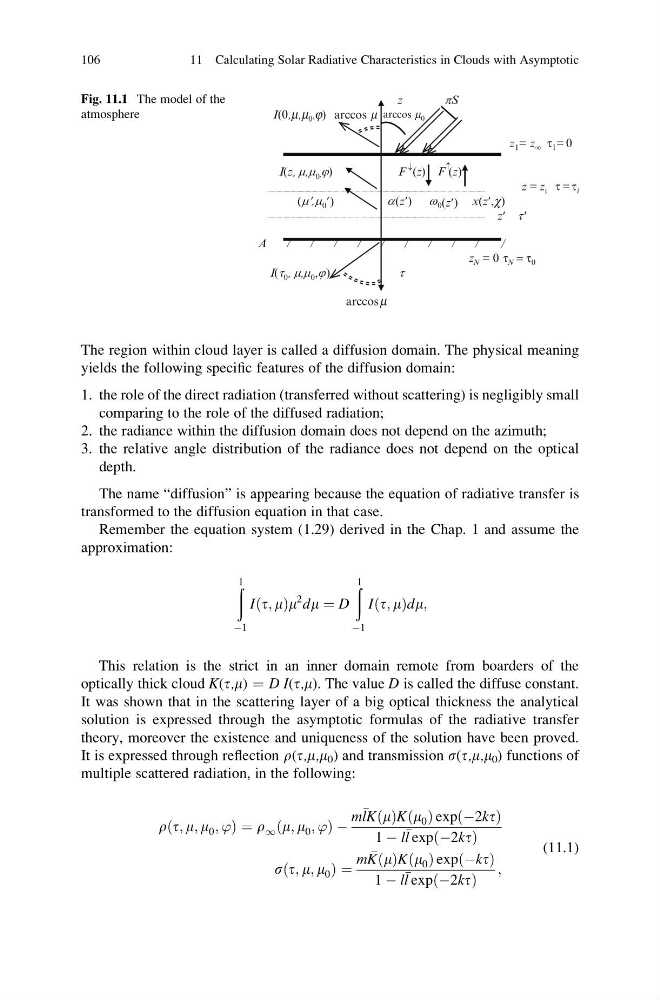
The region within cloud layer is called a diffusion domain. The physical meaning
yields the following specific features of the diffusion domain:
1. the role of the direct radiation (transferred without scattering) is negligibly small
comparing to the role of the diffused radiation;
2. the radiance within the diffusion domain does not depend on the azimuth;
3. the relative angle distribution of the radiance does not depend on the optical
depth.
The name “diffusion” is appearing because the equation of radiative transfer is
transformed to the diffusion equation in that case.
Remember the equation system (1.29) derived in the Chap. 1 and assume the
approximation:
ð 1
À1
Iðt; mÞm
2 dm ¼ D
ð 1
À1
Iðt; mÞdm;
This relation is the strict in an inner domain remote from boarders of the
optically thick cloud K(t,m) ¼ D I(t,m). The value D is called the diffuse constant.
It was shown that in the scattering layer of a big optical thickness the analytical
solution is expressed through the asymptotic formulas of the radiative transfer
theory, moreover the existence and uniqueness of the solution have been proved.
It is expressed through reflection r(t,m,m 0 ) and transmission s(t,m,m 0 ) functions of
multiple scattered radiation, in the following:
rðt; m; m 0 ; ’Þ ¼ r 1 ðm; m 0 ; ’Þ À
m
lKðmÞKðm 0 Þ expðÀ2ktÞ
1 À l
l expðÀ2ktÞ
sðt; m; m 0 Þ ¼
m
KðmÞKðm 0 Þ expðÀktÞ
1 À l
l expðÀ2ktÞ
;
(11.1)
z
pS
I(0,m,m 0 ,j) arccos m arccos m 0
z 1 = z ¥ t 1 = 0
I(z, m,m 0 , j)
F
¯
¯
(z) F (z)
z = z i t = t i
0
(
(
m¢,m ¢
a(z¢) w 0(z¢) x(z¢,c)
z¢ t ¢
A
/
/
/
/
/
/
/
/
/
/
z N = 0 t N = t 0
I(t 0 , m,m 0 ,j)
t
arccos m
Fig. 11.1 The model of the
atmosphere
106
11 Calculating Solar Radiative Characteristics in Clouds with Asymptotic
yields the following specific features of the diffusion domain:
1. the role of the direct radiation (transferred without scattering) is negligibly small
comparing to the role of the diffused radiation;
2. the radiance within the diffusion domain does not depend on the azimuth;
3. the relative angle distribution of the radiance does not depend on the optical
depth.
The name “diffusion” is appearing because the equation of radiative transfer is
transformed to the diffusion equation in that case.
Remember the equation system (1.29) derived in the Chap. 1 and assume the
approximation:
ð 1
À1
Iðt; mÞm
2 dm ¼ D
ð 1
À1
Iðt; mÞdm;
This relation is the strict in an inner domain remote from boarders of the
optically thick cloud K(t,m) ¼ D I(t,m). The value D is called the diffuse constant.
It was shown that in the scattering layer of a big optical thickness the analytical
solution is expressed through the asymptotic formulas of the radiative transfer
theory, moreover the existence and uniqueness of the solution have been proved.
It is expressed through reflection r(t,m,m 0 ) and transmission s(t,m,m 0 ) functions of
multiple scattered radiation, in the following:
rðt; m; m 0 ; ’Þ ¼ r 1 ðm; m 0 ; ’Þ À
m
lKðmÞKðm 0 Þ expðÀ2ktÞ
1 À l
l expðÀ2ktÞ
sðt; m; m 0 Þ ¼
m
KðmÞKðm 0 Þ expðÀktÞ
1 À l
l expðÀ2ktÞ
;
(11.1)
z
pS
I(0,m,m 0 ,j) arccos m arccos m 0
z 1 = z ¥ t 1 = 0
I(z, m,m 0 , j)
F
¯
¯
(z) F (z)
z = z i t = t i
0
(
(
m¢,m ¢
a(z¢) w 0(z¢) x(z¢,c)
z¢ t ¢
A
/
/
/
/
/
/
/
/
/
/
z N = 0 t N = t 0
I(t 0 , m,m 0 ,j)
t
arccos m
Fig. 11.1 The model of the
atmosphere
106
11 Calculating Solar Radiative Characteristics in Clouds with Asymptotic