

dependence T(x) is not an analytical function, however it is possible to specify with a
finite set of values (about 40–50 values) at certain altitudinal levels. At some
geographical sites there are data of aerologic soundings. It is clear that it is impossible to obtain 40 values of the function from one value (observational data). Thus it is
necessary to accomplish 40 observations at different spectral channels. Assume for
the solution the following:
1. Let’s consider that the surface temperature T s is obtained from observations at
the quasi-transparent spectral regions that lie between the major line clusters and
called windows;
2. There is a geographical bridging of satellite observational site and the surface
emissivity e n is known for the specific surface;
3. It is necessary to know the transmission function P(x), it is possible if the
radiation is measured at CO 2 bands because its concentration does not vary
and CO 2 profile is known. CO 2 bands correspond to spectral intervals 2, 3.7, 4.3,
6.3, 8, 12 and 15 mm. It is to choose wave numbers in such a way as to embrace
three spectral diapasons with strong, medium, and weak absorption for obtaining
the temperature T(x) at different altitudes.
The unknown function T(x) is included in the Planck’s function under the
integral, thus it is demanded to factor the Planck’s function outside the integral
sign. It is more effective to find the deviation of the temperature from the average
value at every altitudinal level x.
DTðxÞ ¼ TðxÞ À TðxÞ;
(9.2)
where
T(x) is the average temperature profile obtained from long-standing aerologic
observations.
After writing the Eq. 9.1 for the average temperature profile
T(x) and considering
the difference DT(x) functions might be expanded into a Taylor series over small
values DT(x). Then the equation might be derived after keeping only the first item in
the expansion and neglecting items with higher power.
DJ v
"
¼ J v
"
À J v
" ffi
ð
zP
0
@B
@T
T¼TðxÞ
DTðxÞ
@P n x; top;y
ð
Þ
@x
dx;
(9.3)
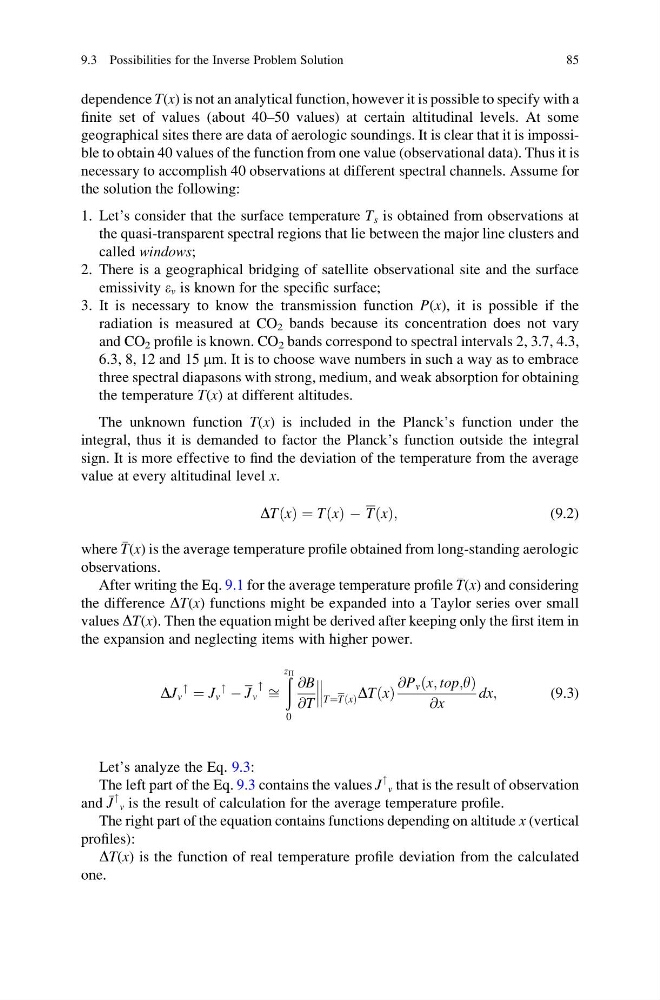
Let’s analyze the Eq. 9.3:
The left part of the Eq. 9.3 contains the values J
"
n that is the result of observation
and
J
"
n is the result of calculation for the average temperature profile.
The right part of the equation contains functions depending on altitude x (vertical
profiles):
DT(x) is the function of real temperature profile deviation from the calculated
one.
9.3 Possibilities for the Inverse Problem Solution
85
finite set of values (about 40–50 values) at certain altitudinal levels. At some
geographical sites there are data of aerologic soundings. It is clear that it is impossible to obtain 40 values of the function from one value (observational data). Thus it is
necessary to accomplish 40 observations at different spectral channels. Assume for
the solution the following:
1. Let’s consider that the surface temperature T s is obtained from observations at
the quasi-transparent spectral regions that lie between the major line clusters and
called windows;
2. There is a geographical bridging of satellite observational site and the surface
emissivity e n is known for the specific surface;
3. It is necessary to know the transmission function P(x), it is possible if the
radiation is measured at CO 2 bands because its concentration does not vary
and CO 2 profile is known. CO 2 bands correspond to spectral intervals 2, 3.7, 4.3,
6.3, 8, 12 and 15 mm. It is to choose wave numbers in such a way as to embrace
three spectral diapasons with strong, medium, and weak absorption for obtaining
the temperature T(x) at different altitudes.
The unknown function T(x) is included in the Planck’s function under the
integral, thus it is demanded to factor the Planck’s function outside the integral
sign. It is more effective to find the deviation of the temperature from the average
value at every altitudinal level x.
DTðxÞ ¼ TðxÞ À TðxÞ;
(9.2)
where
T(x) is the average temperature profile obtained from long-standing aerologic
observations.
After writing the Eq. 9.1 for the average temperature profile
T(x) and considering
the difference DT(x) functions might be expanded into a Taylor series over small
values DT(x). Then the equation might be derived after keeping only the first item in
the expansion and neglecting items with higher power.
DJ v
"
¼ J v
"
À J v
" ffi
ð
zP
0
@B
@T
T¼TðxÞ
DTðxÞ
@P n x; top;y
ð
Þ
@x
dx;
(9.3)
Let’s analyze the Eq. 9.3:
The left part of the Eq. 9.3 contains the values J
"
n that is the result of observation
and
J
"
n is the result of calculation for the average temperature profile.
The right part of the equation contains functions depending on altitude x (vertical
profiles):
DT(x) is the function of real temperature profile deviation from the calculated
one.
9.3 Possibilities for the Inverse Problem Solution
85