

LiDAR bathymetric data were used to calculate the volume of water in the
upper 0.5 m of the water column in the study area. The data were first resampled to
the same resolution as the image mosaic (Fig. 2.7b). For depths greater than 0.5 m,
the data were truncated to create a false bottom, thus representing the top 0.5 m of
the water column. Standard GIS raster calculations were used to create a layer
representing the volume of water per pixel (Fig. 2.7c). The SSC layer was divided
pixel-by-pixel by the Water Volume layer to determine the mass of sediment in the
upper 0.5 m water column per pixel (Fig. 2.7d). By summing all the pixels in the
sediment mass layer, calculations showed a total of nearly 120 kg of suspended
sediment in the upper 0.5 m of the water column in the study area (covering nearly
10 km
2 ), with an average concentration of 13.4 mg/L. This has important implications, as concentrations greater than 10 mg/L have been shown to be deleterious
to coral reef systems (Rogers 1990).
The combination of aerial imagery and in situ sampling provides a method to
calculate the concentration and total mass of suspended sediment in the upper
water column and has particular application for creating ‘‘snap-shots’’ of turbidity
levels on remote or large reef tracts. Note that this approach allows interpolation of
SSC from a limited number of in situ measurements, and that different image band
combinations may work better in different study areas or seasons and should be
tested accordingly. Comparison of levels and distribution of SSC from two different time periods also provides a potential technique for monitoring long-term
changes.
l
l
l
l
l
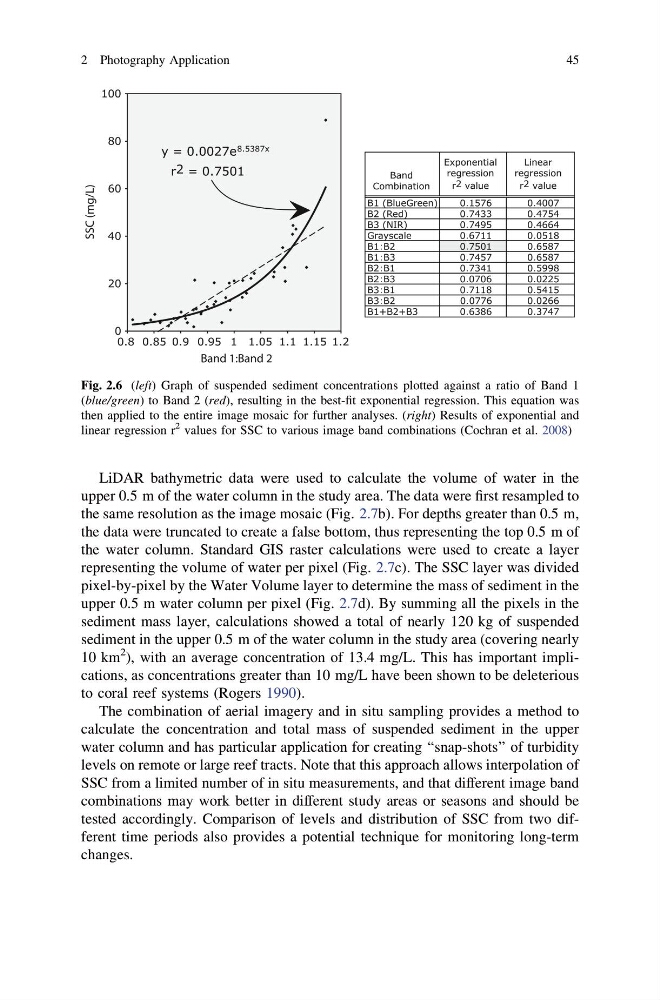
Fig. 2.6 (left) Graph of suspended sediment concentrations plotted against a ratio of Band 1
(blue/green) to Band 2 (red), resulting in the best-fit exponential regression. This equation was
then applied to the entire image mosaic for further analyses. (right) Results of exponential and
linear regression r
2 values for SSC to various image band combinations (Cochran et al. 2008)
2 Photography Application
45
upper 0.5 m of the water column in the study area. The data were first resampled to
the same resolution as the image mosaic (Fig. 2.7b). For depths greater than 0.5 m,
the data were truncated to create a false bottom, thus representing the top 0.5 m of
the water column. Standard GIS raster calculations were used to create a layer
representing the volume of water per pixel (Fig. 2.7c). The SSC layer was divided
pixel-by-pixel by the Water Volume layer to determine the mass of sediment in the
upper 0.5 m water column per pixel (Fig. 2.7d). By summing all the pixels in the
sediment mass layer, calculations showed a total of nearly 120 kg of suspended
sediment in the upper 0.5 m of the water column in the study area (covering nearly
10 km
2 ), with an average concentration of 13.4 mg/L. This has important implications, as concentrations greater than 10 mg/L have been shown to be deleterious
to coral reef systems (Rogers 1990).
The combination of aerial imagery and in situ sampling provides a method to
calculate the concentration and total mass of suspended sediment in the upper
water column and has particular application for creating ‘‘snap-shots’’ of turbidity
levels on remote or large reef tracts. Note that this approach allows interpolation of
SSC from a limited number of in situ measurements, and that different image band
combinations may work better in different study areas or seasons and should be
tested accordingly. Comparison of levels and distribution of SSC from two different time periods also provides a potential technique for monitoring long-term
changes.
l
l
l
l
l
Fig. 2.6 (left) Graph of suspended sediment concentrations plotted against a ratio of Band 1
(blue/green) to Band 2 (red), resulting in the best-fit exponential regression. This equation was
then applied to the entire image mosaic for further analyses. (right) Results of exponential and
linear regression r
2 values for SSC to various image band combinations (Cochran et al. 2008)
2 Photography Application
45