

commonly followed in coral reef remote sensing applications, as indicated by the
literature review results presented later in this chapter.
With respect to the spatial distribution of sample units, in order to have a
random selection of independent samples, a procedure needs to be applied to
assure that the different mapping categories in a given study area have equal
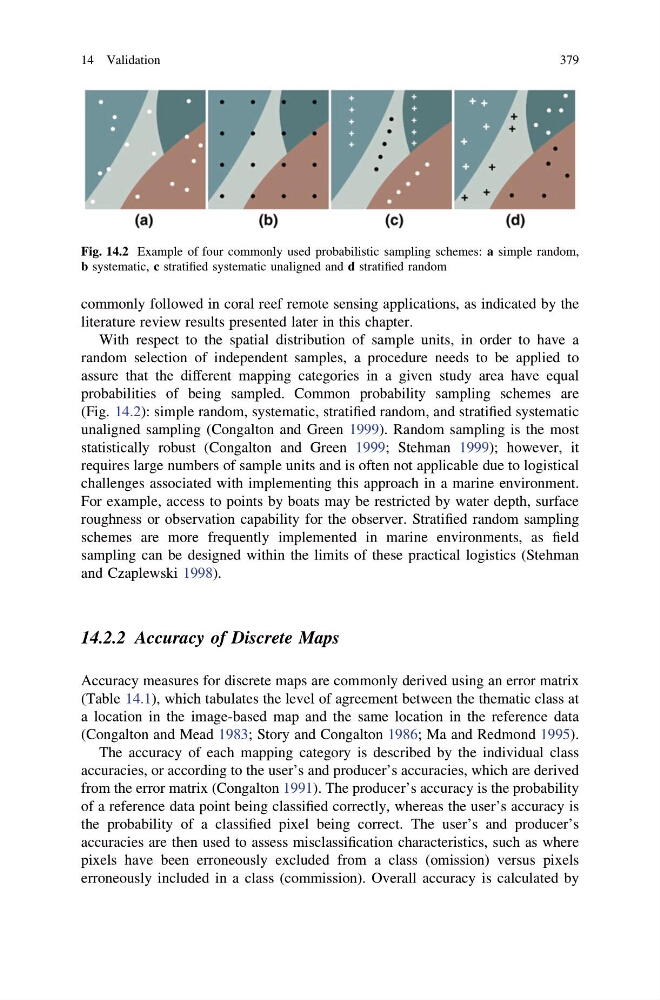
probabilities of being sampled. Common probability sampling schemes are
(Fig. 14.2): simple random, systematic, stratified random, and stratified systematic
unaligned sampling (Congalton and Green 1999). Random sampling is the most
statistically robust (Congalton and Green 1999; Stehman 1999); however, it
requires large numbers of sample units and is often not applicable due to logistical
challenges associated with implementing this approach in a marine environment.
For example, access to points by boats may be restricted by water depth, surface
roughness or observation capability for the observer. Stratified random sampling
schemes are more frequently implemented in marine environments, as field
sampling can be designed within the limits of these practical logistics (Stehman
and Czaplewski 1998).
14.2.2 Accuracy of Discrete Maps
Accuracy measures for discrete maps are commonly derived using an error matrix
(Table 14.1), which tabulates the level of agreement between the thematic class at
a location in the image-based map and the same location in the reference data
(Congalton and Mead 1983; Story and Congalton 1986; Ma and Redmond 1995).
The accuracy of each mapping category is described by the individual class
accuracies, or according to the user’s and producer’s accuracies, which are derived
from the error matrix (Congalton 1991). The producer’s accuracy is the probability
of a reference data point being classified correctly, whereas the user’s accuracy is
the probability of a classified pixel being correct. The user’s and producer’s
accuracies are then used to assess misclassification characteristics, such as where
pixels have been erroneously excluded from a class (omission) versus pixels
erroneously included in a class (commission). Overall accuracy is calculated by
Fig. 14.2 Example of four commonly used probabilistic sampling schemes: a simple random,
b systematic, c stratified systematic unaligned and d stratified random
14 Validation
379
literature review results presented later in this chapter.
With respect to the spatial distribution of sample units, in order to have a
random selection of independent samples, a procedure needs to be applied to
assure that the different mapping categories in a given study area have equal
probabilities of being sampled. Common probability sampling schemes are
(Fig. 14.2): simple random, systematic, stratified random, and stratified systematic
unaligned sampling (Congalton and Green 1999). Random sampling is the most
statistically robust (Congalton and Green 1999; Stehman 1999); however, it
requires large numbers of sample units and is often not applicable due to logistical
challenges associated with implementing this approach in a marine environment.
For example, access to points by boats may be restricted by water depth, surface
roughness or observation capability for the observer. Stratified random sampling
schemes are more frequently implemented in marine environments, as field
sampling can be designed within the limits of these practical logistics (Stehman
and Czaplewski 1998).
14.2.2 Accuracy of Discrete Maps
Accuracy measures for discrete maps are commonly derived using an error matrix
(Table 14.1), which tabulates the level of agreement between the thematic class at
a location in the image-based map and the same location in the reference data
(Congalton and Mead 1983; Story and Congalton 1986; Ma and Redmond 1995).
The accuracy of each mapping category is described by the individual class
accuracies, or according to the user’s and producer’s accuracies, which are derived
from the error matrix (Congalton 1991). The producer’s accuracy is the probability
of a reference data point being classified correctly, whereas the user’s accuracy is
the probability of a classified pixel being correct. The user’s and producer’s
accuracies are then used to assess misclassification characteristics, such as where
pixels have been erroneously excluded from a class (omission) versus pixels
erroneously included in a class (commission). Overall accuracy is calculated by
Fig. 14.2 Example of four commonly used probabilistic sampling schemes: a simple random,
b systematic, c stratified systematic unaligned and d stratified random
14 Validation
379