

13.5 Scatterometers
13.5.1 Analysis Techniques
Scatterometers are airborne or space-based microwave radars that can be used to
observe surface winds. A pencil beam emitter is scanned forward and aft from the
platform and the backscattered energy is received and recorded (Nadel et al. 1991).
Scatterometer analysis does not use phase or Doppler shift information, and is thus
a simpler technology than SAR with less processing required. There are two
physical principles involved in deriving wind vectors from the intensity of
microwave backscatter. The first is that Bragg scatter dominates such that
microwave radar senses capillary waves on the sea surface. The second principle is
an elegant, albeit empirical, linear relationship between root-mean-square (rms)
wave heights (capillaries) and wind speed, identified by Cox and Munk (1954).
The sea surface roughness at the centimeter-scale is produced by wind stress,
which in turn is produced by the surface wind. Also, there is a directional
dependence of wave heights on wind direction, which can be used to define a
directional spreading function (Elfouhaily et al. 1997; Heron et al. 2006).
Figure 13.14 is a stylized illustration of the directional dependence of scattered
energy. The figure shows how the scatterometer makes forward, mid, and aft scans
to sample the directional pattern, so that within a few minutes the same spot on the
ocean surface is observed from three different directions. An empirical Geophysical
Model Function (GMF) is then used to relate the observations of backscattered
energy to the direction and speed of the wind (as discussed in Sect. 13.4.1).
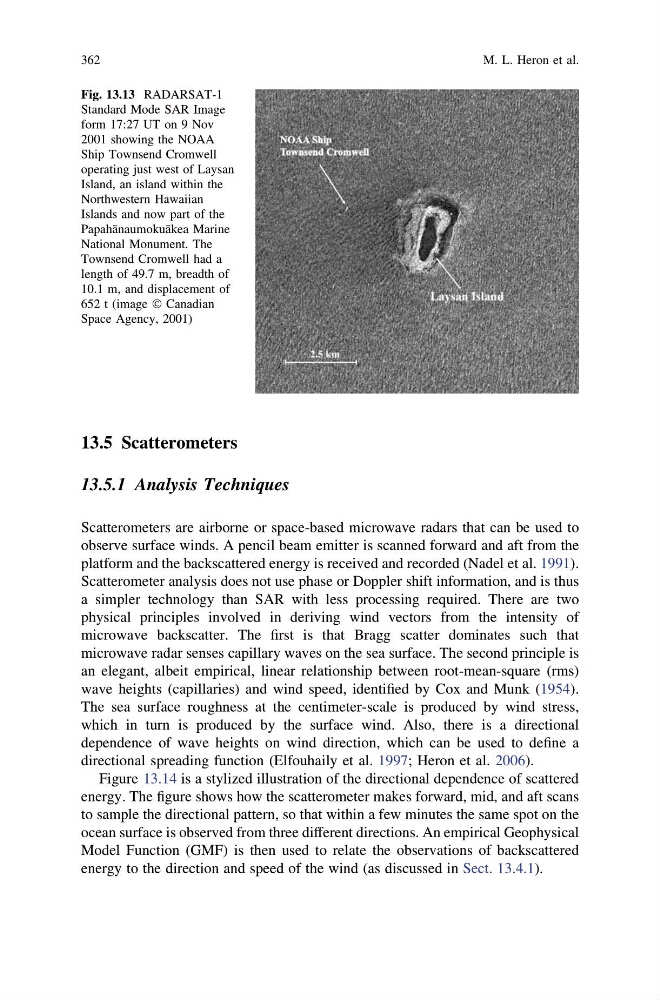
Fig. 13.13 RADARSAT-1
Standard Mode SAR Image
form 17:27 UT on 9 Nov
2001 showing the NOAA
Ship Townsend Cromwell
operating just west of Laysan
Island, an island within the
Northwestern Hawaiian
Islands and now part of the
Papaha ¯naumokua ¯kea Marine
National Monument. The
Townsend Cromwell had a
length of 49.7 m, breadth of
10.1 m, and displacement of
652 t (image Ó Canadian
Space Agency, 2001)
362
M. L. Heron et al.
13.5.1 Analysis Techniques
Scatterometers are airborne or space-based microwave radars that can be used to
observe surface winds. A pencil beam emitter is scanned forward and aft from the
platform and the backscattered energy is received and recorded (Nadel et al. 1991).
Scatterometer analysis does not use phase or Doppler shift information, and is thus
a simpler technology than SAR with less processing required. There are two
physical principles involved in deriving wind vectors from the intensity of
microwave backscatter. The first is that Bragg scatter dominates such that
microwave radar senses capillary waves on the sea surface. The second principle is
an elegant, albeit empirical, linear relationship between root-mean-square (rms)
wave heights (capillaries) and wind speed, identified by Cox and Munk (1954).
The sea surface roughness at the centimeter-scale is produced by wind stress,
which in turn is produced by the surface wind. Also, there is a directional
dependence of wave heights on wind direction, which can be used to define a
directional spreading function (Elfouhaily et al. 1997; Heron et al. 2006).
Figure 13.14 is a stylized illustration of the directional dependence of scattered
energy. The figure shows how the scatterometer makes forward, mid, and aft scans
to sample the directional pattern, so that within a few minutes the same spot on the
ocean surface is observed from three different directions. An empirical Geophysical
Model Function (GMF) is then used to relate the observations of backscattered
energy to the direction and speed of the wind (as discussed in Sect. 13.4.1).
Fig. 13.13 RADARSAT-1
Standard Mode SAR Image
form 17:27 UT on 9 Nov
2001 showing the NOAA
Ship Townsend Cromwell
operating just west of Laysan
Island, an island within the
Northwestern Hawaiian
Islands and now part of the
Papaha ¯naumokua ¯kea Marine
National Monument. The
Townsend Cromwell had a
length of 49.7 m, breadth of
10.1 m, and displacement of
652 t (image Ó Canadian
Space Agency, 2001)
362
M. L. Heron et al.