

There is a trend towards the adoption of rigorous quality control processing on HF
radar data (Heron and Prytz 2011) by assessing the quality of the Bragg peaks as
well as the properties of the data points themselves. In many cases, however, the
quality control processing must rely solely on the consistency of the data points.
Observations of wind directions, one of the primary outputs of HF radar
analysis, are useful in coastal and reef management and research because they
bridge a gap between the terrestrial network of meteorological stations (which are
often not representative of the marine environment) and the offshore global wind
wave models (which are often not representative of the nearshore environment).
Wind direction observations are derived from the ratio of energies in the two firstorder Bragg lines in the spectrum. The principle is that if the wind has a component towards the radar station, then the positively shifted Bragg peak is more
energetic than the negatively shifted Bragg peak; if the two peaks were of equal
energy, for example, then we would deduce that the wind must be blowing
orthogonally to the radar look direction. If we adopt a model shape for the
directional spreading of the wind waves with the Bragg wavelength, and use the
observed Bragg ratios from two radar stations, then the wind direction may be
determined to about ±10 degree (Heron and Prytz 2002). However, Heron and
Marrone (2010) point out that the assumed model shapes for wave direction
usually represent steady state conditions. When there is significant meso-scale
meteorological structure (e.g., cold fronts), it may be better to use the Bragg
energy ratios directly to gain insights into the spatial structure of the wind. Wyatt
and Holden (1994), for example, applied an inversion method for directional wave
spectra that does not assume steady state conditions and is therefore a more robust
algorithm when the wind is not steady.
Wave height observations by HF ocean radar provide spatial data in the coastal
zone where both wave-current interactions and wave shoaling occur. Wave heights
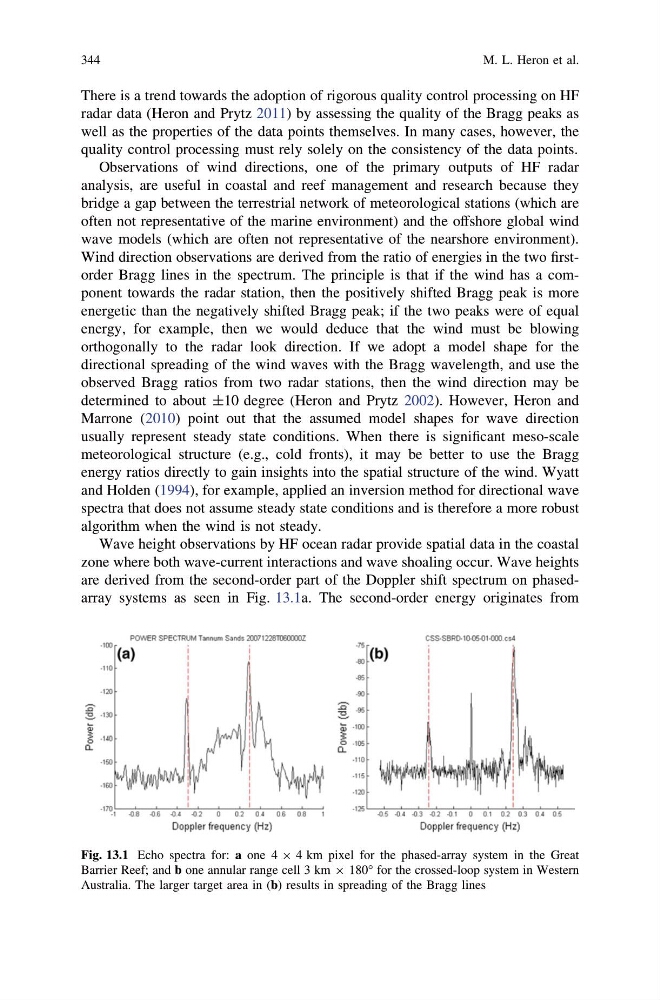
are derived from the second-order part of the Doppler shift spectrum on phasedarray systems as seen in Fig. 13.1a. The second-order energy originates from
Fig. 13.1 Echo spectra for: a one 4 9 4 km pixel for the phased-array system in the Great
Barrier Reef; and b one annular range cell 3 km 9 180° for the crossed-loop system in Western
Australia. The larger target area in (b) results in spreading of the Bragg lines
344
M. L. Heron et al.
radar data (Heron and Prytz 2011) by assessing the quality of the Bragg peaks as
well as the properties of the data points themselves. In many cases, however, the
quality control processing must rely solely on the consistency of the data points.
Observations of wind directions, one of the primary outputs of HF radar
analysis, are useful in coastal and reef management and research because they
bridge a gap between the terrestrial network of meteorological stations (which are
often not representative of the marine environment) and the offshore global wind
wave models (which are often not representative of the nearshore environment).
Wind direction observations are derived from the ratio of energies in the two firstorder Bragg lines in the spectrum. The principle is that if the wind has a component towards the radar station, then the positively shifted Bragg peak is more
energetic than the negatively shifted Bragg peak; if the two peaks were of equal
energy, for example, then we would deduce that the wind must be blowing
orthogonally to the radar look direction. If we adopt a model shape for the
directional spreading of the wind waves with the Bragg wavelength, and use the
observed Bragg ratios from two radar stations, then the wind direction may be
determined to about ±10 degree (Heron and Prytz 2002). However, Heron and
Marrone (2010) point out that the assumed model shapes for wave direction
usually represent steady state conditions. When there is significant meso-scale
meteorological structure (e.g., cold fronts), it may be better to use the Bragg
energy ratios directly to gain insights into the spatial structure of the wind. Wyatt
and Holden (1994), for example, applied an inversion method for directional wave
spectra that does not assume steady state conditions and is therefore a more robust
algorithm when the wind is not steady.
Wave height observations by HF ocean radar provide spatial data in the coastal
zone where both wave-current interactions and wave shoaling occur. Wave heights
are derived from the second-order part of the Doppler shift spectrum on phasedarray systems as seen in Fig. 13.1a. The second-order energy originates from
Fig. 13.1 Echo spectra for: a one 4 9 4 km pixel for the phased-array system in the Great
Barrier Reef; and b one annular range cell 3 km 9 180° for the crossed-loop system in Western
Australia. The larger target area in (b) results in spreading of the Bragg lines
344
M. L. Heron et al.