

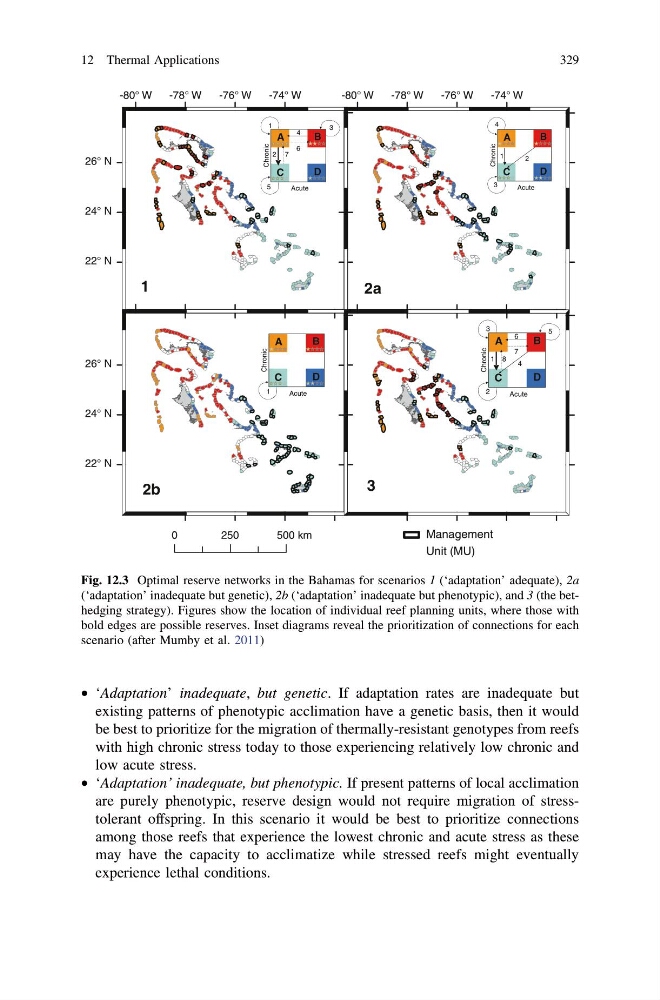
• ‘Adaptation’ inadequate, but genetic. If adaptation rates are inadequate but
existing patterns of phenotypic acclimation have a genetic basis, then it would
be best to prioritize for the migration of thermally-resistant genotypes from reefs
with high chronic stress today to those experiencing relatively low chronic and
low acute stress.
• ‘Adaptation’ inadequate, but phenotypic. If present patterns of local acclimation
are purely phenotypic, reserve design would not require migration of stresstolerant offspring. In this scenario it would be best to prioritize connections
among those reefs that experience the lowest chronic and acute stress as these
may have the capacity to acclimatize while stressed reefs might eventually
experience lethal conditions.
A
B
C
D
4
3
1
Acute
Chronic
2
A
B
C
D
1
3
5
2 7
4
6
Acute
Chronic
A
B
C
D
1
Acute
Chronic
A
B
C
D
3
5
2
1 8
6
7
Acute
Chronic
4
-74° W
-76° W
-78° W
-80° W
26° N
24° N
22° N
0
250
500 km
Management
Unit (MU)
-74° W
-76° W
-78° W
-80° W
26° N
24° N
22° N
1
2a
2b
3
Fig. 12.3 Optimal reserve networks in the Bahamas for scenarios 1 (‘adaptation’ adequate), 2a
(‘adaptation’ inadequate but genetic), 2b (‘adaptation’ inadequate but phenotypic), and 3 (the bethedging strategy). Figures show the location of individual reef planning units, where those with
bold edges are possible reserves. Inset diagrams reveal the prioritization of connections for each
scenario (after Mumby et al. 2011)
12 Thermal Applications
329
existing patterns of phenotypic acclimation have a genetic basis, then it would
be best to prioritize for the migration of thermally-resistant genotypes from reefs
with high chronic stress today to those experiencing relatively low chronic and
low acute stress.
• ‘Adaptation’ inadequate, but phenotypic. If present patterns of local acclimation
are purely phenotypic, reserve design would not require migration of stresstolerant offspring. In this scenario it would be best to prioritize connections
among those reefs that experience the lowest chronic and acute stress as these
may have the capacity to acclimatize while stressed reefs might eventually
experience lethal conditions.
A
B
C
D
4
3
1
Acute
Chronic
2
A
B
C
D
1
3
5
2 7
4
6
Acute
Chronic
A
B
C
D
1
Acute
Chronic
A
B
C
D
3
5
2
1 8
6
7
Acute
Chronic
4
-74° W
-76° W
-78° W
-80° W
26° N
24° N
22° N
0
250
500 km
Management
Unit (MU)
-74° W
-76° W
-78° W
-80° W
26° N
24° N
22° N
1
2a
2b
3
Fig. 12.3 Optimal reserve networks in the Bahamas for scenarios 1 (‘adaptation’ adequate), 2a
(‘adaptation’ inadequate but genetic), 2b (‘adaptation’ inadequate but phenotypic), and 3 (the bethedging strategy). Figures show the location of individual reef planning units, where those with
bold edges are possible reserves. Inset diagrams reveal the prioritization of connections for each
scenario (after Mumby et al. 2011)
12 Thermal Applications
329