

characteristics of traditional El Niño events (Ashok et al. 2007). Referred to as El
Niño/La Niña Modoki, it has been suggested that these Modoki events are
becoming more common with global warming and may be more typical of future
conditions (Yeh et al. 2009; Lee and McPhaden 2010). Further, a recent study by
Redondo-Rodriguez et al. (2011) has found that the influence of ENSO and
Modoki events has a distinct spatial structure on the Great Barrier Reef (GBR).
Classical ENSO events show no significant relationship with SSTs on the northern
GBR, but have a strong signature on the southern GBR. Conversely, El Niño/La
Niña Modoki is significantly related to summer SSTs on the northern GBR, but not
for the southern GBR.
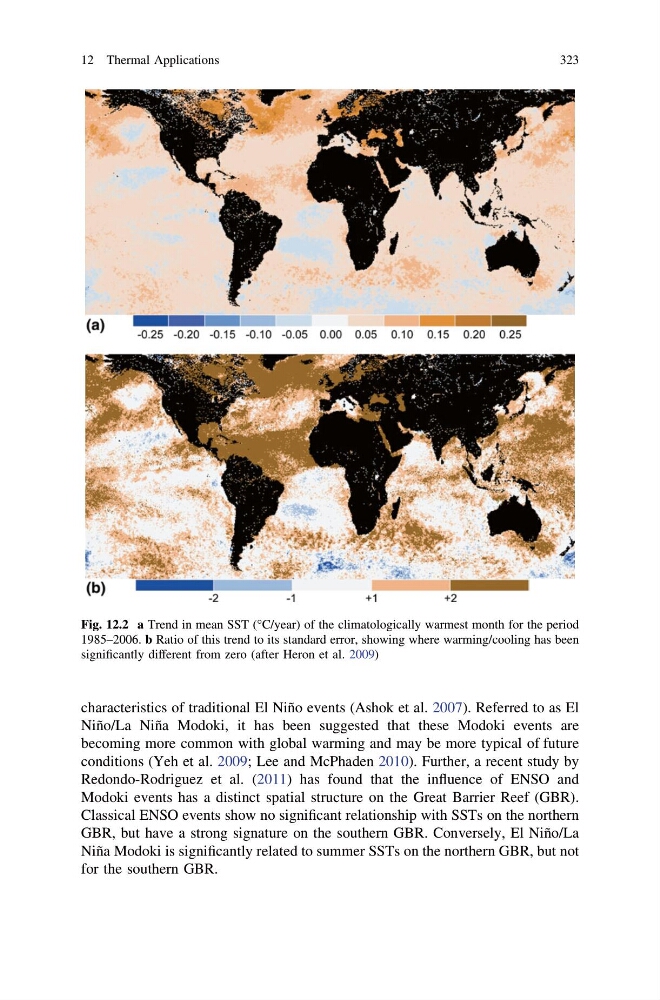
Fig. 12.2 a Trend in mean SST (°C/year) of the climatologically warmest month for the period
1985–2006. b Ratio of this trend to its standard error, showing where warming/cooling has been
significantly different from zero (after Heron et al. 2009)
12 Thermal Applications
323
Niño/La Niña Modoki, it has been suggested that these Modoki events are
becoming more common with global warming and may be more typical of future
conditions (Yeh et al. 2009; Lee and McPhaden 2010). Further, a recent study by
Redondo-Rodriguez et al. (2011) has found that the influence of ENSO and
Modoki events has a distinct spatial structure on the Great Barrier Reef (GBR).
Classical ENSO events show no significant relationship with SSTs on the northern
GBR, but have a strong signature on the southern GBR. Conversely, El Niño/La
Niña Modoki is significantly related to summer SSTs on the northern GBR, but not
for the southern GBR.
Fig. 12.2 a Trend in mean SST (°C/year) of the climatologically warmest month for the period
1985–2006. b Ratio of this trend to its standard error, showing where warming/cooling has been
significantly different from zero (after Heron et al. 2009)
12 Thermal Applications
323