

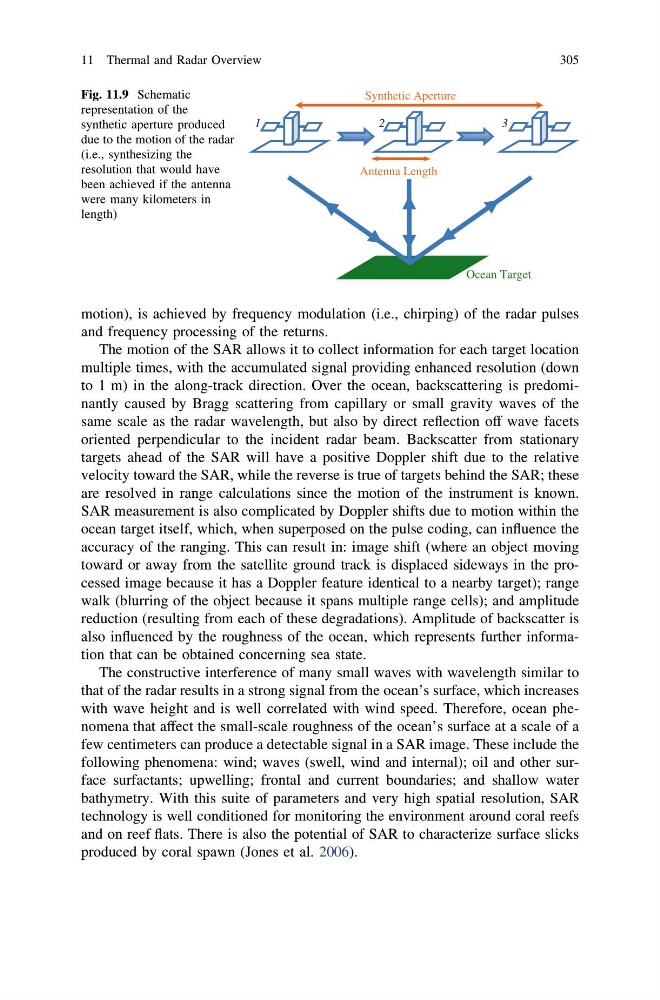
motion), is achieved by frequency modulation (i.e., chirping) of the radar pulses
and frequency processing of the returns.
The motion of the SAR allows it to collect information for each target location
multiple times, with the accumulated signal providing enhanced resolution (down
to 1 m) in the along-track direction. Over the ocean, backscattering is predominantly caused by Bragg scattering from capillary or small gravity waves of the
same scale as the radar wavelength, but also by direct reflection off wave facets
oriented perpendicular to the incident radar beam. Backscatter from stationary
targets ahead of the SAR will have a positive Doppler shift due to the relative
velocity toward the SAR, while the reverse is true of targets behind the SAR; these
are resolved in range calculations since the motion of the instrument is known.
SAR measurement is also complicated by Doppler shifts due to motion within the
ocean target itself, which, when superposed on the pulse coding, can influence the
accuracy of the ranging. This can result in: image shift (where an object moving
toward or away from the satellite ground track is displaced sideways in the processed image because it has a Doppler feature identical to a nearby target); range
walk (blurring of the object because it spans multiple range cells); and amplitude
reduction (resulting from each of these degradations). Amplitude of backscatter is
also influenced by the roughness of the ocean, which represents further information that can be obtained concerning sea state.
The constructive interference of many small waves with wavelength similar to
that of the radar results in a strong signal from the ocean’s surface, which increases
with wave height and is well correlated with wind speed. Therefore, ocean phenomena that affect the small-scale roughness of the ocean’s surface at a scale of a
few centimeters can produce a detectable signal in a SAR image. These include the
following phenomena: wind; waves (swell, wind and internal); oil and other surface surfactants; upwelling; frontal and current boundaries; and shallow water
bathymetry. With this suite of parameters and very high spatial resolution, SAR
technology is well conditioned for monitoring the environment around coral reefs
and on reef flats. There is also the potential of SAR to characterize surface slicks
produced by coral spawn (Jones et al. 2006).
1
3
2
Antenna Length
Synthetic Aperture
Ocean Target
Fig. 11.9 Schematic
representation of the
synthetic aperture produced
due to the motion of the radar
(i.e., synthesizing the
resolution that would have
been achieved if the antenna
were many kilometers in
length)
11 Thermal and Radar Overview
305
and frequency processing of the returns.
The motion of the SAR allows it to collect information for each target location
multiple times, with the accumulated signal providing enhanced resolution (down
to 1 m) in the along-track direction. Over the ocean, backscattering is predominantly caused by Bragg scattering from capillary or small gravity waves of the
same scale as the radar wavelength, but also by direct reflection off wave facets
oriented perpendicular to the incident radar beam. Backscatter from stationary
targets ahead of the SAR will have a positive Doppler shift due to the relative
velocity toward the SAR, while the reverse is true of targets behind the SAR; these
are resolved in range calculations since the motion of the instrument is known.
SAR measurement is also complicated by Doppler shifts due to motion within the
ocean target itself, which, when superposed on the pulse coding, can influence the
accuracy of the ranging. This can result in: image shift (where an object moving
toward or away from the satellite ground track is displaced sideways in the processed image because it has a Doppler feature identical to a nearby target); range
walk (blurring of the object because it spans multiple range cells); and amplitude
reduction (resulting from each of these degradations). Amplitude of backscatter is
also influenced by the roughness of the ocean, which represents further information that can be obtained concerning sea state.
The constructive interference of many small waves with wavelength similar to
that of the radar results in a strong signal from the ocean’s surface, which increases
with wave height and is well correlated with wind speed. Therefore, ocean phenomena that affect the small-scale roughness of the ocean’s surface at a scale of a
few centimeters can produce a detectable signal in a SAR image. These include the
following phenomena: wind; waves (swell, wind and internal); oil and other surface surfactants; upwelling; frontal and current boundaries; and shallow water
bathymetry. With this suite of parameters and very high spatial resolution, SAR
technology is well conditioned for monitoring the environment around coral reefs
and on reef flats. There is also the potential of SAR to characterize surface slicks
produced by coral spawn (Jones et al. 2006).
1
3
2
Antenna Length
Synthetic Aperture
Ocean Target
Fig. 11.9 Schematic
representation of the
synthetic aperture produced
due to the motion of the radar
(i.e., synthesizing the
resolution that would have
been achieved if the antenna
were many kilometers in
length)
11 Thermal and Radar Overview
305