

array) and CODAR SeaSonde (direction-finding). A discussion of considerations
between these systems for deployment is provided in Chap. 13.
Synthetic Aperture Radar (SAR) instruments, which are active microwave
imaging radars, provide unique environmental remote sensing capability. These
instruments, whether flown on an aircraft or carried on a satellite, send out pulses
of electromagnetic radiation at a wavelength of a few centimetres and measure the
backscattered radiation from the Earth’s surface. By recording both the phase and
amplitude of the returning radiation, undertaking coherent addition of the returned
signals over periods of a few seconds, and Doppler processing with sophisticated
signal processing techniques, it is possible to create a high-resolution image,
essentially synthesizing the resolution that would have been achieved if the
antenna were many kilometers in length (thus the term synthetic aperture;
Fig. 11.9). The synthetic aperture procedure creates enhanced resolution in the
along-track direction (i.e., in the direction of satellite or aircraft motion). Highresolution in the cross-track direction (i.e., perpendicular to the direction of
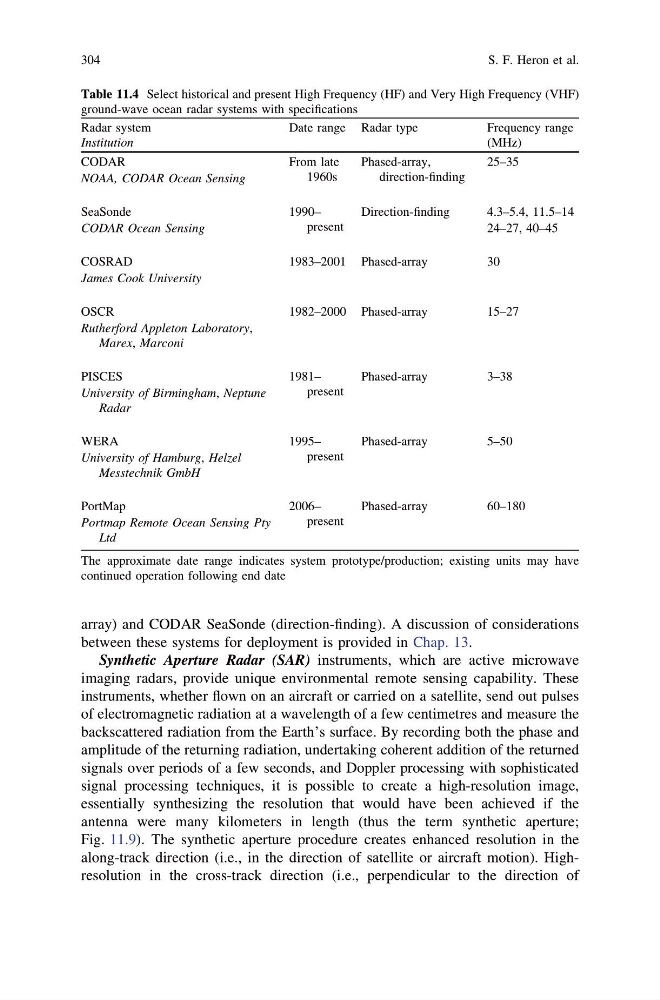
Table 11.4 Select historical and present High Frequency (HF) and Very High Frequency (VHF)
ground-wave ocean radar systems with specifications
Radar system
Date range Radar type
Frequency range
(MHz)
Institution
CODAR
From late
1960s
Phased-array,
direction-finding
25–35
NOAA, CODAR Ocean Sensing
SeaSonde
1990–
present
Direction-finding
4.3–5.4, 11.5–14
CODAR Ocean Sensing
24–27, 40–45
COSRAD
1983–2001 Phased-array
30
James Cook University
OSCR
1982–2000 Phased-array
15–27
Rutherford Appleton Laboratory,
Marex, Marconi
PISCES
1981–
present
Phased-array
3–38
University of Birmingham, Neptune
Radar
WERA
1995–
present
Phased-array
5–50
University of Hamburg, Helzel
Messtechnik GmbH
PortMap
2006–
present
Phased-array
60–180
Portmap Remote Ocean Sensing Pty
Ltd
The approximate date range indicates system prototype/production; existing units may have
continued operation following end date
304
S. F. Heron et al.
between these systems for deployment is provided in Chap. 13.
Synthetic Aperture Radar (SAR) instruments, which are active microwave
imaging radars, provide unique environmental remote sensing capability. These
instruments, whether flown on an aircraft or carried on a satellite, send out pulses
of electromagnetic radiation at a wavelength of a few centimetres and measure the
backscattered radiation from the Earth’s surface. By recording both the phase and
amplitude of the returning radiation, undertaking coherent addition of the returned
signals over periods of a few seconds, and Doppler processing with sophisticated
signal processing techniques, it is possible to create a high-resolution image,
essentially synthesizing the resolution that would have been achieved if the
antenna were many kilometers in length (thus the term synthetic aperture;
Fig. 11.9). The synthetic aperture procedure creates enhanced resolution in the
along-track direction (i.e., in the direction of satellite or aircraft motion). Highresolution in the cross-track direction (i.e., perpendicular to the direction of
Table 11.4 Select historical and present High Frequency (HF) and Very High Frequency (VHF)
ground-wave ocean radar systems with specifications
Radar system
Date range Radar type
Frequency range
(MHz)
Institution
CODAR
From late
1960s
Phased-array,
direction-finding
25–35
NOAA, CODAR Ocean Sensing
SeaSonde
1990–
present
Direction-finding
4.3–5.4, 11.5–14
CODAR Ocean Sensing
24–27, 40–45
COSRAD
1983–2001 Phased-array
30
James Cook University
OSCR
1982–2000 Phased-array
15–27
Rutherford Appleton Laboratory,
Marex, Marconi
PISCES
1981–
present
Phased-array
3–38
University of Birmingham, Neptune
Radar
WERA
1995–
present
Phased-array
5–50
University of Hamburg, Helzel
Messtechnik GmbH
PortMap
2006–
present
Phased-array
60–180
Portmap Remote Ocean Sensing Pty
Ltd
The approximate date range indicates system prototype/production; existing units may have
continued operation following end date
304
S. F. Heron et al.