

Attenuation by the atmosphere also provides the potential to define certain
satellite channels for measuring atmospheric components (e.g., water vapor;
Table 11.1). The information gained from these channels can be useful to refine
knowledge of the state of the atmosphere and can be incorporated into models of
atmospheric radiative transfer (e.g., for atmospheric correction). This allows the
potential for improving SST measurements using ‘‘physical retrieval’’ methods
(Nalli and Smith 1998). These methods use ‘‘first guess’’ SST and atmospheric
profile information, along with satellite radiances, radiative transfer models, and
knowledge of uncertainties in the measurements and procedures, to thereby
determine a refined SST measurement. Improvements in accuracy using physical
retrieval are also possible using local information rather than employing globallyaveraged regression coefficients; however, these potential improvements can be
hard to achieve in practice.
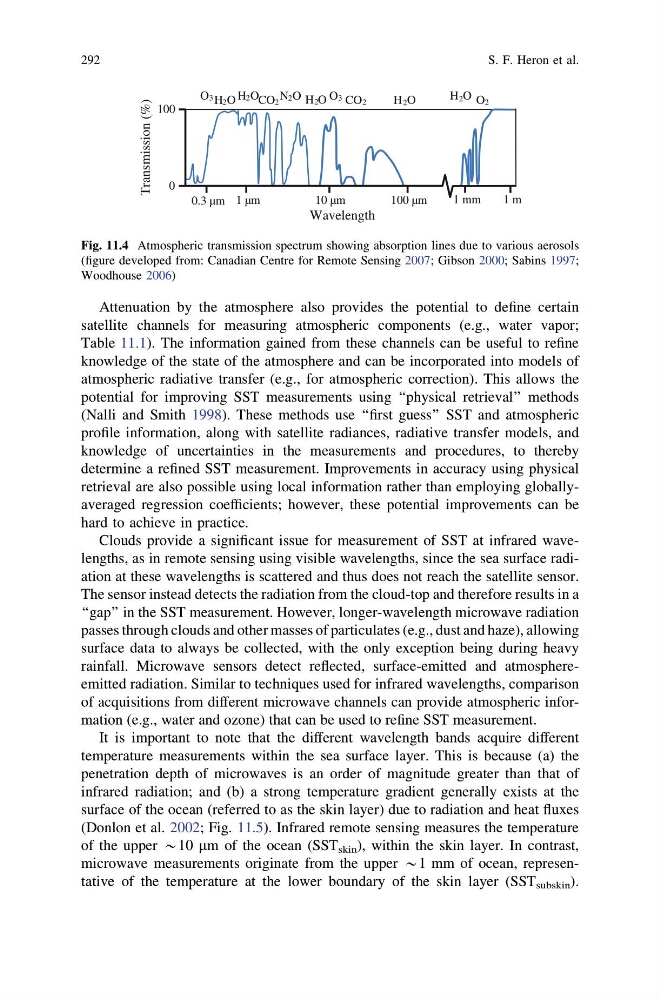
Clouds provide a significant issue for measurement of SST at infrared wavelengths, as in remote sensing using visible wavelengths, since the sea surface radiation at these wavelengths is scattered and thus does not reach the satellite sensor.
The sensor instead detects the radiation from the cloud-top and therefore results in a
‘‘gap’’ in the SST measurement. However, longer-wavelength microwave radiation
passes through clouds and other masses of particulates (e.g., dust and haze), allowing
surface data to always be collected, with the only exception being during heavy
rainfall. Microwave sensors detect reflected, surface-emitted and atmosphereemitted radiation. Similar to techniques used for infrared wavelengths, comparison
of acquisitions from different microwave channels can provide atmospheric information (e.g., water and ozone) that can be used to refine SST measurement.
It is important to note that the different wavelength bands acquire different
temperature measurements within the sea surface layer. This is because (a) the
penetration depth of microwaves is an order of magnitude greater than that of
infrared radiation; and (b) a strong temperature gradient generally exists at the
surface of the ocean (referred to as the skin layer) due to radiation and heat fluxes
(Donlon et al. 2002; Fig. 11.5). Infrared remote sensing measures the temperature
of the upper *10 lm of the ocean (SST skin ), within the skin layer. In contrast,
microwave measurements originate from the upper *1 mm of ocean, representative of the temperature at the lower boundary of the skin layer (SST subskin ).
Transmission (%)
Wavelength
0.3 µm 1 µm
10 µm
100 µm
1 mm
1 m
100
0
O3 CO2
H2O
CO2
H2O
O3 H2O H2O
O2
H 2 O
N2O
Fig. 11.4 Atmospheric transmission spectrum showing absorption lines due to various aerosols
(figure developed from: Canadian Centre for Remote Sensing 2007; Gibson 2000; Sabins 1997;
Woodhouse 2006)
292
S. F. Heron et al.
satellite channels for measuring atmospheric components (e.g., water vapor;
Table 11.1). The information gained from these channels can be useful to refine
knowledge of the state of the atmosphere and can be incorporated into models of
atmospheric radiative transfer (e.g., for atmospheric correction). This allows the
potential for improving SST measurements using ‘‘physical retrieval’’ methods
(Nalli and Smith 1998). These methods use ‘‘first guess’’ SST and atmospheric
profile information, along with satellite radiances, radiative transfer models, and
knowledge of uncertainties in the measurements and procedures, to thereby
determine a refined SST measurement. Improvements in accuracy using physical
retrieval are also possible using local information rather than employing globallyaveraged regression coefficients; however, these potential improvements can be
hard to achieve in practice.
Clouds provide a significant issue for measurement of SST at infrared wavelengths, as in remote sensing using visible wavelengths, since the sea surface radiation at these wavelengths is scattered and thus does not reach the satellite sensor.
The sensor instead detects the radiation from the cloud-top and therefore results in a
‘‘gap’’ in the SST measurement. However, longer-wavelength microwave radiation
passes through clouds and other masses of particulates (e.g., dust and haze), allowing
surface data to always be collected, with the only exception being during heavy
rainfall. Microwave sensors detect reflected, surface-emitted and atmosphereemitted radiation. Similar to techniques used for infrared wavelengths, comparison
of acquisitions from different microwave channels can provide atmospheric information (e.g., water and ozone) that can be used to refine SST measurement.
It is important to note that the different wavelength bands acquire different
temperature measurements within the sea surface layer. This is because (a) the
penetration depth of microwaves is an order of magnitude greater than that of
infrared radiation; and (b) a strong temperature gradient generally exists at the
surface of the ocean (referred to as the skin layer) due to radiation and heat fluxes
(Donlon et al. 2002; Fig. 11.5). Infrared remote sensing measures the temperature
of the upper *10 lm of the ocean (SST skin ), within the skin layer. In contrast,
microwave measurements originate from the upper *1 mm of ocean, representative of the temperature at the lower boundary of the skin layer (SST subskin ).
Transmission (%)
Wavelength
0.3 µm 1 µm
10 µm
100 µm
1 mm
1 m
100
0
O3 CO2
H2O
CO2
H2O
O3 H2O H2O
O2
H 2 O
N2O
Fig. 11.4 Atmospheric transmission spectrum showing absorption lines due to various aerosols
(figure developed from: Canadian Centre for Remote Sensing 2007; Gibson 2000; Sabins 1997;
Woodhouse 2006)
292
S. F. Heron et al.