

is even more dominant (62 % of total ridge area), and is still followed by the dense
coral class (22 %), and the isolated coral class (16 %). Visual analysis suggests
that the different coral habitat classes are non-randomly distributed throughout the
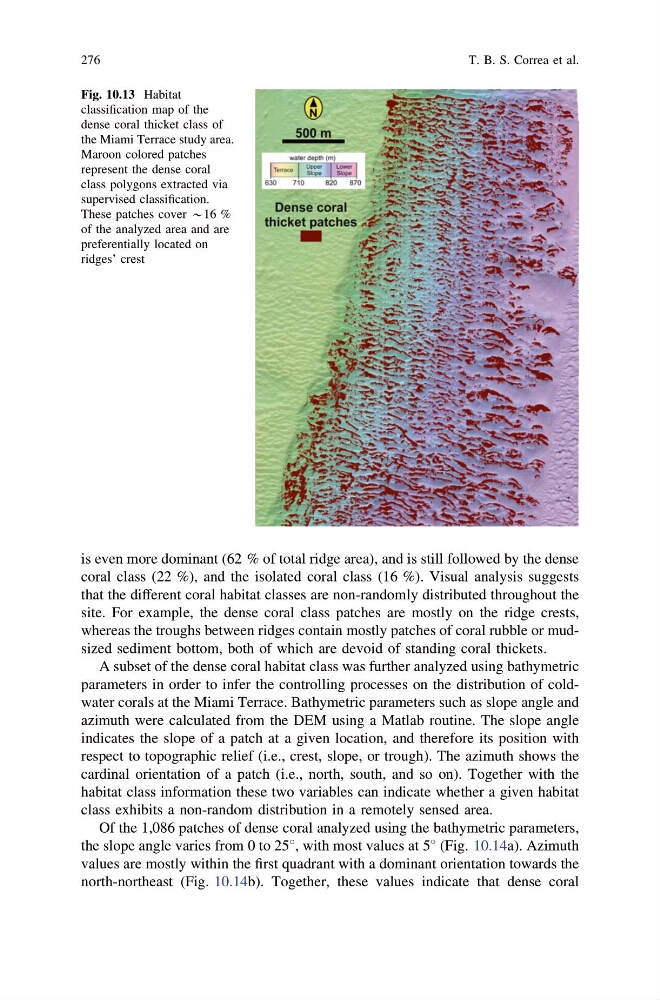
site. For example, the dense coral class patches are mostly on the ridge crests,
whereas the troughs between ridges contain mostly patches of coral rubble or mudsized sediment bottom, both of which are devoid of standing coral thickets.
A subset of the dense coral habitat class was further analyzed using bathymetric
parameters in order to infer the controlling processes on the distribution of coldwater corals at the Miami Terrace. Bathymetric parameters such as slope angle and
azimuth were calculated from the DEM using a Matlab routine. The slope angle
indicates the slope of a patch at a given location, and therefore its position with
respect to topographic relief (i.e., crest, slope, or trough). The azimuth shows the
cardinal orientation of a patch (i.e., north, south, and so on). Together with the
habitat class information these two variables can indicate whether a given habitat
class exhibits a non-random distribution in a remotely sensed area.
Of the 1,086 patches of dense coral analyzed using the bathymetric parameters,
the slope angle varies from 0 to 258, with most values at 58 (Fig. 10.14a). Azimuth
values are mostly within the first quadrant with a dominant orientation towards the
north-northeast (Fig. 10.14b). Together, these values indicate that dense coral
Fig. 10.13 Habitat
classification map of the
dense coral thicket class of
the Miami Terrace study area.
Maroon colored patches
represent the dense coral
class polygons extracted via
supervised classification.
These patches cover *16 %
of the analyzed area and are
preferentially located on
ridges’ crest
276
T. B. S. Correa et al.
coral class (22 %), and the isolated coral class (16 %). Visual analysis suggests
that the different coral habitat classes are non-randomly distributed throughout the
site. For example, the dense coral class patches are mostly on the ridge crests,
whereas the troughs between ridges contain mostly patches of coral rubble or mudsized sediment bottom, both of which are devoid of standing coral thickets.
A subset of the dense coral habitat class was further analyzed using bathymetric
parameters in order to infer the controlling processes on the distribution of coldwater corals at the Miami Terrace. Bathymetric parameters such as slope angle and
azimuth were calculated from the DEM using a Matlab routine. The slope angle
indicates the slope of a patch at a given location, and therefore its position with
respect to topographic relief (i.e., crest, slope, or trough). The azimuth shows the
cardinal orientation of a patch (i.e., north, south, and so on). Together with the
habitat class information these two variables can indicate whether a given habitat
class exhibits a non-random distribution in a remotely sensed area.
Of the 1,086 patches of dense coral analyzed using the bathymetric parameters,
the slope angle varies from 0 to 258, with most values at 58 (Fig. 10.14a). Azimuth
values are mostly within the first quadrant with a dominant orientation towards the
north-northeast (Fig. 10.14b). Together, these values indicate that dense coral
Fig. 10.13 Habitat
classification map of the
dense coral thicket class of
the Miami Terrace study area.
Maroon colored patches
represent the dense coral
class polygons extracted via
supervised classification.
These patches cover *16 %
of the analyzed area and are
preferentially located on
ridges’ crest
276
T. B. S. Correa et al.