

wider. Fish weights are summed over a transect or segment and divided by the
segment length.
As an example from the US Virgin Islands, split-beam echo sounders were
integrated into a sensor package on a benthic habitat mapping survey vessel and
used to map the distribution of fishes and mid-water invertebrates throughout the
water column and near-bottom. Surveys were conducted in two areas identified by
regional management partners as high priority areas for habitat mapping. The first
location was near Virgin Islands Passage, about 16 km SW of St Thomas, US
Virgin Islands and 6 km NE of Vieques Island, Puerto Rico. The second was south
of St. Johns, US Virgin Islands. The survey design was optimized for MBES
hydrographic surveys, where survey transects were conducted either parallel to one
another, or following depth contours, spaced 50–100 m apart. The split-beam echo
sounder was a Simrad EK60 operating at two frequencies, 120 and 38 kHz, though
only the 120 kHz data are discussed here. Fish lengths were estimated from the
average target strength (TS) using a generalized TS-length relationship (Love
1971). Results were then divided into three fish size classes: (1) less than 12 cm,
which represent small, zooplanktivorous or reef associated species, (2) between 12
and 28 cm, representing adults of reef associated species and some juveniles of
commercially important species of snapper and grouper, and (3) greater than
29 cm, representing larger pelagic and reef associated species including snappers
and groupers. Densities were computed for each size class in 100 m segments
along transects, producing units of fish per 100 m
2 .
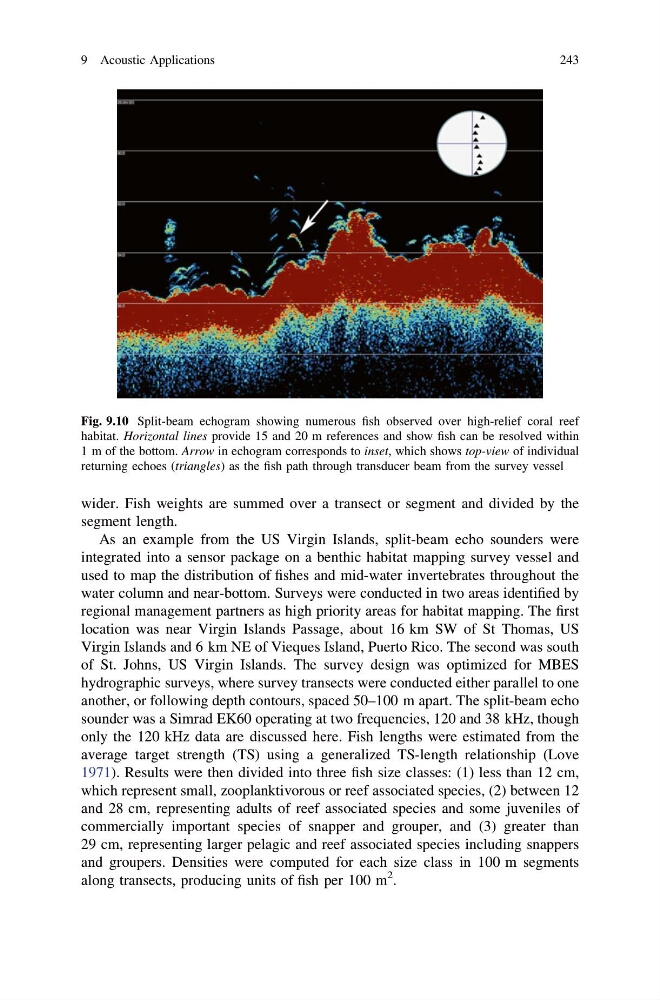
Fig. 9.10 Split-beam echogram showing numerous fish observed over high-relief coral reef
habitat. Horizontal lines provide 15 and 20 m references and show fish can be resolved within
1 m of the bottom. Arrow in echogram corresponds to inset, which shows top-view of individual
returning echoes (triangles) as the fish path through transducer beam from the survey vessel
9 Acoustic Applications
243
segment length.
As an example from the US Virgin Islands, split-beam echo sounders were
integrated into a sensor package on a benthic habitat mapping survey vessel and
used to map the distribution of fishes and mid-water invertebrates throughout the
water column and near-bottom. Surveys were conducted in two areas identified by
regional management partners as high priority areas for habitat mapping. The first
location was near Virgin Islands Passage, about 16 km SW of St Thomas, US
Virgin Islands and 6 km NE of Vieques Island, Puerto Rico. The second was south
of St. Johns, US Virgin Islands. The survey design was optimized for MBES
hydrographic surveys, where survey transects were conducted either parallel to one
another, or following depth contours, spaced 50–100 m apart. The split-beam echo
sounder was a Simrad EK60 operating at two frequencies, 120 and 38 kHz, though
only the 120 kHz data are discussed here. Fish lengths were estimated from the
average target strength (TS) using a generalized TS-length relationship (Love
1971). Results were then divided into three fish size classes: (1) less than 12 cm,
which represent small, zooplanktivorous or reef associated species, (2) between 12
and 28 cm, representing adults of reef associated species and some juveniles of
commercially important species of snapper and grouper, and (3) greater than
29 cm, representing larger pelagic and reef associated species including snappers
and groupers. Densities were computed for each size class in 100 m segments
along transects, producing units of fish per 100 m
2 .
Fig. 9.10 Split-beam echogram showing numerous fish observed over high-relief coral reef
habitat. Horizontal lines provide 15 and 20 m references and show fish can be resolved within
1 m of the bottom. Arrow in echogram corresponds to inset, which shows top-view of individual
returning echoes (triangles) as the fish path through transducer beam from the survey vessel
9 Acoustic Applications
243