

have high accuracy even at a fine level of thematic detail. The first subsection
reviews the supervised classification approach of Foster et al. (2011), which is a
promising development towards increasing classification accuracy at a moderate
level of thematic detail. The second is the unsupervised classification approach of
Gleason et al. (2009, 2011), which provides consistent classifications at multiple
sites with little to no ground truth required.
Supervised classification: The overall accuracy of ASC-derived maps of coral
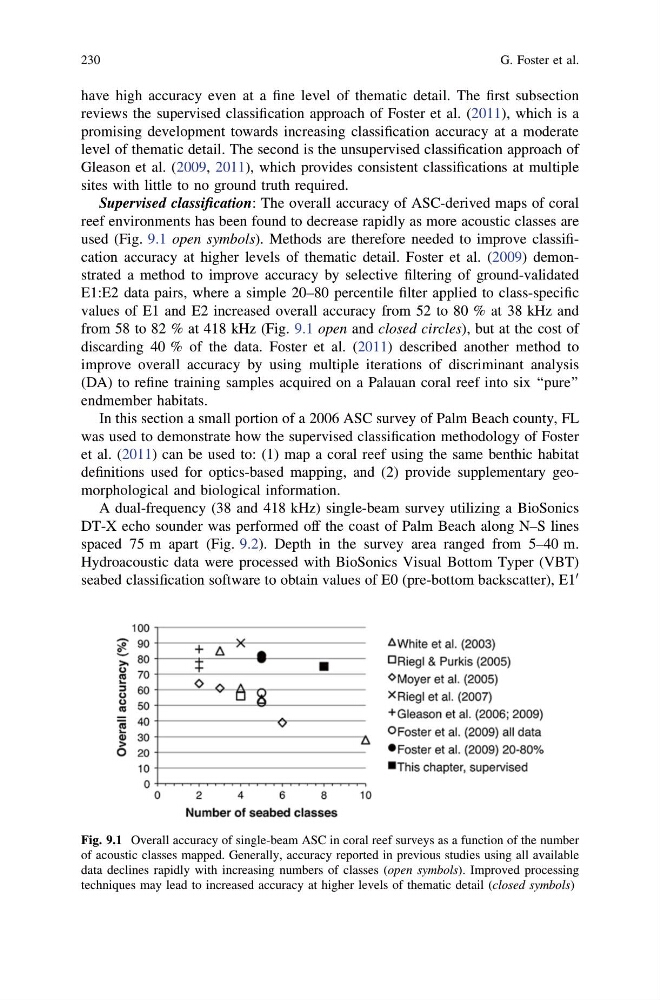
reef environments has been found to decrease rapidly as more acoustic classes are
used (Fig. 9.1 open symbols). Methods are therefore needed to improve classification accuracy at higher levels of thematic detail. Foster et al. (2009) demonstrated a method to improve accuracy by selective filtering of ground-validated
E1:E2 data pairs, where a simple 20–80 percentile filter applied to class-specific
values of E1 and E2 increased overall accuracy from 52 to 80 % at 38 kHz and
from 58 to 82 % at 418 kHz (Fig. 9.1 open and closed circles), but at the cost of
discarding 40 % of the data. Foster et al. (2011) described another method to
improve overall accuracy by using multiple iterations of discriminant analysis
(DA) to refine training samples acquired on a Palauan coral reef into six ‘‘pure’’
endmember habitats.
In this section a small portion of a 2006 ASC survey of Palm Beach county, FL
was used to demonstrate how the supervised classification methodology of Foster
et al. (2011) can be used to: (1) map a coral reef using the same benthic habitat
definitions used for optics-based mapping, and (2) provide supplementary geomorphological and biological information.
A dual-frequency (38 and 418 kHz) single-beam survey utilizing a BioSonics
DT-X echo sounder was performed off the coast of Palm Beach along N–S lines
spaced 75 m apart (Fig. 9.2). Depth in the survey area ranged from 5–40 m.
Hydroacoustic data were processed with BioSonics Visual Bottom Typer (VBT)
seabed classification software to obtain values of E0 (pre-bottom backscatter), E1
0
Fig. 9.1 Overall accuracy of single-beam ASC in coral reef surveys as a function of the number
of acoustic classes mapped. Generally, accuracy reported in previous studies using all available
data declines rapidly with increasing numbers of classes (open symbols). Improved processing
techniques may lead to increased accuracy at higher levels of thematic detail (closed symbols)
230
G. Foster et al.
reviews the supervised classification approach of Foster et al. (2011), which is a
promising development towards increasing classification accuracy at a moderate
level of thematic detail. The second is the unsupervised classification approach of
Gleason et al. (2009, 2011), which provides consistent classifications at multiple
sites with little to no ground truth required.
Supervised classification: The overall accuracy of ASC-derived maps of coral
reef environments has been found to decrease rapidly as more acoustic classes are
used (Fig. 9.1 open symbols). Methods are therefore needed to improve classification accuracy at higher levels of thematic detail. Foster et al. (2009) demonstrated a method to improve accuracy by selective filtering of ground-validated
E1:E2 data pairs, where a simple 20–80 percentile filter applied to class-specific
values of E1 and E2 increased overall accuracy from 52 to 80 % at 38 kHz and
from 58 to 82 % at 418 kHz (Fig. 9.1 open and closed circles), but at the cost of
discarding 40 % of the data. Foster et al. (2011) described another method to
improve overall accuracy by using multiple iterations of discriminant analysis
(DA) to refine training samples acquired on a Palauan coral reef into six ‘‘pure’’
endmember habitats.
In this section a small portion of a 2006 ASC survey of Palm Beach county, FL
was used to demonstrate how the supervised classification methodology of Foster
et al. (2011) can be used to: (1) map a coral reef using the same benthic habitat
definitions used for optics-based mapping, and (2) provide supplementary geomorphological and biological information.
A dual-frequency (38 and 418 kHz) single-beam survey utilizing a BioSonics
DT-X echo sounder was performed off the coast of Palm Beach along N–S lines
spaced 75 m apart (Fig. 9.2). Depth in the survey area ranged from 5–40 m.
Hydroacoustic data were processed with BioSonics Visual Bottom Typer (VBT)
seabed classification software to obtain values of E0 (pre-bottom backscatter), E1
0
Fig. 9.1 Overall accuracy of single-beam ASC in coral reef surveys as a function of the number
of acoustic classes mapped. Generally, accuracy reported in previous studies using all available
data declines rapidly with increasing numbers of classes (open symbols). Improved processing
techniques may lead to increased accuracy at higher levels of thematic detail (closed symbols)
230
G. Foster et al.