

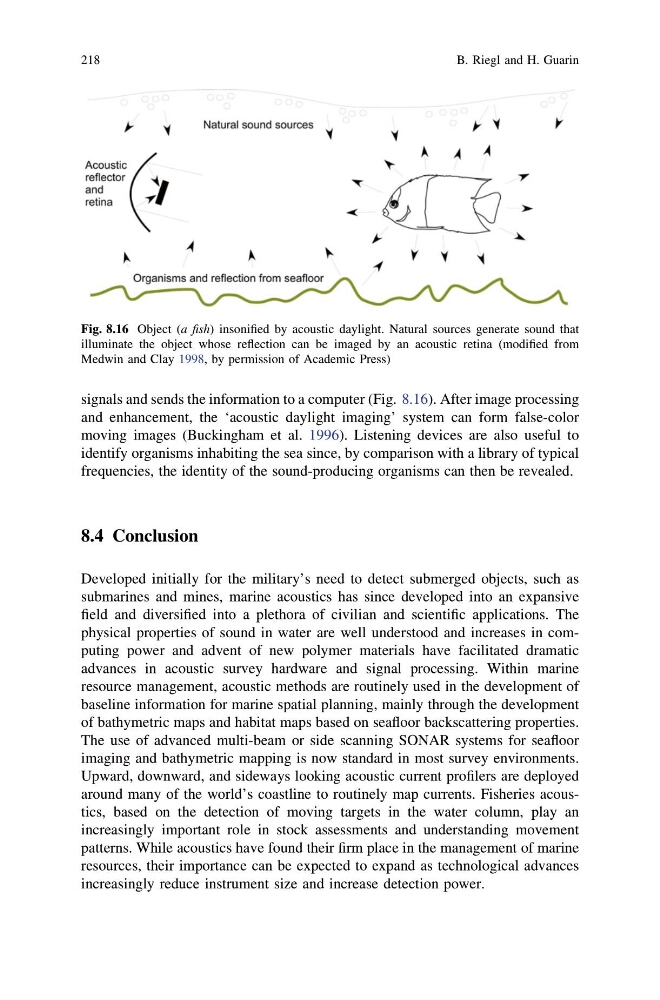
signals and sends the information to a computer (Fig. 8.16). After image processing
and enhancement, the ‘acoustic daylight imaging’ system can form false-color
moving images (Buckingham et al. 1996). Listening devices are also useful to
identify organisms inhabiting the sea since, by comparison with a library of typical
frequencies, the identity of the sound-producing organisms can then be revealed.
8.4 Conclusion
Developed initially for the military’s need to detect submerged objects, such as
submarines and mines, marine acoustics has since developed into an expansive
field and diversified into a plethora of civilian and scientific applications. The
physical properties of sound in water are well understood and increases in computing power and advent of new polymer materials have facilitated dramatic
advances in acoustic survey hardware and signal processing. Within marine
resource management, acoustic methods are routinely used in the development of
baseline information for marine spatial planning, mainly through the development
of bathymetric maps and habitat maps based on seafloor backscattering properties.
The use of advanced multi-beam or side scanning SONAR systems for seafloor
imaging and bathymetric mapping is now standard in most survey environments.
Upward, downward, and sideways looking acoustic current profilers are deployed
around many of the world’s coastline to routinely map currents. Fisheries acoustics, based on the detection of moving targets in the water column, play an
increasingly important role in stock assessments and understanding movement
patterns. While acoustics have found their firm place in the management of marine
resources, their importance can be expected to expand as technological advances
increasingly reduce instrument size and increase detection power.
Fig. 8.16 Object (a fish) insonified by acoustic daylight. Natural sources generate sound that
illuminate the object whose reflection can be imaged by an acoustic retina (modified from
Medwin and Clay 1998, by permission of Academic Press)
218
B. Riegl and H. Guarin
and enhancement, the ‘acoustic daylight imaging’ system can form false-color
moving images (Buckingham et al. 1996). Listening devices are also useful to
identify organisms inhabiting the sea since, by comparison with a library of typical
frequencies, the identity of the sound-producing organisms can then be revealed.
8.4 Conclusion
Developed initially for the military’s need to detect submerged objects, such as
submarines and mines, marine acoustics has since developed into an expansive
field and diversified into a plethora of civilian and scientific applications. The
physical properties of sound in water are well understood and increases in computing power and advent of new polymer materials have facilitated dramatic
advances in acoustic survey hardware and signal processing. Within marine
resource management, acoustic methods are routinely used in the development of
baseline information for marine spatial planning, mainly through the development
of bathymetric maps and habitat maps based on seafloor backscattering properties.
The use of advanced multi-beam or side scanning SONAR systems for seafloor
imaging and bathymetric mapping is now standard in most survey environments.
Upward, downward, and sideways looking acoustic current profilers are deployed
around many of the world’s coastline to routinely map currents. Fisheries acoustics, based on the detection of moving targets in the water column, play an
increasingly important role in stock assessments and understanding movement
patterns. While acoustics have found their firm place in the management of marine
resources, their importance can be expected to expand as technological advances
increasingly reduce instrument size and increase detection power.
Fig. 8.16 Object (a fish) insonified by acoustic daylight. Natural sources generate sound that
illuminate the object whose reflection can be imaged by an acoustic retina (modified from
Medwin and Clay 1998, by permission of Academic Press)
218
B. Riegl and H. Guarin