

Hydroacoustic methods have been successfully used in many applications, for
example the search for spawning aggregations conducted by Johnston et al. (2006).
To measure and track smaller particles (ranging from plankton to fish), estimates can be made if both the target size is known and the scattering lengths are
known as a function of frequency (e.g., the smaller the animal, the smaller its
scattered echo). Since small animals tend to live in dense schools (e.g., plankton),
the small echo and their physical proximity to each other makes individual resolution of the animal often impossible, but they are nonetheless often detected by
mass-scatter. A striking example is the detection of the deep-scattering layers
(DSL) in the ocean, which represents the dial vertical migrations of plankton.
Judicious choice of sampling frequency, or the use of broadband signals, can also
allow for the identification of different plankton (Medwin and Clay 1998).
In a different fisheries application, the phrases ‘passive acoustics’ and ‘acoustic
daylight’ were coined by Buckingham et al. (1992), referring to the use of the
backscattered sound intensity reflected off objects in the environment, or created by
them, as an analogue to light. Either the environment can be insonified and the
reflected sound intensity is used, or an entirely passive device just records the
emitted sound. By differentiation from the acoustic background, objects (e.g., fish)
from which ambient sound is reflected can be detected since they modify the sound
in characteristic ways. In these systems, a receiver picks up the modified noise
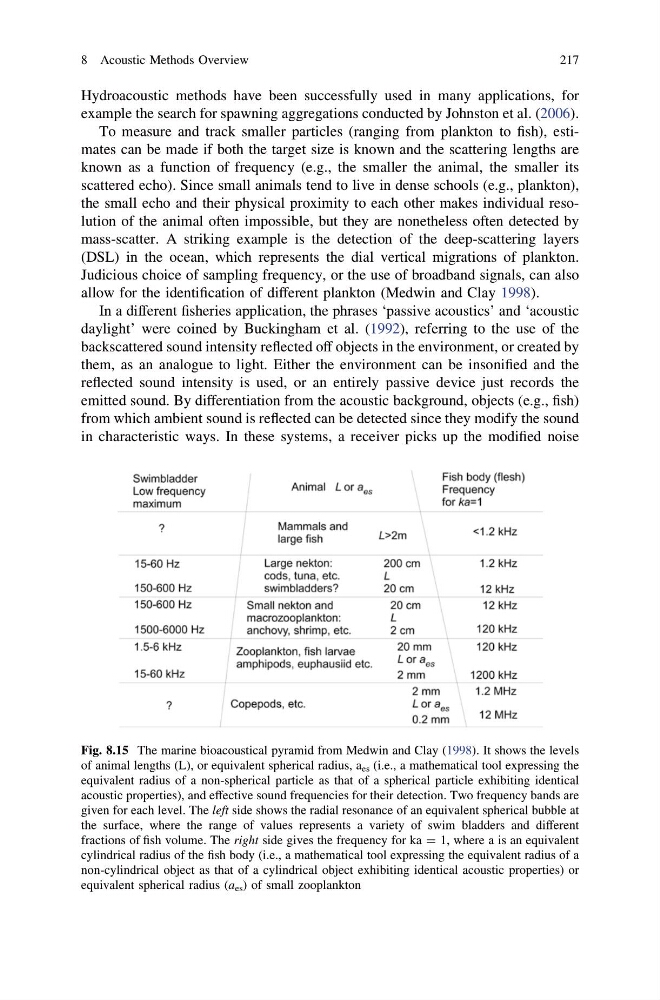
Fig. 8.15 The marine bioacoustical pyramid from Medwin and Clay (1998). It shows the levels
of animal lengths (L), or equivalent spherical radius, a es (i.e., a mathematical tool expressing the
equivalent radius of a non-spherical particle as that of a spherical particle exhibiting identical
acoustic properties), and effective sound frequencies for their detection. Two frequency bands are
given for each level. The left side shows the radial resonance of an equivalent spherical bubble at
the surface, where the range of values represents a variety of swim bladders and different
fractions of fish volume. The right side gives the frequency for ka = 1, where a is an equivalent
cylindrical radius of the fish body (i.e., a mathematical tool expressing the equivalent radius of a
non-cylindrical object as that of a cylindrical object exhibiting identical acoustic properties) or
equivalent spherical radius (a es ) of small zooplankton
8 Acoustic Methods Overview
217
example the search for spawning aggregations conducted by Johnston et al. (2006).
To measure and track smaller particles (ranging from plankton to fish), estimates can be made if both the target size is known and the scattering lengths are
known as a function of frequency (e.g., the smaller the animal, the smaller its
scattered echo). Since small animals tend to live in dense schools (e.g., plankton),
the small echo and their physical proximity to each other makes individual resolution of the animal often impossible, but they are nonetheless often detected by
mass-scatter. A striking example is the detection of the deep-scattering layers
(DSL) in the ocean, which represents the dial vertical migrations of plankton.
Judicious choice of sampling frequency, or the use of broadband signals, can also
allow for the identification of different plankton (Medwin and Clay 1998).
In a different fisheries application, the phrases ‘passive acoustics’ and ‘acoustic
daylight’ were coined by Buckingham et al. (1992), referring to the use of the
backscattered sound intensity reflected off objects in the environment, or created by
them, as an analogue to light. Either the environment can be insonified and the
reflected sound intensity is used, or an entirely passive device just records the
emitted sound. By differentiation from the acoustic background, objects (e.g., fish)
from which ambient sound is reflected can be detected since they modify the sound
in characteristic ways. In these systems, a receiver picks up the modified noise
Fig. 8.15 The marine bioacoustical pyramid from Medwin and Clay (1998). It shows the levels
of animal lengths (L), or equivalent spherical radius, a es (i.e., a mathematical tool expressing the
equivalent radius of a non-spherical particle as that of a spherical particle exhibiting identical
acoustic properties), and effective sound frequencies for their detection. Two frequency bands are
given for each level. The left side shows the radial resonance of an equivalent spherical bubble at
the surface, where the range of values represents a variety of swim bladders and different
fractions of fish volume. The right side gives the frequency for ka = 1, where a is an equivalent
cylindrical radius of the fish body (i.e., a mathematical tool expressing the equivalent radius of a
non-cylindrical object as that of a cylindrical object exhibiting identical acoustic properties) or
equivalent spherical radius (a es ) of small zooplankton
8 Acoustic Methods Overview
217