

over a range of depths (Fig. 8.14). Phased array techniques are also used to aim the
sound (acoustic) energy, allowing for economical production of smaller ADCPs to
accommodate a range of frequencies from 38 kHz to several megahertz. In effect,
these transducers are aimed such that the sound pulse travels through the water in
different, but known directions.
In addition to the transducers, an ADCP typically has an electronic amplifier,
receiver, mixer, oscillator, accurate clock, temperature sensor, compass, pitch and
roll sensor, analog-to-digital converters, memory, and digital signal processor. The
analog-to-digital converters (ADCs) and digital signal processor (DSP) are used to
sample the returning signal, determine the Doppler shift, and sample the compass
and other sensors in order to calculate the range and velocity relative to a known
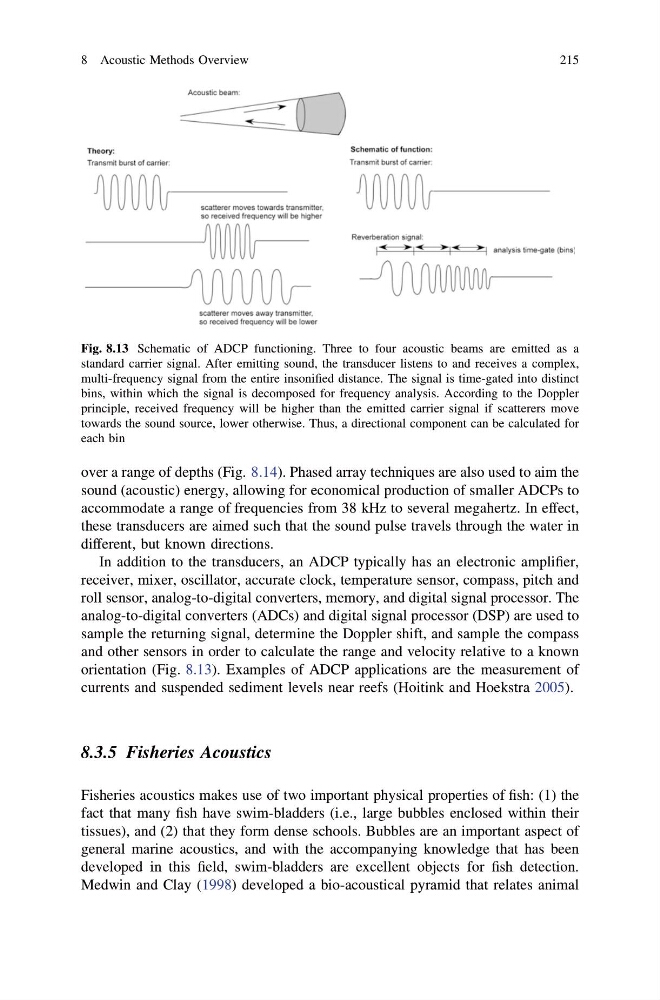
orientation (Fig. 8.13). Examples of ADCP applications are the measurement of
currents and suspended sediment levels near reefs (Hoitink and Hoekstra 2005).
8.3.5 Fisheries Acoustics
Fisheries acoustics makes use of two important physical properties of fish: (1) the
fact that many fish have swim-bladders (i.e., large bubbles enclosed within their
tissues), and (2) that they form dense schools. Bubbles are an important aspect of
general marine acoustics, and with the accompanying knowledge that has been
developed in this field, swim-bladders are excellent objects for fish detection.
Medwin and Clay (1998) developed a bio-acoustical pyramid that relates animal
Fig. 8.13 Schematic of ADCP functioning. Three to four acoustic beams are emitted as a
standard carrier signal. After emitting sound, the transducer listens to and receives a complex,
multi-frequency signal from the entire insonified distance. The signal is time-gated into distinct
bins, within which the signal is decomposed for frequency analysis. According to the Doppler
principle, received frequency will be higher than the emitted carrier signal if scatterers move
towards the sound source, lower otherwise. Thus, a directional component can be calculated for
each bin
8 Acoustic Methods Overview
215
sound (acoustic) energy, allowing for economical production of smaller ADCPs to
accommodate a range of frequencies from 38 kHz to several megahertz. In effect,
these transducers are aimed such that the sound pulse travels through the water in
different, but known directions.
In addition to the transducers, an ADCP typically has an electronic amplifier,
receiver, mixer, oscillator, accurate clock, temperature sensor, compass, pitch and
roll sensor, analog-to-digital converters, memory, and digital signal processor. The
analog-to-digital converters (ADCs) and digital signal processor (DSP) are used to
sample the returning signal, determine the Doppler shift, and sample the compass
and other sensors in order to calculate the range and velocity relative to a known
orientation (Fig. 8.13). Examples of ADCP applications are the measurement of
currents and suspended sediment levels near reefs (Hoitink and Hoekstra 2005).
8.3.5 Fisheries Acoustics
Fisheries acoustics makes use of two important physical properties of fish: (1) the
fact that many fish have swim-bladders (i.e., large bubbles enclosed within their
tissues), and (2) that they form dense schools. Bubbles are an important aspect of
general marine acoustics, and with the accompanying knowledge that has been
developed in this field, swim-bladders are excellent objects for fish detection.
Medwin and Clay (1998) developed a bio-acoustical pyramid that relates animal
Fig. 8.13 Schematic of ADCP functioning. Three to four acoustic beams are emitted as a
standard carrier signal. After emitting sound, the transducer listens to and receives a complex,
multi-frequency signal from the entire insonified distance. The signal is time-gated into distinct
bins, within which the signal is decomposed for frequency analysis. According to the Doppler
principle, received frequency will be higher than the emitted carrier signal if scatterers move
towards the sound source, lower otherwise. Thus, a directional component can be calculated for
each bin
8 Acoustic Methods Overview
215