

chips. Their availability permits the implementation of sophisticated detection
algorithms and increases the number of beams in the swath. Incoming signals are
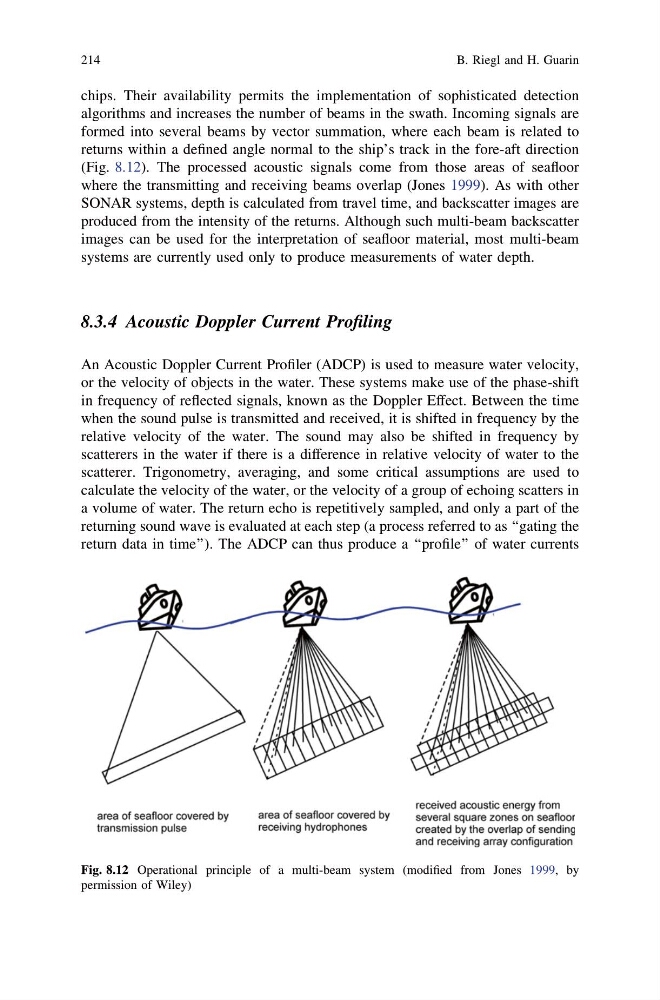
formed into several beams by vector summation, where each beam is related to
returns within a defined angle normal to the ship’s track in the fore-aft direction
(Fig. 8.12). The processed acoustic signals come from those areas of seafloor
where the transmitting and receiving beams overlap (Jones 1999). As with other
SONAR systems, depth is calculated from travel time, and backscatter images are
produced from the intensity of the returns. Although such multi-beam backscatter
images can be used for the interpretation of seafloor material, most multi-beam
systems are currently used only to produce measurements of water depth.
8.3.4 Acoustic Doppler Current Profiling
An Acoustic Doppler Current Profiler (ADCP) is used to measure water velocity,
or the velocity of objects in the water. These systems make use of the phase-shift
in frequency of reflected signals, known as the Doppler Effect. Between the time
when the sound pulse is transmitted and received, it is shifted in frequency by the
relative velocity of the water. The sound may also be shifted in frequency by
scatterers in the water if there is a difference in relative velocity of water to the
scatterer. Trigonometry, averaging, and some critical assumptions are used to
calculate the velocity of the water, or the velocity of a group of echoing scatters in
a volume of water. The return echo is repetitively sampled, and only a part of the
returning sound wave is evaluated at each step (a process referred to as ‘‘gating the
return data in time’’). The ADCP can thus produce a ‘‘profile’’ of water currents
Fig. 8.12 Operational principle of a multi-beam system (modified from Jones 1999, by
permission of Wiley)
214
B. Riegl and H. Guarin
algorithms and increases the number of beams in the swath. Incoming signals are
formed into several beams by vector summation, where each beam is related to
returns within a defined angle normal to the ship’s track in the fore-aft direction
(Fig. 8.12). The processed acoustic signals come from those areas of seafloor
where the transmitting and receiving beams overlap (Jones 1999). As with other
SONAR systems, depth is calculated from travel time, and backscatter images are
produced from the intensity of the returns. Although such multi-beam backscatter
images can be used for the interpretation of seafloor material, most multi-beam
systems are currently used only to produce measurements of water depth.
8.3.4 Acoustic Doppler Current Profiling
An Acoustic Doppler Current Profiler (ADCP) is used to measure water velocity,
or the velocity of objects in the water. These systems make use of the phase-shift
in frequency of reflected signals, known as the Doppler Effect. Between the time
when the sound pulse is transmitted and received, it is shifted in frequency by the
relative velocity of the water. The sound may also be shifted in frequency by
scatterers in the water if there is a difference in relative velocity of water to the
scatterer. Trigonometry, averaging, and some critical assumptions are used to
calculate the velocity of the water, or the velocity of a group of echoing scatters in
a volume of water. The return echo is repetitively sampled, and only a part of the
returning sound wave is evaluated at each step (a process referred to as ‘‘gating the
return data in time’’). The ADCP can thus produce a ‘‘profile’’ of water currents
Fig. 8.12 Operational principle of a multi-beam system (modified from Jones 1999, by
permission of Wiley)
214
B. Riegl and H. Guarin