

the receiver, matches impedance, and pre-amplifies if necessary. From there the
signal passes to the receiver beam-former, which combines the conditioned
transducer signals into beams, whereby each beam represents a spatial filter. Each
receiver beam is then passed to its own receiver channel, which has the functions
of band pass filtering and gain control. In the signal processor, the signal-to-noise
ratio of the beams is enhanced, and other processes, such as matched filter processing and target angle calculations, are performed. The detectors finally apply a
threshold, either fixed or variable, to the signal processor output signals, which are
then recorded by the computer system.
In many advanced SONAR applications, such as swath mapping, the process of
beam-forming is an important component. It is a method of special filtering with
the goal of transmitting or receiving sound preferentially in some directions over
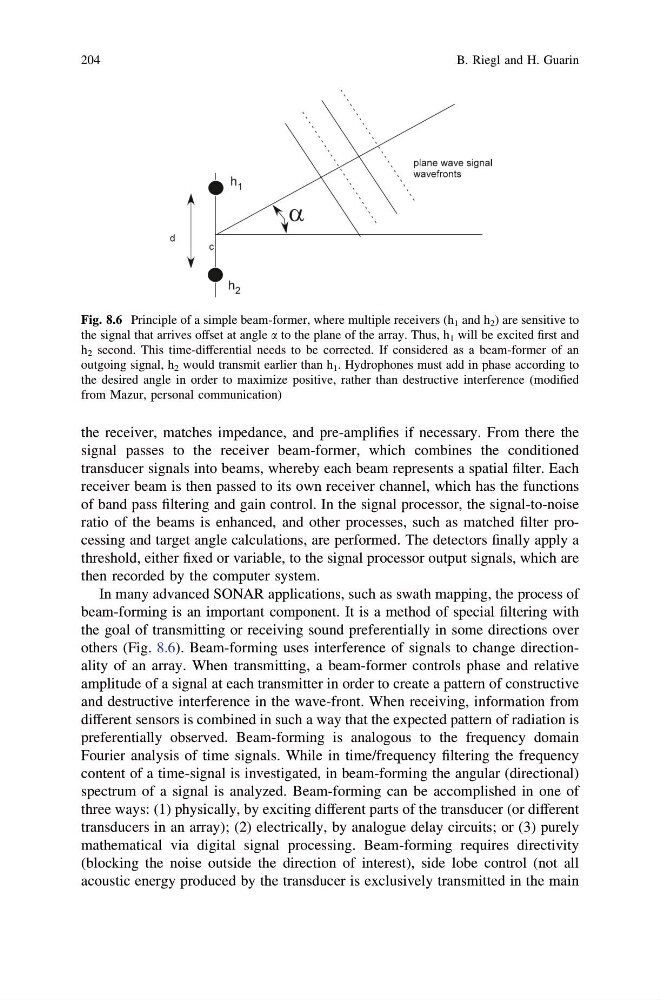
others (Fig. 8.6). Beam-forming uses interference of signals to change directionality of an array. When transmitting, a beam-former controls phase and relative
amplitude of a signal at each transmitter in order to create a pattern of constructive
and destructive interference in the wave-front. When receiving, information from
different sensors is combined in such a way that the expected pattern of radiation is
preferentially observed. Beam-forming is analogous to the frequency domain
Fourier analysis of time signals. While in time/frequency filtering the frequency
content of a time-signal is investigated, in beam-forming the angular (directional)
spectrum of a signal is analyzed. Beam-forming can be accomplished in one of
three ways: (1) physically, by exciting different parts of the transducer (or different
transducers in an array); (2) electrically, by analogue delay circuits; or (3) purely
mathematical via digital signal processing. Beam-forming requires directivity
(blocking the noise outside the direction of interest), side lobe control (not all
acoustic energy produced by the transducer is exclusively transmitted in the main
Fig. 8.6 Principle of a simple beam-former, where multiple receivers (h 1 and h 2 ) are sensitive to
the signal that arrives offset at angle a to the plane of the array. Thus, h 1 will be excited first and
h 2 second. This time-differential needs to be corrected. If considered as a beam-former of an
outgoing signal, h 2 would transmit earlier than h 1 . Hydrophones must add in phase according to
the desired angle in order to maximize positive, rather than destructive interference (modified
from Mazur, personal communication)
204
B. Riegl and H. Guarin
signal passes to the receiver beam-former, which combines the conditioned
transducer signals into beams, whereby each beam represents a spatial filter. Each
receiver beam is then passed to its own receiver channel, which has the functions
of band pass filtering and gain control. In the signal processor, the signal-to-noise
ratio of the beams is enhanced, and other processes, such as matched filter processing and target angle calculations, are performed. The detectors finally apply a
threshold, either fixed or variable, to the signal processor output signals, which are
then recorded by the computer system.
In many advanced SONAR applications, such as swath mapping, the process of
beam-forming is an important component. It is a method of special filtering with
the goal of transmitting or receiving sound preferentially in some directions over
others (Fig. 8.6). Beam-forming uses interference of signals to change directionality of an array. When transmitting, a beam-former controls phase and relative
amplitude of a signal at each transmitter in order to create a pattern of constructive
and destructive interference in the wave-front. When receiving, information from
different sensors is combined in such a way that the expected pattern of radiation is
preferentially observed. Beam-forming is analogous to the frequency domain
Fourier analysis of time signals. While in time/frequency filtering the frequency
content of a time-signal is investigated, in beam-forming the angular (directional)
spectrum of a signal is analyzed. Beam-forming can be accomplished in one of
three ways: (1) physically, by exciting different parts of the transducer (or different
transducers in an array); (2) electrically, by analogue delay circuits; or (3) purely
mathematical via digital signal processing. Beam-forming requires directivity
(blocking the noise outside the direction of interest), side lobe control (not all
acoustic energy produced by the transducer is exclusively transmitted in the main
Fig. 8.6 Principle of a simple beam-former, where multiple receivers (h 1 and h 2 ) are sensitive to
the signal that arrives offset at angle a to the plane of the array. Thus, h 1 will be excited first and
h 2 second. This time-differential needs to be corrected. If considered as a beam-former of an
outgoing signal, h 2 would transmit earlier than h 1 . Hydrophones must add in phase according to
the desired angle in order to maximize positive, rather than destructive interference (modified
from Mazur, personal communication)
204
B. Riegl and H. Guarin