

Finally, the target can emit an echo. This is particularly important in fisheries
SONAR for example. The target often reflects a replica of the transmitted signal at
an echo level that is proportional to the transmitted source level. The echo level
itself depends on the target strength, which is a complex measure of the reflecting
attributes of the target. For example, fish with swim bladders are very good targets,
since air-bubbles reverberate very strongly and provide an excellent return signal.
Fish without swim bladders are poor targets since it is primarily their impedance
difference to the water that determines echo strength. The target echo of a
swimming, or moving target, is Doppler-shifted relative to the transmitted signal.
8.2.3 Sending and Receiving the Signal
In acoustic remote sensing the sound sources used to generate acoustic waves are
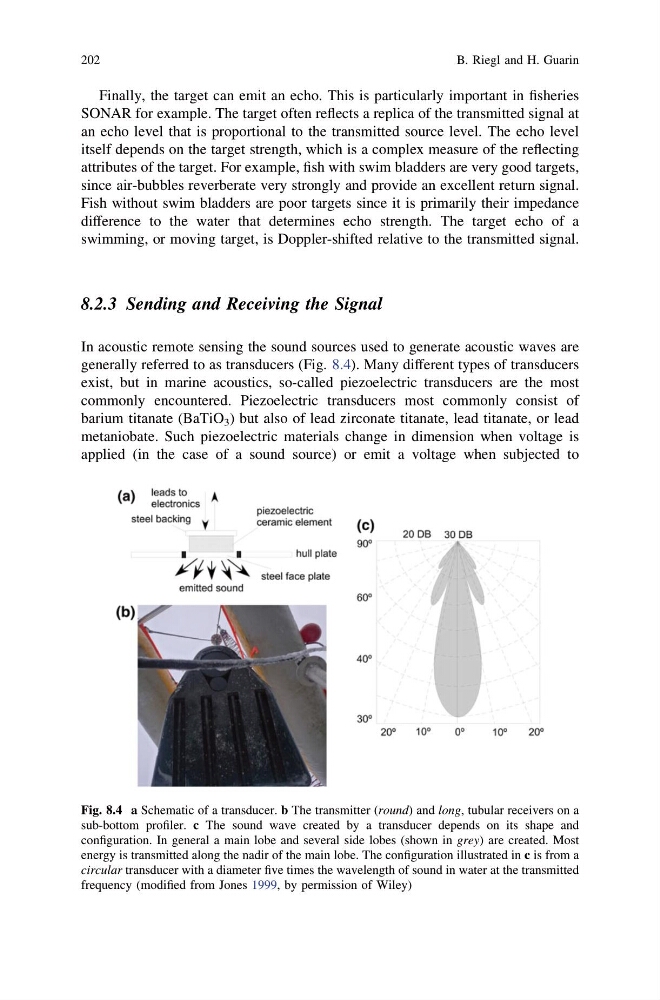
generally referred to as transducers (Fig. 8.4). Many different types of transducers
exist, but in marine acoustics, so-called piezoelectric transducers are the most
commonly encountered. Piezoelectric transducers most commonly consist of
barium titanate (BaTiO 3 ) but also of lead zirconate titanate, lead titanate, or lead
metaniobate. Such piezoelectric materials change in dimension when voltage is
applied (in the case of a sound source) or emit a voltage when subjected to
Fig. 8.4 a Schematic of a transducer. b The transmitter (round) and long, tubular receivers on a
sub-bottom profiler. c The sound wave created by a transducer depends on its shape and
configuration. In general a main lobe and several side lobes (shown in grey) are created. Most
energy is transmitted along the nadir of the main lobe. The configuration illustrated in c is from a
circular transducer with a diameter five times the wavelength of sound in water at the transmitted
frequency (modified from Jones 1999, by permission of Wiley)
202
B. Riegl and H. Guarin
SONAR for example. The target often reflects a replica of the transmitted signal at
an echo level that is proportional to the transmitted source level. The echo level
itself depends on the target strength, which is a complex measure of the reflecting
attributes of the target. For example, fish with swim bladders are very good targets,
since air-bubbles reverberate very strongly and provide an excellent return signal.
Fish without swim bladders are poor targets since it is primarily their impedance
difference to the water that determines echo strength. The target echo of a
swimming, or moving target, is Doppler-shifted relative to the transmitted signal.
8.2.3 Sending and Receiving the Signal
In acoustic remote sensing the sound sources used to generate acoustic waves are
generally referred to as transducers (Fig. 8.4). Many different types of transducers
exist, but in marine acoustics, so-called piezoelectric transducers are the most
commonly encountered. Piezoelectric transducers most commonly consist of
barium titanate (BaTiO 3 ) but also of lead zirconate titanate, lead titanate, or lead
metaniobate. Such piezoelectric materials change in dimension when voltage is
applied (in the case of a sound source) or emit a voltage when subjected to
Fig. 8.4 a Schematic of a transducer. b The transmitter (round) and long, tubular receivers on a
sub-bottom profiler. c The sound wave created by a transducer depends on its shape and
configuration. In general a main lobe and several side lobes (shown in grey) are created. Most
energy is transmitted along the nadir of the main lobe. The configuration illustrated in c is from a
circular transducer with a diameter five times the wavelength of sound in water at the transmitted
frequency (modified from Jones 1999, by permission of Wiley)
202
B. Riegl and H. Guarin