

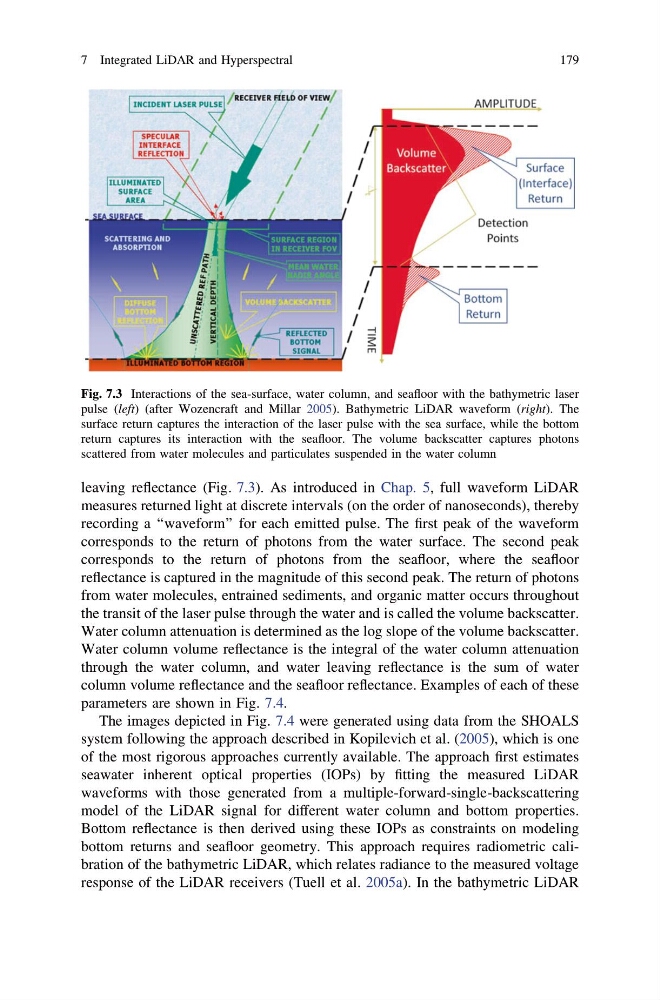
leaving reflectance (Fig. 7.3). As introduced in Chap. 5, full waveform LiDAR
measures returned light at discrete intervals (on the order of nanoseconds), thereby
recording a ‘‘waveform’’ for each emitted pulse. The first peak of the waveform
corresponds to the return of photons from the water surface. The second peak
corresponds to the return of photons from the seafloor, where the seafloor
reflectance is captured in the magnitude of this second peak. The return of photons
from water molecules, entrained sediments, and organic matter occurs throughout
the transit of the laser pulse through the water and is called the volume backscatter.
Water column attenuation is determined as the log slope of the volume backscatter.
Water column volume reflectance is the integral of the water column attenuation
through the water column, and water leaving reflectance is the sum of water
column volume reflectance and the seafloor reflectance. Examples of each of these
parameters are shown in Fig. 7.4.
The images depicted in Fig. 7.4 were generated using data from the SHOALS
system following the approach described in Kopilevich et al. (2005), which is one
of the most rigorous approaches currently available. The approach first estimates
seawater inherent optical properties (IOPs) by fitting the measured LiDAR
waveforms with those generated from a multiple-forward-single-backscattering
model of the LiDAR signal for different water column and bottom properties.
Bottom reflectance is then derived using these IOPs as constraints on modeling
bottom returns and seafloor geometry. This approach requires radiometric calibration of the bathymetric LiDAR, which relates radiance to the measured voltage
response of the LiDAR receivers (Tuell et al. 2005a). In the bathymetric LiDAR
Fig. 7.3 Interactions of the sea-surface, water column, and seafloor with the bathymetric laser
pulse (left) (after Wozencraft and Millar 2005). Bathymetric LiDAR waveform (right). The
surface return captures the interaction of the laser pulse with the sea surface, while the bottom
return captures its interaction with the seafloor. The volume backscatter captures photons
scattered from water molecules and particulates suspended in the water column
7 Integrated LiDAR and Hyperspectral
179
measures returned light at discrete intervals (on the order of nanoseconds), thereby
recording a ‘‘waveform’’ for each emitted pulse. The first peak of the waveform
corresponds to the return of photons from the water surface. The second peak
corresponds to the return of photons from the seafloor, where the seafloor
reflectance is captured in the magnitude of this second peak. The return of photons
from water molecules, entrained sediments, and organic matter occurs throughout
the transit of the laser pulse through the water and is called the volume backscatter.
Water column attenuation is determined as the log slope of the volume backscatter.
Water column volume reflectance is the integral of the water column attenuation
through the water column, and water leaving reflectance is the sum of water
column volume reflectance and the seafloor reflectance. Examples of each of these
parameters are shown in Fig. 7.4.
The images depicted in Fig. 7.4 were generated using data from the SHOALS
system following the approach described in Kopilevich et al. (2005), which is one
of the most rigorous approaches currently available. The approach first estimates
seawater inherent optical properties (IOPs) by fitting the measured LiDAR
waveforms with those generated from a multiple-forward-single-backscattering
model of the LiDAR signal for different water column and bottom properties.
Bottom reflectance is then derived using these IOPs as constraints on modeling
bottom returns and seafloor geometry. This approach requires radiometric calibration of the bathymetric LiDAR, which relates radiance to the measured voltage
response of the LiDAR receivers (Tuell et al. 2005a). In the bathymetric LiDAR
Fig. 7.3 Interactions of the sea-surface, water column, and seafloor with the bathymetric laser
pulse (left) (after Wozencraft and Millar 2005). Bathymetric LiDAR waveform (right). The
surface return captures the interaction of the laser pulse with the sea surface, while the bottom
return captures its interaction with the seafloor. The volume backscatter captures photons
scattered from water molecules and particulates suspended in the water column
7 Integrated LiDAR and Hyperspectral
179