

fluorescence. The attenuation coefficient of oceanic and inland waters can also be
remotely sensed with LiDAR (Tuell et al. 2005; Hoge 2006). These applications
are relevant to reefs, since their health is strongly linked to water quality and
clarity (Rogers 1990; Fabricius et al. 2005).
Depending on the reflective property and structure of the terrestrial target, a
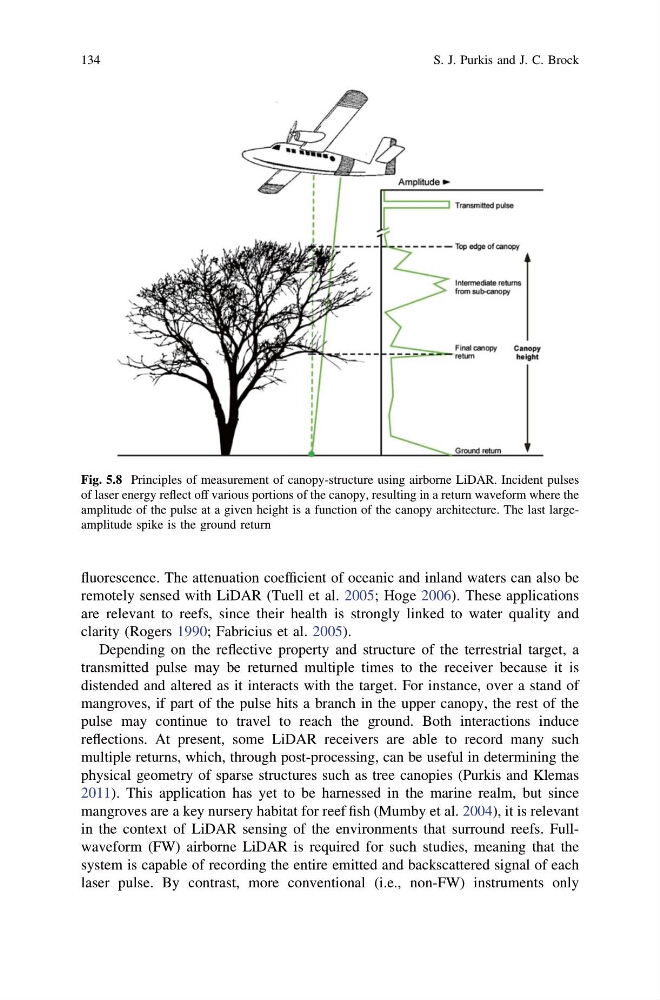
transmitted pulse may be returned multiple times to the receiver because it is
distended and altered as it interacts with the target. For instance, over a stand of
mangroves, if part of the pulse hits a branch in the upper canopy, the rest of the
pulse may continue to travel to reach the ground. Both interactions induce
reflections. At present, some LiDAR receivers are able to record many such
multiple returns, which, through post-processing, can be useful in determining the
physical geometry of sparse structures such as tree canopies (Purkis and Klemas
2011). This application has yet to be harnessed in the marine realm, but since
mangroves are a key nursery habitat for reef fish (Mumby et al. 2004), it is relevant
in the context of LiDAR sensing of the environments that surround reefs. Fullwaveform (FW) airborne LiDAR is required for such studies, meaning that the
system is capable of recording the entire emitted and backscattered signal of each
laser pulse. By contrast, more conventional (i.e., non-FW) instruments only
Fig. 5.8 Principles of measurement of canopy-structure using airborne LiDAR. Incident pulses
of laser energy reflect off various portions of the canopy, resulting in a return waveform where the
amplitude of the pulse at a given height is a function of the canopy architecture. The last largeamplitude spike is the ground return
134
S. J. Purkis and J. C. Brock
remotely sensed with LiDAR (Tuell et al. 2005; Hoge 2006). These applications
are relevant to reefs, since their health is strongly linked to water quality and
clarity (Rogers 1990; Fabricius et al. 2005).
Depending on the reflective property and structure of the terrestrial target, a
transmitted pulse may be returned multiple times to the receiver because it is
distended and altered as it interacts with the target. For instance, over a stand of
mangroves, if part of the pulse hits a branch in the upper canopy, the rest of the
pulse may continue to travel to reach the ground. Both interactions induce
reflections. At present, some LiDAR receivers are able to record many such
multiple returns, which, through post-processing, can be useful in determining the
physical geometry of sparse structures such as tree canopies (Purkis and Klemas
2011). This application has yet to be harnessed in the marine realm, but since
mangroves are a key nursery habitat for reef fish (Mumby et al. 2004), it is relevant
in the context of LiDAR sensing of the environments that surround reefs. Fullwaveform (FW) airborne LiDAR is required for such studies, meaning that the
system is capable of recording the entire emitted and backscattered signal of each
laser pulse. By contrast, more conventional (i.e., non-FW) instruments only
Fig. 5.8 Principles of measurement of canopy-structure using airborne LiDAR. Incident pulses
of laser energy reflect off various portions of the canopy, resulting in a return waveform where the
amplitude of the pulse at a given height is a function of the canopy architecture. The last largeamplitude spike is the ground return
134
S. J. Purkis and J. C. Brock