

than blue in turbid coastal waters. From an engineering standpoint, by placing a
nonlinear medium, usually a crystal, into the laser beam, the 1,064 nm output from
a Nd:YAG laser can be converted to visible light with wavelengths of 532 nm.
This process, termed ‘frequency-doubling’, is a relatively inexpensive way to
produce a visible-light laser and hence the 532 nm adopted by many LiDAR
systems has arisen from the easy availability and low cost of Nd:YAG 1,064 nm
lasers. From a practical standpoint, wavelengths shorter than 532 nm are also
problematic since they interact more strongly with the atmosphere than longer
wavelengths, and secondly, creating a high-intensity blue laser is energetically
significantly less efficient than the 532 nm blue-green laser. For all of these reasons, combined with the fact that blue lasers suffer from temperature problems at
high powers, explains why 532 nm is the preferred wavelength for LiDAR sensors.
Nonetheless, a constraint of adopting visible-wavelength lasers for LiDAR is that
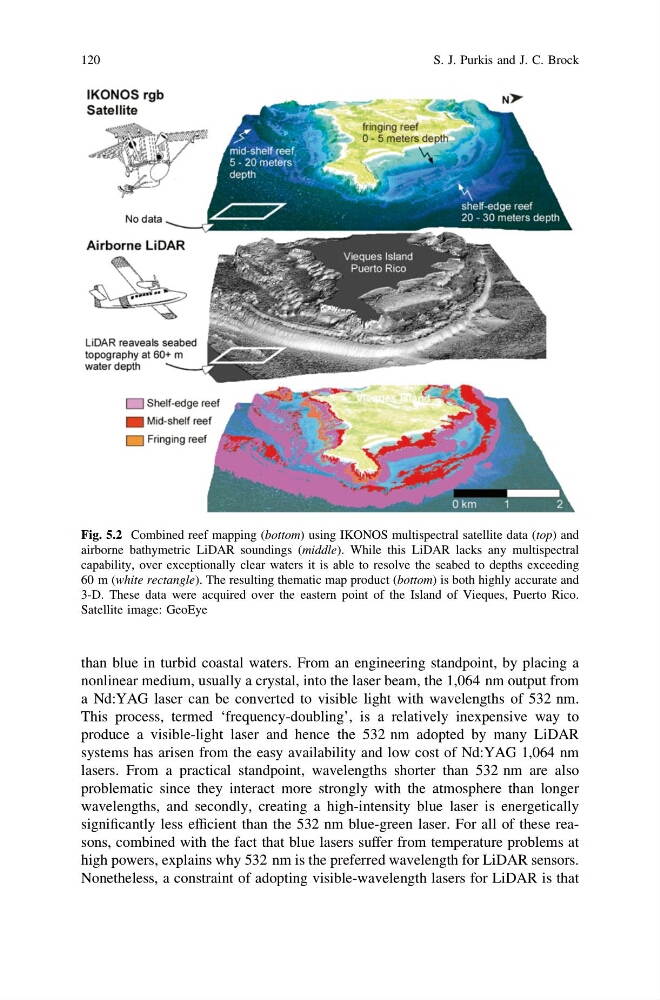
Fig. 5.2 Combined reef mapping (bottom) using IKONOS multispectral satellite data (top) and
airborne bathymetric LiDAR soundings (middle). While this LiDAR lacks any multispectral
capability, over exceptionally clear waters it is able to resolve the seabed to depths exceeding
60 m (white rectangle). The resulting thematic map product (bottom) is both highly accurate and
3-D. These data were acquired over the eastern point of the Island of Vieques, Puerto Rico.
Satellite image: GeoEye
120
S. J. Purkis and J. C. Brock
nonlinear medium, usually a crystal, into the laser beam, the 1,064 nm output from
a Nd:YAG laser can be converted to visible light with wavelengths of 532 nm.
This process, termed ‘frequency-doubling’, is a relatively inexpensive way to
produce a visible-light laser and hence the 532 nm adopted by many LiDAR
systems has arisen from the easy availability and low cost of Nd:YAG 1,064 nm
lasers. From a practical standpoint, wavelengths shorter than 532 nm are also
problematic since they interact more strongly with the atmosphere than longer
wavelengths, and secondly, creating a high-intensity blue laser is energetically
significantly less efficient than the 532 nm blue-green laser. For all of these reasons, combined with the fact that blue lasers suffer from temperature problems at
high powers, explains why 532 nm is the preferred wavelength for LiDAR sensors.
Nonetheless, a constraint of adopting visible-wavelength lasers for LiDAR is that
Fig. 5.2 Combined reef mapping (bottom) using IKONOS multispectral satellite data (top) and
airborne bathymetric LiDAR soundings (middle). While this LiDAR lacks any multispectral
capability, over exceptionally clear waters it is able to resolve the seabed to depths exceeding
60 m (white rectangle). The resulting thematic map product (bottom) is both highly accurate and
3-D. These data were acquired over the eastern point of the Island of Vieques, Puerto Rico.
Satellite image: GeoEye
120
S. J. Purkis and J. C. Brock