

multiplying the result by the speed of light, yields the distance between an
overhead LiDAR unit and a surface target. It should be recognised that since the
laser energy is travelling at the speed of light, the timing mechanism of the sensor
must at least be accurate to within a few nanoseconds, but ideally less than one
nanosecond. As an example, a mistiming of 1 ns will yield a vertical error in the
range of 30 cm.
Laser energy is lost due to refraction, backscattering, and absorption at the
water surface, the sea bottom, and inside the water column. These effects all serve
to diminish the strength of the bottom return and limit the maximum detectable
depth. There is a distinction between bathymetric LiDAR that best measures water
depth versus sensors that can capture submerged topography. The latter needs a
more accurate aircraft trajectory and does not require tidal or swell correction. One
also has to take into account that the speed of light depends on the density of the
atmosphere, which means it varies with pressure, humidity and temperature.
Considering that survey flights with a LiDAR will only be conducted under clear
atmospheric conditions, one can neglect humidity. But pressure has to be considered, specifically if one is flying at various altitudes. For example, assume two
survey flights, one at a coastline (0 m MSL) and one at a high elevation area
(2,000 m MSL), both 2,000 m above ground. Taking the speed of light valid at the
coast and applying it for the high region will lead to calculated distances which are
about 12 cm too short, about twice the error that would be expected to arise from
just positioning inaccuracies (Katzenbeisser 2003).
Each sounding must be corrected for water level fluctuations using either
vertical aircraft positioning derived from GPS, or by referencing the LiDAR
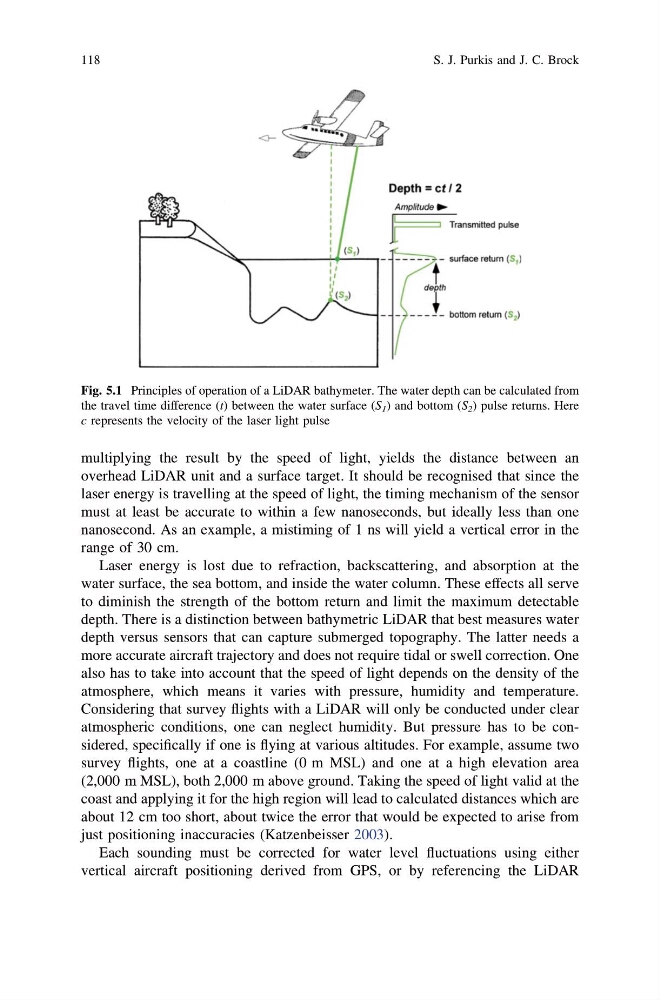
Fig. 5.1 Principles of operation of a LiDAR bathymeter. The water depth can be calculated from
the travel time difference (t) between the water surface (S 1 ) and bottom (S 2 ) pulse returns. Here
c represents the velocity of the laser light pulse
118
S. J. Purkis and J. C. Brock
overhead LiDAR unit and a surface target. It should be recognised that since the
laser energy is travelling at the speed of light, the timing mechanism of the sensor
must at least be accurate to within a few nanoseconds, but ideally less than one
nanosecond. As an example, a mistiming of 1 ns will yield a vertical error in the
range of 30 cm.
Laser energy is lost due to refraction, backscattering, and absorption at the
water surface, the sea bottom, and inside the water column. These effects all serve
to diminish the strength of the bottom return and limit the maximum detectable
depth. There is a distinction between bathymetric LiDAR that best measures water
depth versus sensors that can capture submerged topography. The latter needs a
more accurate aircraft trajectory and does not require tidal or swell correction. One
also has to take into account that the speed of light depends on the density of the
atmosphere, which means it varies with pressure, humidity and temperature.
Considering that survey flights with a LiDAR will only be conducted under clear
atmospheric conditions, one can neglect humidity. But pressure has to be considered, specifically if one is flying at various altitudes. For example, assume two
survey flights, one at a coastline (0 m MSL) and one at a high elevation area
(2,000 m MSL), both 2,000 m above ground. Taking the speed of light valid at the
coast and applying it for the high region will lead to calculated distances which are
about 12 cm too short, about twice the error that would be expected to arise from
just positioning inaccuracies (Katzenbeisser 2003).
Each sounding must be corrected for water level fluctuations using either
vertical aircraft positioning derived from GPS, or by referencing the LiDAR
Fig. 5.1 Principles of operation of a LiDAR bathymeter. The water depth can be calculated from
the travel time difference (t) between the water surface (S 1 ) and bottom (S 2 ) pulse returns. Here
c represents the velocity of the laser light pulse
118
S. J. Purkis and J. C. Brock